martes, noviembre 28, 2006

Good end for the Big Three

The Big Three have once again given us quality events in their closing concerts. I will review initially the Mozarteum Argentino, who brought us to end their year at the Colón an important chamber orchestra for the first time in Argentina: Les Musiciens du Louvre – Grenoble , led by their founder, Marc Minkowski. As implied by their name, this organism (born in 1982) was during the early years Parisian, but since 1996 they have moved to Grenoble due to attractive sponsorship from the city and the region. Although their chief repertoire is the Baroque (I met them in 1994 in Paris with Handel’s “Theodora”) they brought to BA a Mozart programme in celebration of the bicentenary of his birth , a fitting close to the season of an institution bearing the composer’s name.
The concept was historicist and influenced by Harnoncourt: no vibrato, strong dynamic contrasts, fast tempi, dramatic accents. Hardly restful Mozart, but convincing in its own terms. It needs strong control from the conductor, and Minkowski showed himself a musician of strength and sinew, attacks and releases done with instantaneous response. Mozart’s two greatest symphonies, Nos. 40 and 41, were preceded by the final ballet from “Idomeneo”, music of substance and character. The 51-member Orchestra proved itself truly virtuoso in all departments. I hugely enjoyed the similarly strong encores by Joseph Haydn: the 2nd movement of Symphony No.101 (the one that gives the work its name, “The Clock”) and the funny Finale to No. 97, both done with powerful statements and the offbeat humor of Haydn’s late music.
The Orchestra della Toscana has been here before. It is in fact a chamber orchestra, only 47-strong, at least for this tour. Their playing is honest and committed, in a good technical level. The venue was the Coliseo and the conductor, the temperamental Gabriele Ferro. He is currently more an opera than a concert conductor, and he holds the important post of Musical Director at the Naples San Carlo Opera House. Sanguine, intense and rather exaggerated, he is a well-grounded musician. It was curious to see him combined with the very clean and rather cold pianist Roberto Cominati in the Ravel Concerto, very decently done by all concerned but with some conciliation between cool and hot. I didn’t care much for a world premiere, Giorgio Battistelli’s “Apres Josquin”, yet another postmodernist lucubration on an old-time composer. In the Second Part we were in safe ground with Prokofiev’s short and lovely “Classic” Symphony, a bit slow for me, and the suite from De Falla’s “El Amor brujo” minus the vocal parts in a pleasant traversal, lacking some Andalusian mystery. To my mind the best thing was the encore, an exhilarating view of Rossini’s Overture to “L’Italiana in Algeri”. A good “finale” to the meritorious Nuova Harmonia season.
In this last part of the year the most active institution has been Festivales Musicales. Just a few days before the Colón’s closure they feted their 30th anniversary with a fine concert conducted by Festivales’ Artistic Director, Mario Videla. With the admirable collaboration of the Camerata Bariloche and of the Orfeón de Buenos Aires (Néstor Andrenacci and Pablo Piccinni) we were given a Baroque combination of three greats: Johann Sebastian Bach’s Suite No. 3, Vivaldi’s Gloria RV 589 and Handel’s “Foundling Hospital Anthem”. The first two are of course acknowledged and famous masterpieces; the third is a find, grade-A Handel : seven pieces for vocal soloists, chorus and orchestra, where the last is the reemployed “Hallelujah” from “Messiah”. Lovely solos and splendid choruses in this 1742 score, a most welcome culmination to Festivales’ 2006 season. And a good moment to take stock and thank them heartily for so many wonderful experiences throughout these three decades.
Videla’s views on the works were sound and orthodox, generally satifying. Of his Baroque erudition, naturally, there has been no doubt for decades. Of the soloists I found Graciela Oddone in pretty good form, Susanna Moncayo rather uneven, and Carlos Ullán correct. There was a non-subscription event from Festivales which proved to be quite interesting. I have known and liked Salieri’s “Les Danaides” for years, as I have the splendid Gelmetti/Stuttgart CDs of the complete opera. It was certainly a brilliant idea to offer this work here, for BA knows nothing at all about Salieri’s operatic contributions. It’s worth mentioning that La Scala was reinaugurated some months ago with the very work of its original inauguration in the late 18th century: Salieri’s “L’Europa riconosciuta”; and this composer among his many operas has a “Falstaff”. The terrible Greek story of the 50 daughters of Danaus compelled by their father to kill their husbands certainly makes for a strong Classic tragedy, and it comes as no surprise that at the time the score was supposed to be written by Gluck.
It was a pity that there were heavy cuts in the version led by Marcelo Birman with the Compañía de las Luces (some fine things were gone) but as presented the work was gripping and showed that Salieri could be intense, as well as a fine artisan. With strong singing from Sergio Carlevaris and stylish contributions by Ana Moraitis and Pablo Pollitzer, the 25-piece historicist orchestra played quite well and the chorus sang with total commitment. Birman gets better each year and so do his ensembles. The appropriate venue was the Museo de Arte Decorativo. Para el Buenos Aires Herald, 01/12/06

domingo, noviembre 26, 2006

“Boris Godunov”, a grand goodbye

As you know, the Colón is now closed and will theoretically stay thus until May 2008 , when it will be reopened with Verdi’s “Aida”, commemorating the hundredth anniversary of the theatre with the opera performed at its inauguration. Those eighteen months will see the restoration of the main hall and the stage (among other areas) according to the highly controversial Master Plan. Seven crucial bids for specific items still haven’t been announced, which makes it highly doubtful that the chronology will be respected. Specific action has been implemented at the City Legislature, which has sent a questionnaire to the Executive and has formed a Committee for the monitoring of the Master Plan. Time will tell its own story.
But that uncertain future before us was preceded by a triumphant goodbye to the Colón, a series of performances of Mussorgsky’s “Boris Godunov” that meant a powerful contribution to our operatic life . Marcelo Lombardero, the current Artistic Director, has given us, in South-American premiere, the original full version of Mussorgsky ; not the first, 1869 version which our city saw back in 1998 when we had the unforgettable visit of the full Maryinsky Theatre from Saint Petersburg, but the 1874 revision that added two fundamental things to the original seven scenes: the so-called Polish Act and the closing Revolutionary Scene. I’m not recommending that the Rimsky-Korsakov revision that made the work famous all over the world should be scrapped: I think it’s admirable and that the best solution will be from now on to alternate in successive revivals between the 1874 Mussorgsky and the Rimsky.
What are the main differences between pure Mussorgsky (M) and Mussorgsky/Rimsky? (M/R) Well, M is certainly starker and barer, with disquieting harmonies (which informed opinion no longer considers “errors”), a deeper sense of essential Russianness, pronounced verbal Expressionism, an undernourished and gray orchestration. Precisely this last element is the great distinction of M/R, for Rimsky was the undeniable master of color and wrote a treaty on the subject; when you hear his treatment of the Coronation Scene, all the splendor of the Czars is there; with M the feeling is ominous, you hear the downfall rather than the assumption. So the total effect of M is certainly less accessible but profound in the way a Tarkovsky film is.
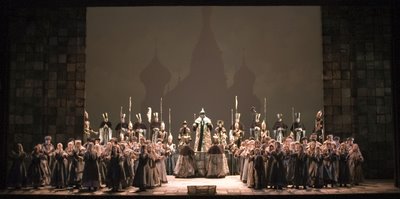
The Colón undertook the task with the seriousness of a first-class opera house. The musical side was of a high level, without being outstanding. The staging, alas, fell into the trendy and silly trap of changing the historical context: Mario Pontiggia, after doing the Prologue and First Act in its proper 1600s ambience, absurdly decided to transport Boris and everybody else to the middle 1800s, ditto in the Polish Act. And then he reversed and the final act went back to the 1600s! However, in other aspects Pontiggia did well: he moved the big choral scenes with good timing, the psychological relationships weren’t distorted, and the drama was communicated. One thing was horrid and shouldn’t have been allowed: the ceremonial Polonaise was done by just three dancers in modern tights to a choreography by Carlos Trunsky that went completely awry in style.

Boris Godunov - Teatro Colón 2006 - Anatoly Kotcherga 3 - Foto de Arnaldo Colombaroli

The aesthetics of Diego Siliano’s stage designs were agreeable though hardly Russian; a silhouette of a cathedral was as far as he went. But (more to cut costs than for artistic reasons) we saw a unit set of a variegated wall used in different combinations and parts to represent such disparate things as a tavern, a monk’s cell, a Polish palace, etc. Of course costume designer Daniela Taiana had to comply to Pontiggia’s excentric translation of the action to the 1800s; her costumes were mostly adequate though some didn’t look rich enough. Good lighting by Rubén Conde.

The conducting by Stefan Lano was clear, with rather slow and morose tempi, certainly logical but lacking expansion and emotional communication; the Orchestra played quite well. Excellent work from the Colón Chorus (Salvatore Caputo) and the Children’s Chorus (Valdo Sciammarella).

There was a solid double cast: Anatoly Kotcherga (debut) did Boris with a fine bass voice used with authority and a massive presence; and Mijail Kit gave us a leaner, older Boris , done with fine professionalism. Except from some tense high notes, both Kit and Feódor Kuznetsov sang admirably as the monk Pimen. I was agreeably surprised by the aplomb and intensity of Enrique Folger as the false Dimitri who will usurp the throne; Fernando Chalabe was correct, no more. We had fine Marinas (the Polish Princess): Cecilia Díaz and Virginia Correa Dupuy. Luis Gaeta was splendidly truculent as the mendicant monk Varlaam; Hernán Iturralde sang well but was less of a character. Ariel Cazes was more convincing as the devious Jesuit Rangoni than the exaggerated Lucas Debevec Mayer. Carlos Bengolea and Gabriel Renaud dealt well with the slimy ambiguity of their Boyar Shuisky. Good jobs from (among others) Ana Laura Menéndez and María José Dulín, Elisabeth Canis and Alicia Cecotti, Omar Carrión and Leonardo Estévez, Renaud and Eduardo Ayas (as Misail), Graciela Alperyn and Marcela Pichot. Osvaldo Peroni and Gabriel Centeno sang well as the Innocent but didn’t catch his peculiar anguish.

As the Innocent sang his final lament, I thought of the pain of the Russian people though the centuries and I wished them well for the future.

23/11/06 para el Buenos Aires Herald

Boris Godunov - Teatro Colón 2006 - Prólogo 2 b - Foto Miguel Micciche

sábado, octubre 21, 2006

LAS DIFICILES SOLUCIONES DEL CASO COLON

Un gran teatro lírico es por naturaleza un ambiente conflictivo en el que se logra con ardua labor conciliar temperamentos artísticos complejos con las restricciones presupuestarias. El Colón ha pasado por múltiples enfrentamientos a través de las décadas, siempre determinados por el carácter contestatario de los gremios ante la ignorancia, escasa sensibilidad y frecuente cinismo de las autoridades. También ha importado el grado de debilidad o fortaleza política del gobierno de turno. El actual conflicto tuvo su inmediato caldo de cultivo el año pasado y llegó a un primer hito cuando en marzo se declaró el estado de asamblea de los trabajadores del Colón. El Secretario de Cultura, Dr. Gustavo López, no hizo caso de las fuertes señales que le estaban indicando la necesidad de negociar, y así se llegó a la huelga que paralizó al teatro durante diez días. Sólo terminó porque se dictó la conciliación obligatoria, seguida del llamado a paritarias, las primeras en diez años. Lector, fíjese en la fecha en la que este artículo se escribió , ya que para cuando esta revista esté en sus manos las cosas pueden haber cambiado; yo hago un análisis de acuerdo a la mencionada fecha. En recientes semanas hubo hechos públicos que testimonian el desagrado de los trabajadores con el desarrollo de las paritarias: conciertos precedidos por la lectura de quejas y desarrollados en ropa de calle, u óperas con ejecución previa del himno nacional (objetable uso de un símbolo patrio en pos de una reivindicación gremial) , pancartas con protestas y allí también ropa de calle. Pero en estos días hay asambleas internas discutiendo la actitud a asumir ante paritarias que no avanzan; ellos dicen que presentan propuestas y no son contestadas. Podría llegarse a otra huelga y quizás al cierre del Colón, reacción de impotencia cuando las autoridades no saben cómo resolver el problema (o, peor, no quieren). Así lo hicieron en los años 80 durante la intendencia de Suárez Lastra. López acusa a las dos entidades gremiales rivales, SUTECBA y ATE, de competir entre sí para obtener más y más beneficios, y considera imposible negociar de esta manera. Después de la renuncia ( o huída) de Tito Capobianco, López insistió en la necesidad de un cambio de modelo y optó por armar un equipo de trabajo sin ninguna autoridad unificatoria y presuntamente autoritaria. Cree él que esto puede funcionar. Confirmó a algunos en sus puestos, sustituyó a otros e inventó nuevos cargos. He aquí el panorama. Director General Administrativo: Leandro Iglesias, que era de la Secretaría de Cultura y tiene amistad con Pablo Batalla, su controvertido predecesor, que conserva influencia desde la Secretaría de Hacienda. Hago notar que es Director General sólo en lo Administrativo; teóricamente una vez establecida la pauta presupuestaria no tiene derecho a injerencia en el proceso artístico. Director de ópera y coordinador artístico: Marcelo Lombardero, cuyo nombre sonaba desde hace varias semanas. El cargo es novedoso, ya que la ópera siempre dependió del Director Artístico, pero es parte de la reforma de López no hacer nombramiento en ese cargo. El matiz es importante: siendo la ópera lo más importante en el Colón, quien está a su cargo es un “primus inter pares”, lo cual se avala con la designación agregada de Coordinador artístico. Pero hay un matiz: si bien lo ejercía con suavidad, teóricamente el Director Artístico tenía al menos derecho de veto sobre otros estamentos como el Ballet o la Orquesta Filarmónica de Buenos Aires. En cambio, aunque Lombardero dará primacía a la ópera, deberá dar sus espacios naturales al Ballet y a la Filarmónica, pero los respectivos responsables manejarán ellos mismos el presupuesto asignado , o sea que programarán con cierta independencia. Esto al menos es la teoría que se desprende del significado de los cargos. Es curioso que algunos medios de prensa llamaron a Lombardero Director Artístico, cuando claramente su designación tiene otro sentido, pero quedó claro para todos sin embargo que el puesto artístico más influyente se había llenado. No es necesario abundar sobre el prestigio que el nuevo funcionario tiene , especialmente como régisseur, ni el hecho de que se ha formado en el Colón (Coro de niños, Instituto Superior de Arte). Sobre sus ideas escribiré más abajo. Director principal de la Orquesta Filarmónica: Enrique Diemecke. Reemplaza al renunciado y resistido Theo Alcántara. El estilo fuertemente histriónico del mexicano Diemecke no es para todos los gustos pero tiene un amplio repertorio, buena relación con la Filarmónica y solvencia profesional. Deberá abocarse de inmediato a rearmar casi toda la temporada, ya que varios conciertos estaban asignados a Alcántara. Director del Ballet: Oscar Araiz. Reemplaza a Michael Uthoff, que había sido un buen nombramiento de Capobianco. No hubiera debido irse pero fue protestado su “cachet” en dólares y no había buen entendimiento del Ballet con él (Uthoff está acostumbrado en Estados Unidos a un grado de disciplina que aquí no es fácil de obtener). Es una lástima, porque tenía buenos contactos y nos aportaba repertorio valioso. Araiz por supuesto tiene una amplia trayectoria y está entre las mejores opciones locales, pero no creo que el Ballet haya ganado con el cambio. Ya sustituyó el “Romeo y Julieta” (Prokofiev) de Uthoff con el suyo propio. Director del Coro: Quedó confirmado el joven italiano Salvatore Caputo, pese a que también pesaba sobre él su honorario en dólares. Quizá se recordó que había pasado lo mismo en épocas pasadas con Boni y Gandolfi y se pensó también la dificultad que los buenos directores locales –y los hay- tienen para que el notoriamente problemático Coro les otorgue el debido respeto y disciplina. Directores del Centro de Experimentación: fueron confirmados Diana Theocharidis y Martín Bauer, pese a que han abundado los proyectos mediocres demostrativos de poco criterio. Directora del Instituto Superior de Arte: fue confirmada Ana Massone, que ha logrado sobrevivir a varios regímenes y a mi parecer ha hecho buen trabajo en condiciones presupuestarias de escasez. Director de estudios: puesto clave, quedó confirmado hasta fin de año Reinaldo Censabella, quien debido al conflicto del Teatro Argentino de La Plata pospuso hasta el año próximo su asunción allí como Director Artístico. En las semanas sin Lombardero tuvo a su cargo la reprogramación que permitió salir adelante después de la huelga. Directores de la Opera de Cámara: retienen sus cargos Lombardero y Guillermo Brizzio. Director de producción: José Luis Fiorruccio. Director Técnico: Rolando Zadra. Ambos confirmados. Administrador Ejecutivo de la Orquesta Filarmónica: Roberto Morales. Y queda un puesto a confirmar: si acepta Stefan Lano, será Director Musical del Colón. Aparentemente que tendrá control sobre la Orquesta Estable, dirigiendo varias óperas en el año. Será fundamental el trabajo conjunto con Lombardero, quien se declara entusiasmado por la posibilidad. No tendría injerencia en la Filarmónica, donde manda Diemecke. Quizás intervenga Lano en aspectos como los repartos operísticos, pero el puesto debe ser definido en sus exactos límites. Su presencia sería por supuesto bienvenida, dada su demostrada capacidad. Qué orientación puede esperarse de Lombardero? Si bien esto es elucubración sobre declaraciones suyas y por conocimiento personal de sus ideas, es probable que: a) Lleve al Colón a un sistema mixto de “stagione” y repertorio, lo cual puede ser negativo si no se aplica con muy elaborado criterio (evitar las “Traviatas” de tercera categoría, mantener suficiente renovación). b) Trate de lograr un mayor acercamiento a otros públicos, volviendo a abonos para estudiantes o jubilados, por ejemplo. c) Tenga una tendencia nacionalista con escaso aporte de extranjeros. Puede exagerarse con mal resultado artístico. d) Intensifique el trabajo en equipo. e) Estimule las producciones de vanguardia. Habrá quien apruebe y otros como yo que se preocupen, habida cuenta de los horrores (para quien escribe) vistos en años recientes en y fuera del Colón. También hay una buena vanguardia y espero que sea la que prevalezca. Analizado el equipo, qué debería ocurrir en estos próximos meses para dar una buena orientación a nuestro teatro? Al menos los siguientes puntos: 1) Llegar a un buen final en las paritarias que signifiquen resultados suficientemente satisfactorios como para asegurar una paz sindical por varios años. Fácil decirlo, difícil lograrlo, teniendo en cuenta la pésima situación de arranque no sólo del Colón sino de los empleados de la Ciudad Autónoma de Buenos Aires en general. En efecto, habría que resolver positivamente: un aumento compensatorio de sueldos tras casi 13 años sin aumentos; el blanqueo del casi 50 % que se cobra “oficialmente” en negro, o sea que no se compute parea la jubilación; y una jubilación adecuada que permita ganar al menos un 80 % del sueldo que ganan ahora, en vez de un 40 % (éstos son números globales y aproximados). Pero si todo esto se obtiene, qué harán en el Gobierno con reclamos similares que con la misma justicia les harán muchos otros miles de empleados de la ciudad? Quién cifra el costo del sinceramiento? Por otro lado, sabía usted que hay unos dos mil quinientos millones de pesos de superávit? 2) Como consecuencia de acuerdos extrajudiciales entre Argentores y el GCBA, se firmó hace un año un plan de pagos para eliminar todas las deudas de derechos de autor; felizmente al 30 de junio 2005 ya no las hay. Cualquier otra deuda deberá regularizarse con urgencia . Sólo así tendremos un Colón respetable. 3) Una definición del momento del cierre del Teatro para realizar refacciones. Se supone que será de Septiembre 2006 a Abril 2008, y ya se han realizado las licitaciones pertinentes. Sin una definición clara no se puede programar, y aunque se ha dicho que continuarán las actividades de los cuerpos estables, bien podemos preguntarnos, por ejemplo, dónde se ofrecerá “El Ocaso de los Dioses” en 2007. La definición permitirá también, en función de la disponibilidad de ámbitos alternativos, afinar la puntería en cuanto a la programación. 4) Neutralizar la terrible licitación que promete dar sede definitiva a la Orquesta Filarmónica en la denominada Ciudad de la Música, transformación de una aceitera en el límite de Boca con Puerto Madero. El proyecto debería descartarse: la zona es mala y no cultural, el módulo de capacidad netamente insuficiente para las necesidades de los abonos de la Filarmónica, y además se quita a nuestra orquesta de conciertos el ámbito que tiene bien ganado para ejercer su arte. 5) Un reglamento de trabajo sensato y sin zonas grises que sea acatado por completo, so pena de sanciones que realmente se apliquen. 6) Eliminación del sistema de cuenta única que tantos problemas ha acarreado desde que se implantó en 1998. Teniendo en cuenta que hay una delegación contable permanente de la Ciudad en el Colón, el teatro debería manejarse con un presupuesto razonable fijado con antelación suficiente, y con cierto grado de autarquía, ya que la delegación podría llevar el control que evite desvíos significativos. 7) Gustavo López también mencionó el posible nombramiento de una comisión asesora. Lo creo completamente negativo ya que socava la autoridad de los directores de área y puede llevar a conflictos de mando. Si el director sirve no necesita asesoría; si no sirve hay que cambiarlo. 8) Debe cambiarse el mecanismo de los contratos internacionales, que ahora se hacen con sólo meses de anticipación cuando los artistas de nombre tienen cinco años de calendario cubiertos. A su vez la buena contratación depende de poder programar los títulos con un horizonte de varios años ( no se contrata a cualquier tenor para cualquier ópera: se piensa en artistas específicos para óperas determinadas). 9) Puede mejorarse el presupuesto del Colón, que es muy bajo. El Colón cifra en dólares apenas unos 15 millones por temporadas (11 se van en sueldos, sólo 4 van para producciones y honorarios), irrisorio en términos internacionales. Incluso en la época del 3 a 1, esta Ciudad no es pobre y puede permitirse una mayor inversión. Claro está que si se produjese el sinceramiento de sueldos y jubilaciones antes mencionado, el presupuesto debería aumentar considerablemente. 10) La Fundación del Colón necesita una ley de donaciones que le permita recibir cantidades mayores por parte de los mecenas. Si los donantes no fueran considerados evasores por la AFIP (porque ésa es la mentalidad) quizá se podría obtener una ley que facilite la donación. Así funcionan los apoyos en países desarrollados. Una ciudad como Buenos Aires debería generar fondos suficientes como para, por ejemplo, poder hacer frente a altos honorarios que minan en demasía el presupuesto del Colón. Conjuntamente con las modificaciones propuestas en el punto anterior, permitiría resolver al menos parcialmente la cuestión de los grandes repartos que ahora parecen imposibles. No es, por cierto, necesaria una fundación paralela como la que pretendía Capobianco. 11) Este tema es de la ciudad , más que del Colón, pero está ligado al punto 4): debe construirse el Auditorio de Buenos Aires en buena zona cultural y con un módulo mínimo de 2500 localidades (mejor 3000). En la actualidad si vienen grandes figuras o conjuntos sólo pueden actuar en el Colón, y por ello nada tiene de graciable que se otorguen fechas al Mozarteum, a Festivales Musicales y a Nuova Harmonia (que pagan bien caro el alquiler de la sala). O sea que al calendario del Colón se le pide una flexibilidad a toda prueba, no requerida en otros teatros del mundo. 12) En el Colón debe evitarse la música popular, que no encuentra allí su adecuado ámbito. La amplificación daña la sala. Y en términos estéticos, no se comprende porqué el tango o el folklore o el jazz deben inmiscuirse en un teatro de ópera, ballet y música clásica. Tampoco debe hacer negocios espurios de ningún tipo alejados de los propósitos de la sala, como han abundado en años recientes. Ni congresos o convenciones o actos oficiales y políticos. 13) Es difícil pedir al Colón una moralidad que raramente existe en el resto del país, pero sólo con una concientización profunda en todos sus estamentos de la necesidad de comportamientos éticos se tendrá el Colón que deseamos. Cómo obtenerlo es otro asunto. Claro está, la contraparte indispensable es que haya funcionarios del Gobierno con la misma alta conciencia. Hay mucho prestigio por recuperar, ya que el Colón ha decepcionado con frecuencia, pero parte de su mística persiste. 14) Por último, cuál es el Colón que queremos? Doy mi opinión, que espero coincida con la suya: un gran teatro de ópera, ballet y concierto de categoría internacional, que cumpla su función de principal emblema cultural de la ciudad y de Argentina , que sea previsible, que no cambie fechas ni intérpretes ni títulos, que mantenga un nivel de calidad permanente, que tenga armonía interna, que logre calidad y cantidad, que sea no sólo un gran edificio (convenientemente remozado) sino un lugar del que se sale enriquecido y en el sentido más profundo, feliz. Un teatro en suma que responda a lo mejor de su inmensa tradición y que lo resguarden autoridades inteligentes , generosas y correctas. Que así sea. 20/08/05 para Cantabile, Buenos Aires

Visitors: a famous singer and a Galician orchestra

One of the toughest things in the life of a performing artist is to know when to retire. This is particularly true of famous singers, whose careers often coast along a good many years past their prime. As long as their level is on the plus side, one admits a certain falling off in their standards, but there comes a point where the law of diminishing returns settles in and the balance changes, for age is inexorable: we’ve had sad experiences with such artists as Victoria de los Angeles, Teresa Berganza or Katia Ricciarelli. I’m afraid the great Belgian bass-baritone José Van Dam, now 66, has reached the point where he should take that hard decision; what he does now is still dignified, but there were enough danger signals to give notice that this should be his last visit. It’s unpleasant for a critic to say so but it’s also a duty often shirked by colleagues. Mind you, there was still a lot to admire, but it’s no use simulating that his concert for the Mozarteum at the Colón (he did the same programme in two sessions) was quite the equal of his traversal of Schubert’s “Winterreise” some years ago, or of his unusual but talented Verdian Simone Boccanegra. He has never had a sensuous voice of Mediterranean appeal, but his focus was rock firm throughout his register and the timbre had a grave beauty. Moreover, his intonation was infallible, and he gave dramatic sense and variety to the words, even if one wished a bit more warmth now and then. A good deal of all this was still discernible in his recent recital but with an admixture of monotonous expression in the French “chansons d’art”, a lack of expansion, some very uncomfortable high notes and unsonorous lows. Of course, he remains a conscientious professional and there were some good things, but mostly in opera fragments (diminished by having a piano accompaniment instead of an orchestra). The chosen songs were quite beautiful in themselves and from the greatest masters: Fauré (three, including a heavily sung “Mandoline”), Duparc (four, with ups and downs), the second series of Debussy’s “Fetes galantes” and his rarely heard “La Mer” (interesting comparison with his orchestral masterpiece). But he was clearly more comfortable in an homage to Mozart where he sang both Figaro (“Non piú andrai”) and the Count (“Vedró”) from “The Marriage of Figaro” and Leporello’s catalog aria from “Don Giovanni”, where he was at his best. After a pianistic interlude (Liszt’s Fantasy on Verdi’s Quartet from “Rigoletto”), well played by Maciej Pikulski, came a French operatic panorama: from Berlioz, two sarcastic pieces for Mephisto from “The damnation of Faust”, done with much point by the singer; Nilakantha’s sweet aria from Delibes’ “Lakmé” , that curious song of a drunk lover from Bizet’s “La jolie fille de Perth” (“Quand la flamme de l’amour”) and another Mephisto, Gounod’s from “Faust” singing his perverse Serenade. As an encore he also did “Astres étincelants” from Massenet’s “Hérodiade”. There were enjoyable things in this last part, and he was well abetted by Pikulski, his longtime accompanist. In some moments Van Dam was his younger self and all was better than well. But the final verdict should be: this was a noble goodbye. The orchestral movement in Spain after the death of Franco has undergone incredible improvement, along with new quality concert halls. I had proof of both in 2000 when I heard the Gran Canaria Philharmonic under Adrian Leaper, the Orchestra of Castilla and León under Max Bragado Darman at Valladolid, and the Galicia Symphony at Santiago de Compostela’s beautiful and modern hall. In all three orchestras there was a characteristic: the abundance of Slav players along with the Spanish. And so it is with the Orchestra Real Filharmonía de Galicia, a recent visitor to BA in the Nuova Harmonia cycle at the Coliseo. It was founded in 1996 by Helmut Rilling and its current Principal Conductor is Antoni Ros Marbá, who conducted “Carmen” here in the Renán period at the Colón. Their concert here was devoted to the German/Austrian school with one exception, the deliciously Rossinian Overture to “Los esclavos felices” by that adolescent genius, Juan Crisóstomo Arriaga. The orchestra gave us two important symphonies, No.35, “Haffner”, by Mozart; and No.4, “Italian”, by Mendelssohn. At least as it came on tour, the organism isn’t big (53 players) but it’s enough for the chosen scores. Ros Marbá is a well-schooled and honest interpreter ; his rather robust Mozart and his nicely built but a bit slow Mendelssohn were good enough without scaling the heights, and the Orchestra, ditto. The best thing was Beethoven’s Piano Concerto No.4, which allowed the audience to welcome the debut of a notable Mexican artist, Jorge F. Osorio, a mature pianist who has recorded all five Beethoven concerti. His playing was imbued with a classical, solid feeling that made me think of Backhaus, with beautifully crafted phrasing and very sound technical means. The pleasure was prolonged with a sensitively played encore, Brahms’ Intermezzo in E major from op.116. The orchestral encores were a melancholy Galician song in a nice orchestration , and Falla’s famous “Fire dance” from “El amor brujo”. I see in this budding of good orchestras a state policy of cultural promotion and a result of Spain’s integration in the European Community. 25/10/06 para el Buenos Aires Herald

Romantic operas dominate

As a genre , opera spans a bit over four centuries but apart from Mozart most of the standards come from one rich period, the Romantic, lasting from about 1810 to 1910. Productions at our city again confirm this trend. Adelaida Negri is a distinguished veteran soprano who had a big international career and in the final years of her activity has settled in her country founding the Casa de la Opera de Buenos Aires. Thanks to her we have heard admirable bel canto works which have been neglected by the Colón; thus we had the three Donizetti British queens, a rarity such as Bellini’s “La Straniera” and Rossini’s final opera, “Guglielmo Tell”. She offers two titles a year, and recently she has had the positive input of Fundamús, led by producer Eduardo Casullo. Considering the costs and difficulties of producing opera, one can only say that the lady has shown courage, interesting programming and continuity in years of crisis. The venue is currently the Avenida. I don’t agree with her first choice of this year; Bellini’s “Norma” has been heard both at the Avenida and at the Colón in recent years, and it wasn’t a good idea to compete with one’s memory of Negri’s performances of yore . The soprano knows the style and is always a commanding presence dramatically, but alas, her vocal means nowadays aren’t enough to cope with the myriad difficulties of one of the most important roles of the repertoire. Also, I found tenor Juan Tarpinian, playing the Roman consul Pollione, exceedingly rigid in tone and demeanor. Brazilian mezzosoprano Glacimere Oliveira (debut) has some good qualities but not enough for the pure lines of Adalgisa. And bass Claudio Rotella was a middling Oroveso. There were decent jobs from the Orchestra and Chorus (Juan Casasbellas) formed ad-hoc, with good leadership from Giorgio Paganini . Casullo’s production was abetted by well-conceived costumes by Mariela Daga, but the uncredited stage designs were rather strange, for my idea of Gallic woods in Druidic times isn’t green streamers falling from the above. Groupings were traditional and unobtrusive. On the other hand, I completely agree with her other choice, Amilcare Ponchielli’s “La Gioconda” (1876). This lurid melodrama has a libretto by Tobia Gorrio (anagram of Arrigo Boito) , a free adaptation of Victor Hugo’s “Angelo, tyrant of Padua”. Italian melodrama certainly tends to exaggeration, but this is a case of aesthetic overkill, and unless the singers are perceptive actors it can easily become a parody . The clumsy contradictions that encumber this Venetian story of love, vendetta and politics would certainly sink it were it not for a solid hour of really attractive music: splendid arias and duets that are true meat for big singers. Perusing the CD catalog I find six complete recordings and innumerable ones of the most famous arias such as “Suicidio” and “Cielo e mar”. People of long memories (I’m one of them) will surely remember the stupendous Colón revival of 1966 with Suliotis, Tucker, MacNeil and Bartoletti. Four decades later is a long time indeed, and I went to the performance with much expectation . Without odious comparisons, the result was certainly commendable. You need star voices for this larger-than-life canvas to have its full effect; we didn’t have them, but several gave good accounts of themselves. Leonardo López Linares was an appropriately villainous Barnaba, the spy of the Inquisition, singing with firmness and character. José González Cuevas tackled valiantly his Enzo Grimaldo, with some dicey moments and lack of expansion at climaxes, but mostly holding his own. Glacimere Oliveira is beautiful and that helps for Laura; her singing is enthusiastic though short on line. La Cieca (the Blind Woman) may be as a role tiresomely pietistic but it got the right quality of voice from Alicia Alduncin. Marcelo Otegui was firm in his singing of the lowering Alvise, Inquisitor. In short parts Gastón García showed an impressive bass voice. So we come to La Gioconda, that Callas favorite, a role of extreme intensity. Adelaida Negri still has a powerful presence and vocally also has her moments, but along that you have to accept vibrato-ridden highs and very threadbare lows. The opera has a famous ballet episode, the “Dance of the Hours”. I’ve known it since I was a small kid as a brilliant parody in Disney’s “Fantasia”, so it’s hard for me to forget crocodiles, hippos and ostriches dancing in points. The Ballet Clásico de Buenos Aires did a traditional choreography by its Director, Guido de Benedetti, with two principals from the Colón, Karina Olmedo and the Argentino, Bautista Parada, both very good; but some ladies of the corps de ballet should watch their weight. The orchestra could be bettered, some strings weren’t up to par, but the conducting of Paganini was well conceived, with sane tempi and some tension. The Chorus sang and acted with involvement under Casasbellas. The production by Casullo had some good features along with mistakes. The scenes with chorus were animated and folklike and the relationships of the principal characters were adequately exposed. He used attractive projections but not always accurately: certainly the Grand Canal residences I saw in the First Act can’t be perceived from the Ducal Palace. And there were strange wrong details. Fine costumes from Mariela Daga and good masks from Sergio Schroeder. Complementary stage designs by Atilio de Laforé were adequate. 24/10/06 para el Buenos Aires Herald

Imaginative programming from Pilar Golf and Ars Nobilis

Our own artists sometimes provide very interesting experiences. And not only in the capital but in its surrounding area, as happens with the cycle of concerts offered by the spectacular Pilar Golf. One special occasion even had a staging by Marcelo Perusso. It was called “Paris-Cocteau . Human voices”. The First Part could well have been a straight piano concert, but draperies, lighting and statues gave a nice atmosphere to José Luis Juri’s generally fine and stylistic playing; he gave us Satie (“Gnossienne No. 1”), Stravinski (his wonderful “Tango”), the delicious Ravel “Noble and sentimental waltzes” and Debussy’s evocative “The joyful island”. But the real justification for the title of the “soirée” was the Second Part, an inspired interpretation of “La voix humaine”, the sensitive adaptation by Poulenc of a Cocteau text for the radio. This, unless handled with care, can be bathetic, but wasn’t in the intense personification by Vera Cirkovic of a jilted woman having a last phone call with her lover. The singer is a real actress with perfect diction and she is communicative and sensual. She was supported with fine intelligence and precision by Juri. And the staging was unobtrusive. Juri was also the pianist of a group of fine professionals playing Austrian chamber music masterpieces. The others were: Pablo Saraví, violin; Verónica D’Amore, viola; Claudio Baraviera, cello (this talented artist is living in Spain); and Luis Tauriello, bass. They played with efficacy Mozart (Quartet for piano and strings in G minor), Mahler (his Quartet Movement for the same combination, his sole chamber work) and Schubert's atypical and wonderful “Trout” Quintet with bass. Somehow the magic was missing though the level was of course good. Almost no reservations about a fascinating all-Handel evening with soprano Soledad de la Rosa and the Orquesta Barroca del Rosario under Juan Manuel Quintana. The title was “Handel arias for Francesca Cuzzoni”, a famous diva of the composer’s company. Recitatives and arias alternated with purely orchestral passages in a finely contrasted programme of lovely music, the best of Baroque opera. Some of the pieces were quite unfamiliar. On the other hand, the chosen arias from “Rodelinda” and “Giulio Cesare” and the ballet music from “Alcina” are standards in Europe (not here). Although intonation wasn’t always as pure as it should, the 21 players responded well to Quintana’s stylish conducting, and de la Rosa is certainly the best singer we have for this repertoire: crystal-clear voicing in all registers, beautiful phrasing and taste, skill in divisions and long-lined breathing. Ars Nobilis is having a busy season with three Festivals at the Sociedad Científica Argentina. Two are already in the past: an homage to Mozart in five subscription concerts, and a tribute (three free sessions) to composer Eduardo Alemann, who died last year and was married to Mabel Mambretti, the organizer of these concerts. The third is dedicated to Beethoven and still has a concert to go. Mozart. It was certainly useful to hear the complete Piano Trios, six in all from K.254 to K.564, not all of them masterpieces but even less than topnotch Mozart is well worth knowing. The best player was pianist Cristina Filoso, generally accurate and in style apart from minor lapses; Carlos Nozzi, the cellist, was clean and correct; but violinist Oleg Pishénin had many faults of intonation and a most un-Mozartian heavy vibrato. Silvia Kersenbaum’s strong touch has always been better suited to later composers than Mozart, and there wre some mistakes. So a mixed review for her recital of wonderful pieces, Sonatas K.330, 457 and 331, Fantasia K.475, Rondo K.485 and Adagio K.540. The pleasure was unalloyed, instead, in the recital offered by the baritone Víctor Torres and pianist Carlos Koffman, 14 songs in German except for two in French. Refinement, excellent taste and diction, and a fine-grained timbre quite suitable to the music: such were the qualities of this outstanding singer, who was very well accompanied by Koffman. Alemann. This distinguished composer was also a newspaperman and music critic of integrity and he gave decades of quality work to the Argentinisches Tageblatt. As a composer most of his music was accessible and straightforward, though not lacking in modernistic traits. Intelligent craftmanship was allied to a sense of proportion in his abundant chamber music. I could hear two of the three long concerts and I was happy to meet a good deal of material I didn’t know. Very able professionals gave us an informative and valuable conspectus of his creations. Lack of space precludes further detail on this commendable initiative. Beethoven. Alexander Panizza has a big technique and has pursued an international career. He certainly has the means to play the famous “name” sonatas he chose. Most of what he did was firm and professional; however, lapses of memory cropped up in the enormous “Hammerklavier” almost to the brink of disaster. But the final balance of his two concerts was certainly positive. To conclude, the Armonía Opus Trío’s unconventional makeup (David Lheritier, clarinet; María Marta Ferreyra, bassoon; Fanny Suárez, piano) allowed for a curious programme made up of Duetto No. 1 for clarinet and bassoon, Trio op.11 and Trio op.38 (this last a transcription of the Septet); the bassoon substituted for the prescribed cello in the Trios. I could only hear the First Part and they seem to me honest players, though not quite virtuosos. 26/10/10 para el Buenos Aires Herald

Revivals of Puccini standards

In recent years I’ve often written about the much increased market of operatic performances , paradoxically during years of crisis. The situation still prevails this year; 2007 is enigmatic due to the Colón’s closure. But there’s a downside, and that is the prevailing lack of adventurousness, the obstinate recurrence of operatic standards when there’s such a gigantic and worthwhile repertoire waiting in the wings. Recent performances of Puccini’s “Madama Butterfly” and “La Boheme” are such cases. I will start with the first listed, offered at the Luna Park by Sigma 6 s.a. I don’t generally relish amplified performances, especially in Winter (Summer makes it more acceptable but even then I prefer an air-conditioned closed theatre with good natural acoustics). However, I must admit that the audio specialists have done a very fine job in the case of this “Butterfly”, especially avoiding the glassy string sound and obtaining a good balance (this time the conductor was in charge, as he should be). The contact mikes were ugly (they looked like gigantic flies on the singers’ brows) but true and without interferences; and it’s a curious thing, a really poor voice still sounds poor when amplified; luckily the voices were good to begin with. The producer was Daniel Suárez Marzal, whose audacities have sometimes bothered me (as in his Luna Park “Traviata”); most of what he did this time I liked, however. He knows and loves Japan and it shows: the aesthetics were refined, accurate and beautiful and the drama was followed with naturalness and ease. Some adjuncts could be argued about: though I liked the raking of a Zen garden, I thought too artificial the dancing at both ends of the very wide stage. What did irk me was the presence in the Third Act of impassive Western onlookers in the steps behind the stage, an unnecessary postmodern touch. He had the technical support of Juan Carlos Greco. Mini Zuccheri did the costumes. There were two casts: two performances of the first and one of the second (an attempt to put on a fourth and a fifth evening foundered). I saw the first and I was surprised by the Butterfly, Eiko Senda (debut), a Japanese living in Brazil (and married with the second-cast baritone, Federico Sanguinetti) who showed herself in possession of an ample and sweet voice admirably handled and who gave us a sincere and authentic interpretation. Gustavo López Manzitti was his usual sturdy self as Pinkerton; I prefer a more pliant and plangent voice for this role, but there’s no gainsaying his firmness, and he looks the part. Omar Carrión was an excellent Sharpless. Good jobs from Carlos Giaquinta, Alicia Cecotti, Juan Barrile, Mirko Tomas and Mónica Sardi. The Orchestra was billed Asociación de Profesores Orquesta Estable del Teatro Argentino de La Plata; the Chorus had no appellation but the list of members clearly showed it to come from La Plata too, and its conductor was their regular one at the Argentino, Miguel Martínez ; they did nicely the Humming Chorus at the end of Act 2.In this version there was no interval between Acts 2 and 3. Reinaldo Censabella did one of his best conducting jobs, with precisely judged tempi and the right amount of give and take. Frankly, for an alternative company to compete with the Colón in the same opera is hardly wise, and as Juventus Lyrica had offered “La Boheme” a few years ago I felt this year’s run of performances quite unnecessary. Also, where was the need for them of a new production, especially as it was evident there was little money? Producer Oscar Barney Finn’s incongruous idea to stage it as if in a film studio seemed to have no other rationale than spending less, e.g. reducing the Café Momus to few chairs and two tables, and brought about some disastrous decisions, such as making the most dynamic choruses an image of oratorical stasis, seriously restricting the acting area in an already small stage, stressing snow and cold in the First Act whilst everybody has fun in the open air lightly clad in the immediately occurring Second, etc. Before the music of each act, there were mimed scenes as if preparing the scenes for filming. Some nice acting touches compensated somewhat. I was sorry that talented stage designer Emilio Basaldúa’s comeback was saddled with such a wrong concept, and costume designer Mini Zuccheri has certainly done better jobs. There were alternate casts but not homogeneously. In the one I attended I thought Soledad Espona a pleasant Mimí - though nothing special- and Norberto Fernández, as he showed three years ago, finds Rodolfo quite congenial and is still the best thing he has done. Espona is very young, almost a debutante, so this was auspicious. Virginia Savastano was an over-the-top Musetta, singing with total command. Fernando Grassi (Marcello) was the best of the cast, a really sympathetic portrayal of the painter, beautifully acted and sung. Nice jobs from Fernando Santiago (Schaunard), Mario De Salvo (Colline) and Gui Gallardo (in sober and well-sung portrayals of Benoit and Alcindoro, more communicative than when he did the parts at the Colón). Hamstrung by the staging, the Chorus under Miguel Pesce sang well, however; and the Orchestra (basically from the Colón) was led in good taste and proper tempi by Carlos Calleja. 10/10/06 para el Buenos Aires Herald

Welcome visitors from the North (II)

There has been such a profusion of visitors that I will be very synthetic in this second instalment. Ralph Votapek and our city have been in love for over forty years. The splendid American artist has always personified a combination of admirable mechanic ability with sensitive style and eclecticism. Now sixtyish, his qualities remain unaltered. As part of the celebrations of the Collegium Musicum’s 60 years, he played at the Avenida an interesting concert. He had the First Part to himself, offering Debussy’s “Dance”, the so-called, curiously enough, “Styrian taratella”; and a long traversal by Earl Wild (that well-remembered virtuoso) of Gershwin’s “Porgy and Bess”, of transcendental difficulties, tossed off with stunning naturalness by Votapek. And then he showed himself a perfect chamber music pianist, collaborating with the excellent Quinteto Filarmónico in Mozart’s Quintet for piano and winds and the lovely Poulenc Sextet for a similar combination. The Festival Chopiniana 2006 is proving to be full of worthwhile discoveries. The venue is the Avenida, with its warm acoustics. It started with bad luck when Ewa Poblocka couldn’t come for family reasons; the situation was saved by the mentor and soul of Chopiniana, Martha Noguera, which unfortunately I couldn’t hear. The debut of the 28-year-old Matthias Soucek was a triumphant vindication of the Viennese school and it doesn’t surprise me that he is a disciple of Paul Badura-Skoda . He is full of prizes and he deserves them. His programe was sheer pleasure all through the evening. Mozart (Sonata K.570, with discreet ornamentation added), Chopin (a liquid Barcarolle), Liszt (a nonchalantly brilliant “Concert paraphrase on Verdi’s Quartet from ‘Rigoletto’ “) and very specially the best Schubert heard in a long time (Impromptu D.935/3 and the marvelous Three pieces D.946). And Soucek’s own paraphrase on Viennese waltzes and Gulda pieces, light and imaginative. Martin Kasik (debut) is 30 and he too is a disciple of Badura-Skoda, though leavened with such diverse other teachers as the Czech Ivan Klansky and the (now deceased ) Lazar Berman. He is different from Soucek: certainly very solid and professional, he lacks his colleague’s charisma and charm; his interpretations are seriously considered and admirable but you also sense a lot of hard work behind it; with Soucek everything flows. Kasik chose a quality programme: Chopin dominated, with the op.27 Nocturnes, the op.24 Mazurkas and Ballad No. l ( the latter had “in fine” some blemishes). Schumann’s arduous and vast “Kreisleriana” was very competent but had no magic. I particularly liked his introspective view of Brahms’ late Six pieces op.118. An interesting encore: Klement Slavicky’s Toccata. Philippe Giusiano (debut) is French and 33; he comes from another tradition, as a Frenchman with Italian ascendance. Of course, prizes. But his teachers are French (Pierre Barbizet, Jacques Rouvier). As I heard him play, it became apparent that he has the best Gallic qualities of precision, clearness and taste. He is a very controlled player able to vanquish any hurdle. One might want a bit more passion but that’s nitpicking. The programme erred stating that he was to play Mozart’s Sonata K.457; it was in fact the unnumbered Sonata K.547, including in this version a strange median movement which I don’t find in the Bartok and Casella editions. After a fluid Sonata No. 11, op.22, by Beethoven, Chopin had the field: Fantasia Impromptu, Scherzo No. 4 and Etudes op.25 Nos. 6 to 12. And the encores: Nocturne No.4 and Prelude No.24. For some reason this year we have plenty of visiting trios. The Guarneri of Prague came back and offered two concerts: one for Festivales and the other for AMIJAI’s ssubscription series; that’s the one I heard. They played two wonderful and basic works: Beethoven’s Trio No.6, “Archduke”; and Dvorak’s “sui generis” Trio No.4, “Dumky”. There was strong unity in the interpretative concept, but it was again apparent that the dominant figure is pianist Ivan Klansky, magisterial in his firmness and articulation. Violinist Cenik Pavlik is quite uneven, with good passages along ungrateful ones. Marek Jerie (cello) is very clean but has a small sound and a retiring deportment. I could only hear the Vienna Piano Trio in Shostakovich’s Trio No.2, but they seemed very professional and smooth; too much so maybe, for this work needs some ferocity as well. They played at the Gran Rex for the Midday Concerts. Stefan Mendl, piano; Wolfgang Redik, violin; Matthias Gredler, cello. The intimate venue of the Museo Fernández Blanco allowed me to hear in warm acoustics a Trio with no collective name; it is known by the surnames of its members: Karvay (Dalibor, violin, Slovak); Karanovic (Milan, cello, Serbia); Stroissnig (Stefan, piano, Austria). All quite young and talented. I could only hear the First Part: Mozart’s Trio K.548 and Schubert’s Trio No. 1. They impressed me very favorably and were quite homogeneous in approach and technique. The catalan LOM Piano Trio is called thus due to the initials of its members: L(igorio), Daniel, piano; O(rpella), Joan, violin; M(or), José, cello. It made a fine debut at the ornate Salón Dorado de la Casa de la Cultura playing a very interesting programme: Beethoven’s Trio No.5, “of the Spirits”; Turina’s “Círculo”, three atmospheric pieces; Shostakovich’s one-movement Trio No.1; and Granados’ considerable Trio op.50, a good example of admirable Spanish chamber music. The players are again young and talented and it was a pleasure to hear them. 05/10/06 para el Buenos Aires Herald

Mozart rides again

It is of course a Mozart year, and so opera organisations include at least one of his operas. But he is the sort of composer that doesn’t need a celebration to be remembered. Two revivals demonstrate it. “La Clemenza di Tito” is Mozart’s last opera and the result of a commission. It follows a model that by 1791 was on the way out: the “opera seria”, whose rigid mold had long been transcended by Mozart himself among others). The Court Poet Metastasio had written immensely popular librettos during half a century and composers wrote their own version of them.In this case Caterino Mazzolá adapted Metastasio to make the goings on more dramatic, but most of it remains stilted, with the exception of the scene of Rome’s fire. That Mozart manages to instil so much life in this unbelievable tale of endless conspiration always pardoned is a tribute to his genius, and there’s plenty of lovely music in it, but although it can be counted in the lot of his best seven operas, it is definitely No.7. I feel that Buenos Aires Lírica’s revival of their 2003 presentation was unnecessary and I would have felt that way even if I liked the staging, which I don’t. I believe this is a year in which the neglected but valid works should have a hearing, and I would have welcomed “Mitridate”, “Lucio Silla” or “La Finta Giardiniera”. Marcelo Lombardero has opted for a Postmodernist approach; some people agree with that point of view, I can’t. I do admit that he tells the basic story well (he has always had that knack) but an opera about a Roman Emperor that shows him surrounded by hippies in a Roman square saluting from a modern car is to me unacceptable. He changes tack in the last scene when he suddenly gives us the wigs of Classicism, which was the way in Mozart’s time; this I could accept but applying it to the whole work, though the action is much more convincing done in the proper historical period of the action.There’s no reason why it can’t be intense and dramatic done thus. Nowadays it seems that to be avantgarde is to do what the libretto asks for... Most do Postmodernism and end up being retro! Lombardero’s production was revived by Rita Cosentino and it included stage designs by Daniel Feijóo, costumes by Luciana Gutman and lighting by Horacio Efron. They all had to follow the producer’s ideas, but even so, was it necessary to give Vitellia such whorish clothes? The musical side was better. Luis Gorelik , the conductor, adopted reasonable tempi but didn’t quite obtain the necessary clarity of articulation from a rather dense orchestra even if some solos went well (the obligatos of clarinet and corno di bassetto in two arias). Manuel de Olaso was imaginative in the harpsichord recitatives, and the chorus was correct under Juan Casasbellas. There was a good cast. Carlos Ullán doesn’t find acting easy, but it’s pretty hard to stomach such an absurdly benevolent monarch (the historical truth is mixed: cruel as a general, benevolent in a populist way when Emperor but within reason) and he sang with proper style. Carla Filipcic Holm only found her best voice in the Second Act, when she gave us a splendidly sung aria. Adriana Mastrángelo was more markedly uneven: with serious trouble in the triplets of “Parto, parto” (First Act) she was exquisite in her Second Act aria. Solid work from Vanesa Mautner (Annio) and Alejandro Meerapfel (Public) and an agreeable Servilia from Ana Laura Menéndez. Also among the best seven (I feel it’s number five) I rank “Die Entfuehrung aus dem Serail” (“The Abduction from the Seraglio”), the “Turkish” Singspiel of 1782. Written for specific singers of enormous range, it is perhaps his opera fraught with the greatest hurdles, which has always made it hard to cast. With contrasting tragic and comic scenes and a long spoken role (Pasha Selim) this piece on the clash of cultures and love stories has wonderful music. Up to now it has only been done at the Colón, but in recent years smaller theatres have shown a lot of enterprise. For the Roma of Avellaneda it is surely commendable to have tackled it and in German. They have very little money, so the lady producers María Concepción Perre and María de la Paz Perre opted for movng panels constructing and dividing different locales, imagination supplanting means; costumes were very simple except Konstanze’s. The imposing height of actor Sergio Geuna and his correct diction gave us a good Selim, who proves magnanimous in the end . Vocally Soledad de la Rosa dominated, singing with fresh voice and complete register her arduous music; I only wish she undertook a serious slimming regime. Carlos Natale is a young tenor that goes from strength to strength; on the evidence of his first Belmonte he may become a Mozartian tenor of the first rank. Claudia Montagna was acceptable as Blonde though she eschewed some high notes. Ariel Pecchinotti was a poor Pedrillo, and Leonardo Palma could only approximate both his lowest and highest tones, but he is an actor of presence and made something of the truculent Osmin. The conducting of Susana Frangi was rather basic and the Avellaneda Orchestra is certainly far from the requirements, but they attained mostly a decorous level. There was a passable chorus. 29/09/06 para el Buenos Aires Herald

Welcome visitors from the North(I)

Fortunately the flow of visitors from the Northern Hemisphere proceeds apace .This is a first installment. The Bach Choir of Mainz under Ralf Otto made an excellent impression a couple of years ago, hence a return visit for the Mozarteum 2006 season, and centred on Mozart. They were supported by the Rheinland-Palatinate Philharmonic and four soloists traveled for the tour. Two were known here: tenor Daniel Sans and bass Klaus Mertens. Two made their local debut: young Canadian soprano Hélene Guilmette and mezzosoprano Mechthild Georg replacing the announced Gerhild Romberger. Deplorable circumstances –a strike in Norway and the parlous state of Varig- impeded the much awaited presence of the Norwegian National Opera Company here, for they would have done the complete “Peer Gynt" music by Grieg , a premiere for us. This forced a reprogramming and the solution for the subscribers was to offer for each cycle two performances by the German groups; but as the Colón had available only the originally planned two dates, the other two had the Opera Theatre as venue. The wonderful Mass No. l8, K.427, was left unfinished by Mozart, and it is thus that it has been heard here many times in recent years. However, the Mainzers brought a novelty : the Mass as completed by Robert Levin, musicologist, harpsichordist and pianist . Levin gives us 25 more minutes, mostly adapted from Mozart’s sole oratorio, “Davidde penitente”. The extra music is worth hearing though not quite in the same level, so we now have a very long Mass of about 75 minutes. As Illuminism came to Vienna, it had some torchbearers such as Baron Van Swieten. He not only commissioned Haydn to write his great oratorios, he also asked Mozart to orchestrate along Classicist lines some of Handel’s scores; among them, “Messiah”. This version was heard here some years ago and now we met it again. I followed the original Handel and the instrumental additions were clear enough; some seemed rather incongruous, such as the clarinet. I don’t know if Mozart allowed choral lines to be sung by soloists, as happened several times in the Mainzers’ performance, but I don’t like it: this is plainly choral music. To me the Mozart version is a curiosity worth knowing, but I’m quite ready to go back to pure Handel, and in the historicist line. The big thing in this visit was the Mainz Bach Chorus: it has splendid voices very well-trained by Ralf Otto, a sober and knowledgeable conductor. Their firmness and clarity was a constant pleasure. The Orchestra was more variable, and along with many well-played passages there were also some misadjustments. Of the soloists two were good: soprano Guilmette did find some of the great difficulties in Mozart beyond her but she sang well elsewhere with a fresh timbre and nice style; and Mertens, who has made dozens of recordings (especially the Bach cantata series under Koopman) is a dependable artist though the voice is a bit small for the Colón. I’m afraid the replacement mezzo couldn’t cope with the music in either case, and Sans seems to me weak in every department. As happened last year, through the good offices of Jorge Helft we had the several concerts by three marvelous players of the Ensemble Intercontemporain (Paris), long associated with Pierre Boulez: Jeanne Marie Conquer, violin; Alain Damiens, clarinet; and Dimitri Vassilakis, piano. They were joined by French soprano Sylvie Robert, who resides here, and several Argentine musicians. I could hear three of the four concerts they offered and I count them among the most stimulating of the year. The first was at the Casa de la Cultura of the Fondo Nacional de las Artes, a small venue of rather poor acoustics. The programme was quite unconventional: several of the “Little preludes and fugues” by J.S.Bach; the three imaginative “Chansons de négresses” by Milhaud; three “Clairs de lune”: two by Debussy (piano piece and song) and one by Fauré (song), and with the bonus of the Verlaine poem read by that talented old lady, Alix Bader, in perfect diction; the arduous First Sonata by Boulez; “Jatekok” by G. Kurtág; songs by Joseph Kosma and Jacques Prévert; and the monodrama “La Dame de Montecarlo” by Cocteau and Poulenc, a lovely period piece in a staging by Alfredo Arias . Bader intervened before Poulenc with some Jules Supervielle. An exquisite night with Vassilakis and Robert in great form. A rather uncomfortable venue, one of the exhibition halls of the MALBA (dicey acoustics and seating and no doors), was what could be obtained for a transcendent occasion: the fascinating 40 “Kafka fragments” by Gyoergy Kurtág, based on the diary and letters of the great writer, audaciously scored for just soprano and violin. It was a “tour de force” for Robert and Conquer and they emerged with flying colors. The work is endlessly varied and very strong, and the necessary texts were distributed to the public. A stupendous concert at the Museo Fernández Blanco was dedicated to the Vienna School with masterpieces by Schoenberg (“Pierrot Lunaire”, “Fantasy”), Berg (an arrangement of the Adagio of the Chamber Concert and the Four pieces op.5 for clarinet and piano) and Webern (Four pieces op.7 for violin and piano). There was also an homage to Gyoergy Ligeti, recently deceased: these piano pieces: “Capriccio No.1”, “Invention” and Etude No. 5 (“Rainbow”). All was marvelously done. 28/09/06 para el Buenos Aires Herald

Diemecke brings new life to the Philharmonic

As you may remember, Arturo Diemecke took charge of the Buenos Aires Philharmonic last year after the resignation of Theo Alcántara, closely identified with former Colón Director Tito Capobianco. Diemecke had conducted here before and with success. The members of the Phil were consulted as to Alcántara’s replacement and gave out a short list of three conductors that had done good work with them in recent seasons; Diemecke won. Now, as two thirds of the current season have passed, it is apparent that he has brought new life to the Phil with a combination of dynamism, fantastic memory, big and worthwhile scores done with high quality, intensive and productive rehearsing and a thorough knowledge of the music and his profession. On the negative side, he is too histrionic by half, almost clownish at times in his saluting ritual, and musically sometimes tends to overfast tempi and a tendency to overaccentuate climaxes. Not inspirational nor metaphysical in the sense Decker was, extrovert and sanguine, this Mexican in his fifties with steady jobs in his country and in the USA proves to be a good option for the Phil. In an earlier review I referred to various subscription concerts of the Phil season, including the first of two concerts conducted by Ronald Zollman; I will take it now from there. His second concert showed again that he is an intelligent and sensitive artist. He programmed only Classicism, which was refreshing and kept the orchestra on its toes. It was a pleasure to hear the chamber sounds of Haydn’s early Symphony No.6, “Morning”, with nice solos from several Phil first desks (it is in fact a “Concertante Symphony”).The Hummel Trumpet Concerto was sandwiched between two Mozart pieces, the Overture to “Don Giovanni” and Symphony No. 38, “Prague”, all done with good results and generally accurate playing by the orchestra and its trumpet first desk Fernando Ciancio, mostly brilliant . On the other hand I was disappointed by conductor Lior Shambadal (debut), a burly Israelite in his fifties currently Principal Conductor of the Berlin Symphony. In an all-Mozart programme he lacked finesse ; streamlined and rather thick playing in the Overture to “The Impresario”, the welcome Symphony No. 28 and Symphony No. 4l, “Jupiter”, sometimes unclear. It was left to another first dek, oboist Néstor Garrote, to bring the necessary Mozartian charm and taste to Concerto K. 314 . Two concerts I heard in final rehearsal, so this is no proper review but an impression. Chinese American conductor Kenneth Jean made his debut with Brahms’ Symphony No. 2 and seemed to me a well-routined professional, no more (I couldn’t hear Britten’s Serenade with tenor Carlos Bengolea). The other was conducted by Pedro Calderón as part of the series given at the Coliseo as compensation for the concerts that were lost last year through strikes, which seems to me a decent thing to do. I was attracted to go by Kodály’s rarely played but splendid Variations on the song “The Royal Peacock”, where the conductor’s savvy won the day. I found Elsa Púppulo in rather good shape in Saint-Saens’ difficult Piano Concerto No.2. There was also some Dvorák and Aguirre/Ansermet. And then came Diemecke’s winning streak, a whole series of concerts all of them valid and important. Apart from the unnecessary “Festive Overture” by Shostakovich, the ninth session of the subscription series presented a well-rehearsed and honorable version of Mahler’s enormous and oh so arduous Symphony No. 6, a true test of stamina and concentration passed with at least a B plus, even if it lacked the tragic inexorability of the best interpretations. The next concert offered a curious combination of Mauricio Kagel (as part of the festival dedicated to this composer) and Claude Debussy. Of the latter, wonderfully subtle versions of the “Prelude to the afternoon of a faun” with Claudio Barile (flute) and “Sacred and profane dance” with harpist Baltazar Juárez Dávila (debut, Mexican). The two Kagel premieres were interesting. “Das Konzert”, although it lists as other soloists a harp and two percussionists, is completely dominated by the flute (in the virtuoso hands of Barile) and is certainly a considerable demonstration of technique and imagination. The “Quodlibet” is based on fifteenth-century French songs but sounds fully twentieth-century; I found it uneven though with some valid bits and it was valiantly “sung” (if such is the word with such a sampler of different vocal emissions) by the Hungarian mezzo Klara Csordas. Diemecke seemed to have the measure of both scores. The following concert was orchestrally excellent and it held a surprise, very badly explained in the programme. It said: “The Ring of the Nibelungs”, fragments. But there was a clue: in the programme page there is an acknowledgment of the score’s editor; it says: “Der Ring ohne Worte”, compilation by Lorin Maazel. Well, it turned out to be a powerful 52-minute symphonic scenario with fragments from all four operas. A further complication:Adriana Mastrangelo was supposed to sing but was taken ill (what would she have sung? a mystery). But no matter : Diemecke and the Phil gave us white-hot intensity and high technical quality. The conductor also paid full homage to Ginastera with an admirable traversal of his difficult “Variaciones concertantes”. The only weak point was a disjointed version of Liszt’s Concerto No.2, where Luis Ascot barely coped with the virtuosic music. 26/09/06 para el Buenos Aires Herald

“Jonny spielt auf”, an opera of its time

Germany, 1927. The Weimar Republic (1919-31) had its big crisis in 1923, when hyperinflation wiped out the savings of millions of citizens. The Nazis made their first attempt at seizing power but failed . A stabilization of the mark at its prewar par value was enforced. In 1925 Field Marshal von Hindenburg , then 77, succeeded Ebert as President. An investment boom brought an artificial era of prosperity which lasted until 1929. It is during this period of recovery and before a new downturn started in 1929 led to Nazi domination that Ernst Krenek’s “Jonny spielt auf” was composed and premiered.
World War I had been provoked by Germany; its loss left the national mood in disarray and a spirit of cynicism and iconoclasm engendered a musical school that reflected this bitterness. Kurt Weill wrote “Die Dreigroschenoper” (“The Threepenny Opera”) in 1928 on a Brecht text, and the collaboration with the great playright culminated with “Grandeur and decadence of the City of Mahagonny” (1930), both works seen in our city in recent years. And the young Paul Hindemith, prior to his later academic style, created such strong stuff as “Murder, hope of women” on a play by Kokoschka (yes, the painter) in 1919, or “Cardillac” in 1926 (both awaiting a local premiere).

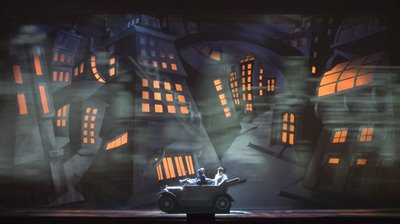
Marcelo Lombardero has long been attracted as singer and producer by th German/Austrian twentieth-century school. Apart from the Weills of the Weimar Republic period, as producer he has put on Viktor Ullmann’s “The Emperor of Atlantis” (written in a concentration camp) and Zemlinsky’s posthumously premiered “King Kandaules”. And he sang in Korngold’s “Die Tote Stadt” (“The Dead City”) , 1920. When he took over from Tito Capobianco the Artistic Direction of the Colón (initially called Coordination, but no matter) , he told the then Culture Secretary Gustavo López that he accepted with the condition that he would have a production of his own , for he was a professional producer. His choice was the Latin-American premiere of Ernst Krenek’s “Jonny spielt auf” (“Jonny plays”), a huge success in 1927 (he was 27) when many German theatres rivalled in multiple productions of the opera. It was very much what the Germans call a “Zeitoper” (“an opera of its time”) and nowadays its appeal is limited, but putting it in context it’s worth getting to know , even if for me Hindemith or Henze or Schoenberg deserve precedence (there’s plenty of them unknown here). It was going to be the sole hit of his career, for Krenek was at heart a follower of the twelve-tone Viennese School, whose often hermetic and difficult music was respected by specialists but rarely appreciated by mainstream music lovers (an exception would be Berg’s “Wozzeck”). He was twelve-tone before and after “Jonny...”, but there he attempted a schizophrenic blend of German expressionism ( frenzied Late Romantic writing) with whiffs of jazz-influenced white dance music (epitomized by the Paul Whiteman Orchestra). It doesn’t really work due to the unbelievable libretto by Krenek himself, which mixes a torrid love story of composer and singer with violin players of classical (Daniello) and jazzy extraction (Jonny) and the stealing of Daniello’s Amati by Jonny. We have to endure pseudophilosophical mumbojumbo concerning the composer Max’s love for the glacier as a symbol of nature’s power and transcendence. The music is mostly skillful and has patches of inspiration, although its very different worlds never jell together. Krenek had a long career; he died at 9l after spending decades in the USA turning out learned and cerebral music that is rarely played. But he could be less dogmatic and be expressive, as in his “Symphonic Elegy” . It was Lombardero’s production and Daniel Feijóo’s spectacular stage designs that made the day, for the cast failed in its two principals: Carlos Bengolea should be doing secondary character parts and not leads, for his vocal quality is grating in the extreme; he has been promoted much beyond all logic; and Cynthis Makris’ Anita showed her in declining vocal condition with a harsh and vibratoed high register (I tremble for her announced Turandot), though she moves well and looks handsome. Luciano Garay made a brave shot at playing Jonny, the Negro jazz-player, done as it was in the premiere by a white in blackface “a la Al Jolson” in “The Jazz Singer”, one of the first films with sound. He is lithe and a good actor, and he only faltered in his solo dominated by a brass chorale. Víctor Torres did a good Daniello, Patricia González was adequate as Yvonne, Ricardo Cassinelli yelled as usual (he should be honorably sent home), and there were good jobs from Hernán Iturralde , Gabriel Renaud and the three caricaturesque Police officers (Marcos Padilla, Norberto Marcos and Walter Schwarz). Stefan Lano’s conducting was rather slow but technically capable, and the little-employed Chorus under Salvatore Caputo was correct. With unerring sense of time and space Lombardero moved impeccably his singers in a production that, aided by Feijóo (who also had recourse to slides of the glacier with the collaboration of Leandro Pérez), Luciana Gutman (costumes) and Horacio Efron (lighting) gave us a fully valid view of the libretto; the last quarter of an hour was simply stunning, with its train and its clock that transforms into a sphere in which Jonny rides and leads the crowd with jazzy strains. 19/09/06 para el Buenos Aires Herald

Jonny spielt auf - Teatro Colón 2006 - Fotos de Miguel Micciche

The Baroque and Classicism in good hands

By now the historicist movement not only affects our view of the Baroque (and earlier music of Medieval and Renaissance times) but it is also exploring Classicist times and the Romantics, for it basically tries to approximate the executional practices of those periods. We music lovers have had plenty of illuminating experiences in recent decades, and even if veterans like me still like their I Musici recordings, there’s a lot to be said for the historicist approach. A number of recent visitors have proved it yet again. The Akademie fuer Alte Musik Berlin (The Berlin Academy for Old Music) had a big success here two years ago. Now they were invited back by the Mozarteum to their two cycles at the Colón; they left the Baroque and their two programmes were either all-Mozart or Mozart and contemporaries. One piece was present in both: the feted composer’s motet “Exsultate jubilate”, often done here in recent months. Korean soprano Yeree Suh (debut) has a small voice that she handles with accuracy in a rather dry manner; I prefer this music with an ampler, creamier voice, but her florid singing was good. There were other soloists in the all-Mozart first concert: Midori Seiler (debut, Japanese mother and German father) is one of the ensemble’s concertinos, and she played with fine intonation and some charm Concerto No.2 K.211. It takes some time to accustom oneself to the rather gruff tone of the period bassoon , but once assimilated one could enjoy Christian Beuse’s fluid playing of the Bassoon Concerto K.191. Led by concertino Georg Kallweit the 22-player ensemble , which includes strings, organ, flute, oboes, bassoon and horns, showed a refined technical level and style in Divertimento K. 138 and Symphony No. 29, both very well-known works. I found the second programme more interesting, for we were offered a quite worthwhile surprise, certainly a premiere: the Symphony in G minor by Franz-Ignaz Beck (1734-1809), strong, intense music worthy of comparison to a Mozart of good standard. In fact, better than his early Symphony No. 10, K.74 and on a par with F.J. Haydn’s most agreeable Symphony No. 3, Hob. 1:3 , also heard on this occasion. There was also limpid playing by flutist Christoph Huntgeburth of Mozart’s Concerto K.313. The ensemble was always accurate and stylish. A small group from London, the Ensemble Florilegium (debut), played at the Avenida for Festivales Musicales in their Mozart & Salieri series. Its Artistic Director is the splendid flutist Ashley Solomon, who uses a wooden instrument of authentic 18th century sound, sweet and rather small. The other executants are professional but not very exciting: Rodolfo Richter, violin; Jennifer Morsches, cello; and Ina Pritchard, fortepiano and organ. The fortepiano proved to have a very weak sound and as we so rarely hear such instruments here I wonder if Mozart’s could be so fragile considering such music as his Sonata No. 8, certainly very dramatic. I am inclined to think that this particular fortepiano was too soft. The programme was changed, and for the better. The First Part proved uninteresting, for there was second-rate Mozart (Church Sonatas K.274 and 245, and “Divertimento No.2 K.439”, wrongly described thus: it is really the second of 5 Divertimenti App.229, Einstein 439b, originally for two clarinets and bassoon, in an unspecified arrangement). And Salieri’s Ode “Deh, si piacevoli” and “Il Genio degli Stati Veneti” were to most listeners merely informative about the run-of-the-mill talent of that composer, though it allowed us to hear the fresh voice of Katia Escalera, brought along for the tour, a Bolivian soprano that had sung here before in something utterly different, one of the Valkyries last year. Things picked up in Telemann’s splendid “Paris Quartet” in G major, vital Baroque done with plenty of character. It was published in 1738 and its proper description is TWV 43:G4. The Second Part started with arrangements of arias and a duet from Mozart’s “The Magic Flute”, agreeable and apposite enough, especially Monostatos’ airy and fleeting tune. (My Grove dictionary doesn’t list this arrangement, probably not Mozart’s). We then heard an ad-hoc “Divertissement” made up by the artists combining instrumental and vocal pieces. The former: “Allegro, Menuett I and II” K. 46, and “Allegro, Andante and Polonaise”, K.487; both have problems of nomenclature which should have been clear (Festivales is generally more serious about such matters): K.46 is an arrangement for string quintet not made by Mozart of his Serenade K.361; and K. 487 is described as “12 duets for 2 wind instruments”; so, you see, we were offered arrangements for flute, violin, cello and keyboard with no clarification of the exact situation. Anyway, this was pleasant but hardly important Mozart. To the rescue came his two lovely Lieder, “Abendempfindung” and “An Chloe”, in classy versions by Escalera, who showed a beautiful voice and fine style. And some Johann Sebastian Bach brought us back to the Baroque in convincing fashion: although an arrangement, it is apparently Bach’s own of his Triosonata in G BWV 525 originally for organ, and it works well as chamber music. Also it was beautifully played by the artists. A fine encore: that wonderful aria, “Mio caro bene” from Handel’s “Rodelinda”, in an exquisite version by Escalera and Florilegium. I always hope to hear original versions; we have plenty to choose from without having recourse to alternative textures. 14/09/06 para el Buenos Aires Herald

A midseason concert miscellany from the Big Three

Concert life in BA is astonishingly big in number and there are plenty of positive events. Herewith some of them in recent weeks from the Big Three (our main concert institutions). The Athestis Choir from Italy made a deep impression two years ago, but in two successive years Nuova Harmonia announced them at the start of the season and then due to different problems replaced them: last year with a local choir, and in 2006 by a quartet of singers called Athestis Soloists, whilst the chamber orchestra that supported the choir in 2004 was this time an instrumental ensemble of eight players called Il Tempio Armonico. Although I would certainly have preferred the visit of the Choir, this Coliseo concert dedicated to Italian Baroque and Classicism proved interesting. The players proved a find: led by violinist Davide Monti, the ensemble included two other violins, viola, cello, bass, organ and double harp. The latter instrument is surely a novelty as part of the continuo: I’ve seen a theorbo used, but not a double harp, which gave to the texture a charming touch. As the group is tightly knit and very professional, its contributions, of course more chamber than symphonic, were technically very good and historically aware. They chose pleasant music: the Concerto op.VI No.7 by Evaristo Dall’Abaco (1675-1742), Vivaldi’s Concerto “Il Favorito” (fine solos from Monti) and Baldassare Galuppi’s Sonata a quattro No.2. There was a replacement in the vocal quartet: Argentine countertenor Martín Barrera Oro (he has also performed as Martín Oro) took the parts of contralto Elena Croci, and proved again that he is a good singer. Of the others I preferred the clear focus of bass Matteo Bellotto to the blandness of tenor Vincenzo Di Donato and the uneven production of soprano Roberta Pozzer. The vocal pieces were the very succinct Magnificat by Albinoni and the more expansive and classicist “Nisi Dominus” by Galuppi, a late score of 1777, probably both premieres. The encore was Mozart’s “Ave Verum”. Festivales Musicales presented at the Colón an Austrian conductor, Uwe Christian Harrer, who came to our city decades ago as director of the Vienna Choir Boys. The programme responded to that institution’s year’s theme, Mozart and Salieri. From the former that lovely work in the French taste, the Concerto for flute and harp, where I was partially convinced by the soloists: Claudio Barile too variegated in color for the Classicist flute, and Lucrecia Jancsa playing with clear articulation but a very small sound. No objections to Soledad de la Rosa’s limpid singing of that famous Mozart motet, “Exsultate jubilate”. Harrer’s conducting of the augmented Camerata Bariloche was clean and stylish. It was quite valuable to hear the premiere of Salieri’s Requiem in C minor, written in 1804, a big 48-minute score which holds some surprises, such as the solo weight of the English horn, the imaginative alternation of the vocal quartet and the chorus, the fine orchestration and some dramatic ideas. I feel this is the best Salieri work we’ve heard so far this season and one that shows him an accomplished composer, though not a genius. The best of the vocal quartet were De la Rosa and bass Walter Schwarz, with rather undersized contributions from contralto Susanna Moncayo and tenor Manuel Núnez Camelino. The Orfeón de Buenos Aires sang well (it was prepared by Néstor Andrenacci and Pablo Piccinni) and the Camerata played very professionally under the authoritative conducting of Harrer. Probably no other European chamber ensemble has visited us as assiduously as the Beethoven Quartet of Rome (piano and strings), where three ex members of I Musici (Félix Ayo, violin; Alfonso Ghedin, viola; and Enzo Altobelli, cello) joined pianist Carlo Bruno in 1970 (due to Altobelli’s death he was later replaced by Mihai Dancila). They were soon “adopted” by the Mozarteum Argentino and have come with almost biannual regularity ever since. This season they were announced for earlier dates; alas, Bruno fell ill. The dates were reprogrammed at the Colón and Bruno has been replaced by Marco Grisanti, a distinguished player thus making his local debut. And as was planned originally, they were joined by violinist Cristina Dancila (debut, daughter of Mariana Sirbu, I Musici’s concertino, and presumably related to Mihai, the programme brought no illumination on this rather interesting point), for they were paying homage to another famous ensemble much loved here, the Quintetto Chigiano. They offered two different programmes of quintets ; the first I couldn’t hear, it had Shostakovich and Brahms; the second, Franck and Schumann. I find the Franck a splendid work, quite as important as the Violin/piano Sonata; I felt Grisanti played with much sensitivity and command of the material, but he was too soft and retiring, Franck needs more assertive phrasing; the strings were quite good. I had no reservations about the much played Schumann, orthodox and firm. The encores were fine: the final movement of Boccherini’s Quintet G 324, op.30/6, “La Musica Notturna delle Strade di Madrid”, from pianissimo to fortissimo to pianissimo (the Retreat); and the exhilarating Scherzo from Shostakovich’s Quintet. There was a moving speech from Ayo thanking the Mozarteum for his 50 years of collaborating with them since the days of I Musici (Ayo was its concertino) and lamenting the closing for repairs of the Colón, for he loves this theatre deeply. I can only hope for the best. 12/09/06 para el Buenos Aires Herald

Opera: A mixed bag of premieres

As you know, currently Buenos Aires offers a varied operatic programme. And not only the three main companies (Colón, Buenos Aires Lírica, Juventus Lyrica) are to be counted, but numerous smaller outfits in such venues as the Roma Theatre in Avellaneda, La Manufactura Papelera or the Xirgú Theatre; and of course, the Avenida. I generally welcome enterprise and innovation, but several recent attempts haven’t been convincing. For half a century I have treasured my old vinyl recordings of Gluck’s “Orphée et Eurydice” with respectively Simoneau and Gedda. And during all that time I have been amazed that such a masterpiece remained unknown to our public. Of course, our city has long admired the original Italian version, “Orfeo ed Euridice”, often done in recent years though poorly. (Let’s not fall into the trap of believing that the Colón’s 1966 revival was the French version: it was instead a French translation of the quite different 1762 Italian opera, transposing furthermore the mezzo register to a baritone, whilst the French 1774 is for a tenor). So I was happy to be informed of a project to premiere the French version; alas, it was a disappointment. Richer in orchestration and incorporating many dances according to the French tradition, the old Greek myth sounds good in the Pierre Louis de Moline translation of Calzabigi’s Italian libretto. And the music remains mellifluous but even more so as well as soberly tragic. There was a good point in this venture at the Avenida: the careful work of Gustavo Codina as conductor and the fine sound of three different choirs that combine in the final scene: Coro de Cámara Zahir, Coral Ensamble and Vocal Meridión. And there were partial merits in the work of the very young countertenor Damián Ramírez (Cupid, a soprano part) and Cecilia Layseca (Eurydice). But the production was bad and the tenor was in such poor health that he shouldn’t have appeared. Producer Marga Niec made grave mistakes: she substituted vague and mediocre pantomime for the required ballet (and at times gave us exactly nothing: the impressive Dance of the Furies was merely played, not danced), and offered kitschy spectral images in a dense and boring stage picture (Víctor De Pilla) complemented by oppressive lighting (Oscar Bonardi) and nondescript neutral costumes (uncredited). Osvaldo Peroni is physically the antithesis of Orpheus the poet but he might have atoned with some nice singing; but he had no voice left and the ordeal was surely painful for him and the audience. The whole thing should be rethought and recast and then put again before the public, with Baroque dances in proper style (no points). We have such an immense gap of knowledge in operas of the Baroque period that I’m generally happy when any of them is announced. But surely there are priorities in a city that has only seen two Handel operas, still lacks one of the three Monteverdi, and has had Vivaldi and Cavalli operas decades ago (just one of each). In these circumstances it was a rather strange idea to offer the premiere of “As variedades de Proteu” (1737), libretto by Antonio José Da Silva, music by Antonio Teixeira. It was the result of painstaking work of reconstruction by Argentine musicologist Aníbal Cetrángolo, who lives in Venice. However, he hasn’t shown good judgment: we were exposed to endless repetitions of material; if he had trimmed a full hour we might have had a good show. Anyway, Teixeira is a modest composer writing in Italian style on a Portuguese text; his stuff is moderately pleasant but thin , hardly a revelation. But there was a curiosity value, for this was a marionette opera, a genre that has had some illustrious examples, such as Haydn’s. And it had long stretches of pure theatre, with good actors behind the stage giving life to the Da Silva libretto whilst the action was presented by the splendid marionettes of Tito Loréfice. There were clear evidences of insufficient rehearsal: of all the singers only one had the part by heart, the others had to read the music as in a concert, which made nonsense of any theatrical effect ; it was an ungrateful job for producer Ana D’Anna. One point was well taken: the singers were dressed like the marionettes, which helped in following the plot. The “variedades” of the title refer to the transforming abilities of Proteus (modelled on the Greek myth) and the plot is an involved one of crossed lovers and political consequences typical of the Baroque theatre. Fernando Grassi in a “gracioso” role was convincing (he was the one who didn’t read his part). The others were trammeled by dependence on the score, but Elena Jáuregui showed some charm and Florencia Machado and Mario de Salvo were in good voice. The others weren’t up to par: Marisu Pavón, Carlos Ullán, Manuel Núnez Camelino and Vincenzo Di Donato. It remains to be said that the 15-member orchestra of historicist players under Cetrángolo had a very mediocre night . A capsule notice on an ill-attended revival at the Roma Avellaneda: the incomplete “L’oca del Cairo”, just seven numbers of minor Mozart complemented by arrangements of other music of his by Virgilio Mortari to make the work viable. Correct singers did their job in a simple staging by Daniel Suárez Marzal and were abetted by a small orchestra conducted by Susana Frangi. 05/09/06 para el Buenos Aires Herald

Audacious challenges from BAL and Juventus

The two principal off-Colón opera companies formulated audacious challenges and by and large met them: Buenos Aires Lírica (BAL) did Tchaikovsky’s “Eugene Onegin” (or Yevgeny Onyegin, as they transliterated the Cyrillic original) in Russian; and Juventus Lyrica tackled Verdi’s most difficult opera, “Falstaff”. Both of course at the Avenida, the by now well-established alternative to the Colón. “Eugene Onegin” hasn’t been done often here, but the Colón performances of 1977 (with Benackova, Portella and Noreika, conductor N. Jarvi) and 1997 (with Pieczonka, Hvorostovsky and Galuzin, conductor Ermler) were admirable and left a most pleasurable sensation. It had been a moving experience to meet first hand these “lyric scenes”, as the composer called them, on the novel in verse by Pushkin. Fortunately BAL’s version was good enough to justify the revival. The opera is, along with “Pique Dame”, the best of Tchaikovsky’s extensive and ill-known opera production, of which we have only seen here -apart from those two- his very last one, “Iolanta”. True, the dramatic structure of “Onegin” is rather loose and protracted, and its pungent lyricism could do with more urgency now and then. In our cynical times its very Romantic story may seem a bit unbelievable but after all we are accepting the Jane Austen novels, so why not Pushkin? And the music is full of beauties, both orchestral and vocal; of course, Tatyana’s Letter Scene and Lenski’s aria (the young poet killed in an absurd duel by his friend Onegin) but also the brilliant Polonaise and other pieces. Mercifully the production of Rita Cosentino didn’t go the way of her modernized “Rigoletto” and we were given a reasonably realistic “Russian” view, with some caveats however. The same basic decor with modifications was used for completely different houses, but the countrified gentry can’t be so similar to the city palace of Prince Gremin. The clothes didn’t look rich enough (apart from those of the people, which were adequate). And the choreography by Viviana Iasparra was either poor (First Act) or damnably nonexistent (the all-important Polonaise had a very disappointing staging as mere posturing of the guests). But the movements of the singers were natural and derived from the words and looked acceptable for the Russia of the early 1800s. Stage and costume designer, Oria Puppo; lighting, Horacio Efron. The all-Argentine cast sang good Russian thanks to the instruction by Rosita Zozulia, a Russian émigré residing here. I found Armando Noguera quite convincing in the title role, with the right type of lyrical voice and very appropriate deportment. The confidence put by BAL’s authorities on the young Daniela Tabernig proved justified, for she did a sincere and nice-sounding Tatyana, of impressive professional assurance. Once again Enrique Folger (Lenski) showed both his communicative feeling and the fissures of his technique. Gabriela Cipriani Zec did well as the coquettish Olga. As the mother of Tatyana and Olga, Larina, Mónica Sardi was accurate but looked and sounded too young. Marta Cullerés was quite right for the old nanny Filipyevna. Ariel Cazes was dignified but rather dull as Gremin, with a serviceable voice that lacked nobility and beauty. Ricardo Cassinelli was more acceptable as Triquet than in other recent roles, though still shouty. The young basses Walter Schwarz and Esteban Hildebrand did well as Zaretsky and the Captain. Carlos Vieu is a very able conductor, but this time he had to deal with an unresponsive orchestra that lacked weight and brio and solo players that made gross mistakes (that cello!). The good Chorus sang nicely under Juan Casasbellas. “Falstaff” is the almost miraculous result of Verdi’s return to comedy, almost octogenarian, decades after his early “Un giorno di regno”. It has a formidable libretto by Arrigo Boito conflating parts of Shakespeare’s “The Merry Wives of Windsor” and “Henry V” in a splendid farce about the fat old knight’s defeats in love from those redoubtable wives, Alice and Meg. Three perfect acts divided into six scenes of an almost incredible musical variety and the most refined technique . Ana D’Anna, Juventus Lyrica’s guiding hand, was the producer and this time avoided the arbitrary stagings she often gives us, trying instead to be faithful to the richly theatrical action and its admirable feeling for Elizabethan times. Apart from a couple of botched situations, most was sanely conceived and funny in a measured way, with sufficiently detailed stage designs by D’Anna and quality costumes by the refined Ponchi Morpurgo, who did “Falstaff” before in her career; the red dress of Alice was splendid. The musical side was good. Antonio Russo is a wise conductor who kept things together with the right tempos, but the result lacked some brilliance. Nice choral work under Miguel Pesce. The protagonist was taken by Ricardo Ortale with rotund humor and he coped acceptably with the vocal hurdles that abound. Gustavo Zahnstecher was a sonorous Ford. I especially liked the Alice of Mónica Ferracani, who was in fine fettle; agreeable though a bit thin the Nannetta of Laura Delogu; Meg, often a cypher, had dramatic and musical presence with Lara Mauro; but Alicia Alduncín is an oratorio contralto, not a Quickly: she lacked character and presence . Norberto Fernández wasn’t quite the subtle lyric tenor Fenton should be, but he was agreeable enough. Good jobs from Mario De Salvo (Pistola) and Norberto Lara (Bardolfo), and a rather shouty Dr. Cajus from Hernán Sánchez Arteaga. 22/08/06 para el Buenos Aires Herald