A child’s first impressions are indelible. I first came into contact with Shakespeare’s “A Midsummer Night’s Dream” in 1951 when, just 13, I saw my sister play The Wall in a Swiss school’s end-of-term performance. The “sad” story of Pyramus and Thisbe remained with me. Then, at about 15, I saw twice the wonderful 1930s Max Reinhardt film with Mickey Rooney as Puck. Toscanini’s record of Mendelssohn’s incidental music was already with me. Then in 1962 the Colón premiered Britten’s “A Midsummer Night’s Dream” and I was bowled over. Many years later I got the author-conducted CDs and saw the admirable Glyndebourne video conducted by Haitink. But the most magical experience was when visiting Exeter in 1995 I went for a night stroll and bumped impromptu into a charming open-air performance of Shakespeare’s play in a lovely wood clearing. So it was with trepidation and hope that I met this 2006 “AMND” at the Colón.
Alas, I was confronted with a tower of red velvet chairs instead of a wood as sole “decor” of Acts 1 and 2, arbitrarily and wrongly strung together, and then the same chairs put horizontally in rows for the Third Act. The pageboy object of the implied erotic interest of both Oberon and Tytania -and reason for their quarrels- was replaced by...a pram presumably holding a baby. And the elves were boys and girls in Argentine white school uniforms! All this just won’t do. (This was a coproduction with the Nice Opera. The producer was Paul-Emile Fourny, the stage designs were conceived by Louis Désiré and the lighting was by Désiré and Patrick Méeus. There was no credit for the costume designer).
A pity, for this opera needs a skillful evocation of magical happenings to work. When it’s properly done, I find it one of the best post-World War II operas. Benjamin Britten and Peter Pears pared down the play to about half to make it manageable as an opera, but every word is Shakespeare’s. And as a composer Briiten most cunningly respected the three tiers of the play: the fairy world of Tytania, Oberon and Puck has iridescent touches of orchestration, suspended harmonies , high voices for the Queen (coloratura soprano) and King (countertenor) , a children’s choir for the elves and a spoken role for Puck, the mischievous messenger of Oberon who sows confusion among the humans inadvertently; the Rustics who put on the unintentionally funny tragedy of Pyramus and Thisbe are humble artisans characterized with fine parodistic sense and with an orchestration of their own; and the Romantics, as I think may be called the two couples at odds, have intense writing that can be both tender and harsh according to the situation.
Let’s analyze the singers according to those tiers and compare them to ’62. The new interpretation scored heavily by casting Oberon with a countertenor, as it should be. Back then there was no local experience whatsoever with that kind of voice, and the Artistic Director Roberto Caamano thought that a countertenor wouldn’t carry in the vast expanses of the Colón; he replaced it with a mezzosoprano. On the other hand, it was a pity that the originally announced Franco Fagioli didn’t appear, for Fabrice di Falco, born in Martinique, lacked tonal allure and projection, though he was correct musically.
Tytania was sung by Pamela Coburn with increasing firmness, though she isn’t quite the required coloratura soprano, but a lyric soprano of some agility; she wasn’t helped by an inadequate costume. The other big mistake in 1962 was that Puck was acted (it isn’t a singing part) by a rather aged light soprano, when it needs a lithe adolescent boy ; Gary Tushaw isn’t that, but at least he is an adequate British actor. No charisma, however, and the part needs it.
The two pairs of lovers who are to suffer mismatches at the hands of Puck were quite convincing. I especially liked the American tenor Jonathan Boyd, who made a most accomplished debut , with a fine, expansive lyric voice of just the right timbre. Luciano Garay as Demetrius has a harsher role for he repudiates Hermia; the interpreter was dramatically apt but some bits needed more plangent vocalizing. I enjoyed the involved work of both Graciela Oddone and Mariana Rewerski, who sang very well and looked beautiful.
Britten is partly to blame for the neutrality transmitted by the parts of Theseus and Hyppolita, and one wonders if Shakespeare himself was well inspired in choosing the surroundings of Athens as a venue and giving such mythological names to the Duke and Duchess. Luis Gaeta and Alejandra Malvino are experienced troopers and did their bit adequately.
I part company with the local Rustics, who showed themselves unidiomatic both in pronunciation and style. Back in 1962 there were some splendid artists all around but especially there was the Bottom done by Forbes Robinson and Joseph Rouleau as Quince. Carlos Esquivel in this part was good, but Gustavo Gibert was a flat and uninteresting interpreter of Bottom, others were nondescript and Ricardo Cassinelli was downright offensive playing Flute and Thisbe in the worst style of a Corrientes “revista”. To think that this was Peter Pears’ role!
To atone there was fine work from the Children’s Chorus under Valdo Sciammarella and good conducting by the American Arthur Fagen (debut), who showed himself a reliable maestro.
25/07/06 para el Buenos Aires Herald
sábado, octubre 21, 2006

Splendid visitors from Europe
Recent weeks have provided some admirable concerts from European visitors. Some were pleasant surprises, others gave further proof of their recognized quality, a few were not completely satisfactory.
Among the surprises were a string orchestra and a quartet from Italy, both in Nuova Harmonia’s cycle. Cellist Enrico Dindo had made a stunning impression last year in recital; now he came as both player and leader of a string ensemble he founded, I Solisti di Pavia. The programme was well contrasted: Classicism in the First Part (Mozart, Divertimento K.138, and Haydn, Concerto for cello Hob.VII No.1) and Tchaikovsky in the Second (the Serenade and the Andante Cantabile from Quartet op. 11 in the arrangement the composer made for cello and strings). The ensemble seemed to me quite first-rate in its intonation , articulation and attack, young players with professionalism and passion led with style by Dindo, who prepared them very well and played beautifully his own parts. Further pleasure in this Coliseo date was provided by the encores: Tchaikovsky’s Notturno op.l9 No.4 for cello and strings and the Sarabande from J.S.Bach’s Suite No. 1 for solo cello.
The Quartetto Cremona was an even greater surprise: I don’t hesitate to consider it one of the best young groups in the world both for its sterling technical qualities and for its astonishingly mature interpretations. It was unfair that the hand programme didn’t list the names of the artists. Also at the Coliseo, they offered music of the highest quality and with no concessions. Shostakovich’s Quartet No. 8 is desolate and autobiographic; its intensity was given with searing truth by the players. For the other two scores the Cremona was joined by violist Giuseppe Russo Rossi. They played masterpieces: the Quintet in G minor K.516 by Mozart, surely his best and most prophetic; and the Quintet No.2 op.111 by Brahms, a dense work of astonishing craftsmanship. In both these young artists gave us playing to remember, references for any future interpretation. Intelligence, skill, taste and drama.
The Camerata Bariloche played for Nuova Harmonia at the Colón conducted by the New Zealander Ross Pople, whom our city met a long time ago as cellist and conductor of the London Festival Orchestra. He is a good, solid musician, and gave more than adequate interpretations of standards: Mozart’s Overture to “Cosí fan tutte”, Grieg’s “Elegiac Melodies”, Mendelssohn’s Violin Concerto op.64 and the Beethoven Fifth Symphony. The soloist was the Italian Domenico Nordio (debut), who played rather timidly with a small sound and a lack of adrenaline, but not badly; he does have a correct technique. His encore was an interesting choice: the Allemande from the Fourth Sonata for solo violin by Eugene Ysaye. Pople’s was routine: the Dance of the flutes from Tchaikovsky’s “The Nutcracker”.
I believe the Virtuosi di Praga (under its founder and concertino Oldrich Vlcek) made their local debut in a concert at the Colón of Festivales Musicales. Considering the strong tradition of excellence of Czech string players, I was rather taken aback with some instances of bad intonation in Mozart’s Divertimento K.138. The illness of Zofie Srámková, in the other hand, forced the replacement of the same composer’s Flute Concerto K.313 by another score of his, the Horn Concerto No.2, K.417. Unfortunately the soloist, Jan Karas, didn’t pass muster, and with a small though agreeable sound he played the piece with many irritating mistakes.
Fortunately the Second Part was muh better: it was very pleasurable to hear Salieri’s Symphony “La Veneziana”, unpretentious but full of charm, in an easy, fluid performance. And Mozart’s Symphony No.29, one of the best of his early scores in this form, was cleanly and expertly put forward. Fine encores: the Andantino from Mozart’s Divertimento No. 11; the Dvorák Humoresque No.7; and a “Pizzicato” from Gluck’s “Don Juan”.
The hallowed Berg Quartet has come here several times invited by the Mozarteum Argentino. They visited us again, with an important change in their personnel: due to the death of violist Thomas Kakuska, his post is now occupied by a disciple, Isabel Charisius. She proved equal to the great responsibility and I found her fully integrated with violinists Guenther :Pichler and Gerhard Schulz and cellist Valentin Erben. The group was founded 35 years ago . I’m afraid I find Pichler a bit weaker in the purely technical side compared to what he used to be; the other veterans hold their own very well, and Charisius is a find.
Their two concerts at the Colón had the same scheme but different works: in each two quartets by Mozart and one by Bartók. In the session I heard it worked splendidly. From Mozart, No.15 K.421, a dark work in D minor, and his last, No.23, K.590, one of the “Prussian” Quartets , with some astonishingly modern bits. The Berg were on their toes, always fresh and inventive. And then, the superbly imaginative Fourth Quartet by Bartók (1928) in a reference rendering. A beautiful slow Haydn movement was the lovely encore.
The Trio Mediterrain is Berlin-based (!) with a Spanish clarinettist (Laura Ruiz Ferreres), a Portuguese cellist (Bruno Borralhinho) and a German pianist (Florian von Radowitz). In the intimate Sofitel hall, and after a long wait (one of the piano’s strings had snapped) , we heard very nice and accomplished versions of Beethoven (Trio op.11), the Schumann “Fairy tales” op. 132 and Brahms’ Trio op. 114.
18/07/06 para el Buenos Aires Herald
Symphonic brilliance from Czechs and Italians
The Czech Philharmonic is justly famous; its first conductor in 1896 was none other than Antonin Dvorák and it has had great principal conductors of that nationality: Vaclav Talich, Rafael Kubelik, Karel Ancerl, Vaclav Neumann. In 1993 a non-Czech was chosen: Gerd Albrecht. He was succeeded by Vladimir Ashkenazy in 1998; he was the first to bring the orchestra to our city, with fine results. And now we have a return visit in which Albrecht takes further contact with his former orchestra.
Albrecht , now 71, is one of the most distinguished German conductors and this was his fourth visit. He came in 1973 when he was 38 to conduct the Colón Orchestra and in the following decades visited us with the Zurich Tonhalle and with another European orchestra. He has made many enterprising recordings, especially of twentieth-century opera. With the Czechs he again showed his patrician good taste, sense of balance and orthodox , stylistic phrasing. He makes music with precision and brio and eschews any eccentricity.
The two programmes for the Mozarteum Argentino at the Colón were based on the most famous Dvorák symphonies, and whilst I generally root for innovation, I was certainly happy to hear masterpieces like the Eighth and Ninth in such splendid renderings by an orchestra has the music in its bones. The stunning unanimity, lustre and perfect intonation of the strings, the admirable quality of the brass (particularly a virtuoso horn soloist), the musicality of the woodwinds and the sheer rightness of every inflexion were a joy to hear.
The first work in each programme was well-chosen: Ligeti, who has died very recently, left in “Lontano” (1967) a fine testimony of his craftmanship and vital ideas in an advanced idiom. And Dvorák’s Overture “Othello” is dramatic, intense and finely wrought; it was only the third time that such a piece was heard in Buenos Aires. Both scores were finely played, and so were the two encores (the same in both nights): the lovely Slavonic Dance op. 72 No. 2 (Dvorák) and that fun piece, the gypsy tango “Jealousy” by Jacob Gade , incredibly a Dane.
The soloist in both concerts was the Georgian pianist Elisabeth Leonskaja, absent for long years from our city, where she reaped applause decades ago in several visits. Now sixtyish, she keeps well. The Schumann Concerto (first night) seemed a bit under-vitalized, without quite the forward motion and the strength it needs at climactic moments, and some of the phrasing seemed un-Germanic, but of course she was highly professional. In that session I preferred her encore, a beautifully rippling Impromptu op. 90 No.4 by Schubert. On the second night she faced the challenge of Beethoven’s Fifth Concerto (“Emperor”) and I rather liked her interpretation, even if she comes from a different tradition and some of the phrasing seemed strange; but the technical solidity was impressive and she was capable of poetic statements. Again the encore was fine: a delicate traversal of the Adagio from Mozart’s Sonata No.12, K.332.
The Orchestra Giovanile Italiana (Italian Youth Orchestra) visited us some years ago and left an agreeable impression. In this new visit it had the advantage of a forceful and precise conductor making his BA debut: Roberto Abbado (nephew of Claudio). Their concert was a part of the Nuova Harmonia season and the venue was the Colón.
I didn’t like the programme, however. A faded avantgarde Italian piece and two overplayed German standards isn’t my idea of something interesting. Probably Bruno Maderna’s “Serenata per un satellite” was a premiere. The composer lived between 1920 and 1973 and this work dates from 1969. The piece was dedicated to the Director of the European Space Operation Center on the occasion of the launching of the satellite Boreas. The trend then was aleatory music, leaving considerable leeway to the interpreters both in the choice of instruments and in the exact length of some fragments of composition. The whole thing seems sterile now and the eight minutes of Abbado’s version with a chamber ensemble left no mark at all. I was certainly sorry that something more substantial wasn’t found: Petrassi, Dallapiccola, Ghedini...
Pianist Simone Pedroni is in his thirties and he made his BA debut meeting head-on the challenge of Brahms’ massive First Concerto . He has an ample technique that can solve all difficulties, although his tone isn’t quite as big as this score ideally entails. His phrasing can also be delicate where warranted, and I liked the decision and clear rhythm he imposed at the beginning of the third movement. He also showed his sensitivity in the encore, Rachmaninov’s Elegy op.3 No.1, rarely played. The Orchestra , under Abbado’s knowing leadership, dug into the forceful beginning of the Concerto with real punch, and generally played with good sound and intense delivery within a sane framework of well-chosen tempi and a right sense of tension and distension.
Arguably Abbado’s view of Beethoven’s all-time hit, the Seventh Symphony, was a bit too harsh , with unrelentless hammering at the admittedly obsessive rhythms of the score , but anyway this music certainly needs dynamism and continuity, with its positively Dionysiac climaxes. It was just a bit overdone, that’s all, for you can have the same drive with greater euphony.I loved the encore, a crisp and sunny version of Rossini’s funny Overture to “Il Signbor Bruschino”. This was really Italianate.
18/07/06 para el Buenos Aires Herald
The Phil’s season, the National’s non-season
The relative good news is that the Buenos Aires Philharmonic is having a correct season. The unrelieved bad news is that the National Symphony isn’t having one.
I wrote a couple of months ago about the initial subscription concert of the Phil. Too many weeks passed before the second: it was conducted by Max Bragado-Darman , Spanish, who was supposed to make his debut here last year but was prevented by a strike from doing so. I had appreciated his work as conductor of the Symphony of Castilla and León at the beautiful Teatro Calderón of Valladolid in March 2000 and I had then a rather noncommittal impression: correct technique communicating not much. He has been working lately also with the Monterrey Symphony in California and I think he is now a better interpreter.
The score in which he could show his mettle was Schumann’s First Symphony (“Spring”): here Bragado conducted with impulse and coherence and obtained fine playing from the Phil. Elsewhere he gave a well-colored frame for Pablo Saraví’s sensitive violin in Vaughan Williams’ soaring “The lark ascending”. Altogether paler was Mozart’s Concerto No. 1 from both conductor and soloist (one of the Phil’s concertinos). The first work in the programme was a Mexican short piece programmed by the Orchestra’s Principal Director Arturo Diemecke, who is of that nationality: “Jericó” proved to be a well-written and rather noisy score by Alexis Aranda, who acknowledged applause.
Pedro Calderón was decades ago the Phil’s Principal Conductor for an unprecedented time of 25 years, and he now has been at the helm of the National Symphony for more than a decade; he is widely acknowledged as our most experienced conductor and he conducts the Phil for a concert every year. But the one I comment did have some mishaps: it would have been interesting to hear Salieri’s Symphony “Il giorno onomastico” (presumably a premiere) but somehow the orchestral parts weren’t obtained (an oft-repeated story, alas) and so it was replaced by a shorter work, the well-known Gluck Overture to “Iphigénie en Aulide” (to judge by its heaviness, probably the Wagner edition).
Things didn’t improve with a lackluster interpretation of Mozart’s marvelous Symphony No.25 in G minor (the same tonality as the famous No. 40), aggravated by abundant horn fluffs. But I did enjoy Reger’s Variations and fugue on a theme by Mozart (from Sonata No. 11 for piano), certainly one of the best scores of this erudite composer; Calderón is a builder and he always feels at home in complex structures (years ago he did with the Phil the other great Reger set of Variations, the ones on a merry theme by Hiller). The orchestra here responded well.
I liked the fourth concert, which brought the debut of Bulgarian conductor Rossen Milanov, who divides his time currently between his country and the USA (where he studied). Clear-minded and energetic, he delivered a thrilling Beethoven Fourth Symphony, a favorite work of mine, where the Phil seemed galvanized. Claudio Barile played Mozart”s Concerto No. 1 for flute K.313 with his accustomed dexterity, even if his highly colored playing is more attuned to Impressionism. He used well-made cadences by Taffanel, Gaubert and Rampal. Milanov accompanied nicely. Barile played as an encore a strange avantgarde piece, “Flames must not encircle side” by Robert Dick, with a special technique of circular breathing. The session had started with another Mexican score, Mario Lavista’s “Clepsidra”, to my mind very well-made and original; I think it was a premiere (damnably the Colón doesn’t specify such things nowadays; it did in better times).
The latest Phil concert allowed the audience to meet conductor Ronald Zollman, who last year couldn’t make his debut due to the Colón’s second strike. He is a middle-aged Belgian Flemish conductor who has held posts in Belgium, Mexico and Israel. After a correct Beethoven “Coriolan” he accompanied the Phil’s first desk Gabriel La Rocca in Mozart’s Bassoon Concerto. It was brilliantly played with accomplishment and style, though cadenzas by Claude Kuhnemann and by La Rocca himself were rather out of period.
Scriabin’s overheated and difficult 45-minute Symphony No. 2 was admirably expressed in Zollman’s passionate but controlled version, with fine playing from the Phil, especially the brass section. The artists may be angry because the Colón promised work clothes and didn’t deliver (hence the men play in shirtsleeves and the women in sober black) but they are currently in good shape.
Unfortunately I haven’t heard any of the open-air protest concerts the National Symphony has played in front of the Obelisk, so I don’t know in what shape they are. The sad fact is that the season hasn’t started due to gross differences of opinion between the Culture Secretariat’s functionaries and the players concerning basic labor conditions. Longstanding grievances concerning not only salaries but also what they call the “career” (special considerations due to experience and seniority) seemed in the way of solution last year (with recommendations from both the Senate and the Chamber of Deputies to the Executive to be fair with the artists) when suddenly a projected decree that would have solved matters was cancelled and the whole thing was derived to labor negotiations (“paritarias”) which dragged on and on with the absence of Culture functionaries. So in March the players decided to strike, conciliations weren’t obeyed by Culture and further postponements maintain the Orchestra paralyzed to this day.
29/06/06 para el Buenos Aires Herald
“Cosí fan tutte”, cynic comedy at its best
The Colón’s current Artistic Director, Marcelo Lombardero, has opted for one of the operas of the Da Ponte trilogy to represent Mozart in the season commemorating the 250th anniversary of his birth. Lombardero’s predecessor, Tito Capobianco, had planned to premiere “Mitridate, Re di Ponto”, an early “opera seria”, and I would have preferred it for such an occasion warrants a bit of programming audacity. However, “Cosí fan tutte” was in fact audacious not by being chosen but because it was presented with an all-Argentine double cast with the exception of Adriana Mastrángelo, and she’s Uruguayan.
Considering the very high prices for residents and the discrimination against foreigners who pay as much as double in certain seats and performances, one can seriously doubt if this is honest value for money in an international opera house. Even so, I was rather happy at the results of this revival and I cavil whether it’s so easy to find decent local casts for this particular work in many First World countries.
Of course I’ve written several times for the HERALD about this marvelous comedy, for this opera has been offered , e.g., by both principal alternative opera companies, Buenos Aires Lírica and Juventus Lyrica, and some times with singers that were also at the Colón (at a third of the price). Seeing now two performances due to the double cast, I marveled anew at the immense skill and beauty of Mozart’s music, but also at the talented Da Ponte’s cynic concoction. Although many have a wrong sense of rococo blandness about the late Classical period, it is also the time of the Marquis de Sade, of Choderlos de Laclos’ “Dangerous liaisons”, of the Casanova Memoirs (he was a great friend of Da Ponte’s), of the French Revolution. Its cynicism and ambiguity are certainly contemporary. And, if Don Alfonso can be decried as a misogynist bastard by feminists, the completely uninhibited Despina has an extremely low opinion of men and she uses them as instruments of pleasure and money.
Michael Hampe has done productions of Mozart’s “The Magic Flute” and Rossini’s “Cinderella” for the Colón and has shown that his European fame is well acquired, for those productions had taste and style. There was conflict with the Colón when he did “The Magic Flute” in 2004, for he was angry at what he felt had been a lack of collaboration. Maybe (I’m not sure but it seems a reasonable surmise) that’s why he didn’t come personally for “Cosí” and his Santiago de Chile production was staged here by Caroline Lang (it was a co-production with Santiago). Hampe opted for a traditional production, with pleasant stage designs evoking Naples imagined by Ramón López (also author of the lighting plot) and agreeable clothing by Germán Droghetti (the Albanian costumes were funny).
Some people were disappointed at the linearity and the unsurprising quality of the staging; not me: Hampe/Lang respected the libretto and the music at all times and made the story intelligible. Maybe there was too much symmetry but by and large the comedy worked. Creativity of the wrong kind can ruin Mozart.
A definite plus was the conducting of Rodolfo Fischer, Chilean, who had made an impressive debut with Buenos Aires Lírica when he conducted two years ago “Ariadne auf Naxos” (R.Strauss). With an acute sense of style and balance both in the pit and in connection with the stage, he accomplished with both casts a sense of easy ensemble and fine phrasing. In a few spots matters could have moved a bit faster, however. The Orchestra generally played well, with the exception of the grievous horn mistakes in the Rondo “Per pietá” (in both performances I saw). The Chorus did its rather easy job well under Salvatore Caputo.
Both casts were good. Fiordiligi is very arduous musically; Virginia Tola finally made her comeback (when some years back the Colón didn’t pay her work in “Les Contes d’Hoffmann” she sued and won); having done the part recently at Brussels’ La Monnaie Theatre, she sang and acted with considerable ease, aided by her physical allure;even if one felt some strain in top notes, most of her musical line was accurate and beautiful. Carla Filipcic Holm had her first big role at the Colón, but she has sung Fiordiligi successfully at the Avenida; in full control of her beautiful voice, she did some exquisite things and played the comedy with spirit.
Both Dorabellas (Adriana Mastrángelo and Mariana Rewerski) had some trouble managing the music with real smoothness and euphony and their timbre didn’t sound mezzo-ish enough to contrast with Fiordiligi, but they were good in ensemble work. Graciela Oddone was a pert and funny Despina with fresh voicing, better than the young María Virginia Savastano, who overdid the vulgarity.
The refinement and “savoir faire” of Raúl Giménez made him by far the best Ferrando; Carlos Ullán was good in the ensembles but had problems with long notes in the arias. Hernán Iturralde was a stalwart Guglielmo sung with very firm tones; the much younger Nahuel Di Pierro was certainly fluent and pleasant but a bit undervoiced; both are fine comedians.
The lyrical voice and gentle manner of Víctor Torres doesn’t jell with Alfonso’s image, though he sang beautifully; Omar Carrión’s demeanour was the right one for the old sceptic but his voice is too small for the Colón.
22/06/06 para el Buenos Aires Herald
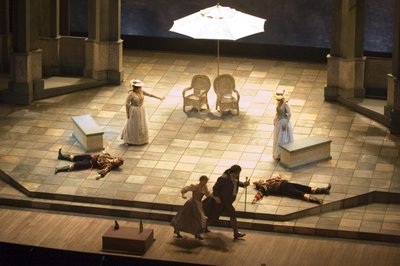
Cosi fan tutte - Teatro Colón 2006 - Acto 1 - final conjunto - Foto de Arnaldo Colombaroli
Monteverdi’s “L’incoronazione di Poppea”: bad guys win
It is an established fact by now that the Claudio Monteverdi trilogy of extant operas are considered repertoire in Europe. He wasn’t the first in writing operas (the privilege corresponds to Jacopo Peri and his “Euridice” in 1600; his 1597 “Dafne” is almost completely lost) bu certainly his “La favola d’Orfeo” (1607) was the opera in which most of the characteristics of the genre were firmly implanted. Of the 1608 “Arianna” only the famous Lament was preserved. And then, a musical mishap of major proportions occurs: his following ten operas between 1608 and 1640 are lost. By the time he wrote “Il ritorno d’Ulisse in patria” in 1641 he was 74; this we still have. And we have the 1642 “L’incoronazione di Poppea”.
“Poppea” has a splendid text by Giovanni Busenello, pithy and sarcastic in its tone, highly wrought in its language, as harsh an indictment of unlimited power (Nero’s) and of female seduction as we have: politics moved by sex and instinct , Seneca’s wonderful counsel cancelled by commanded suicide. After the Venice premiere there were only copies of the Monteverdi manuscript: one, with additions in Monteverdi’s hand, is at the Biblioteca Marciana, Venice; another comes from the Naples revival of 1651 and is also a copy, this time at the Conservatory San Pietro a Maiella at that city.
After his century Monteverdi was all but ignored until the beginnings of the twentieth century, when Vincent d’Indy edited “Poppea” in 1904 and “Orfeo” in 1905. Westrup, Malipiero, Benvenuti, van den Borren, Krenek and Redlich eventually offered their own editions up to 1950 (Redlich’s fuses Venice and Naples). And then came the recordings: the pioneering ones by Walter Goehr, Ewerhart, Pritchard (the Leppard condensation). And then the historicists: Curtis, Harnoncourt, Hickox, Jacobs and Gardiner. There’s even a Kraack arrangement conducted by Von Karajan...
Buenos Aires has been reasonably advanced in the matter of stage productions. A condensation by D’Indy was conducted by Ansermet in 1927 at the Grand Splendid. At the Colón Tullio Serafin conducted the 1938 performances. I could attend the 1965 revival under Bartoletti, quite musical but not historicist: this came at the hands of René Jacobs in 1996 with an excellent production by Gilbert Deflo and such singers as Anna Caterina Antonacci and Michael Chance; it was a huge success. And now we have this courageous and largely successful endeavor by Buenos Aires Lírica where all concerned except Italian producer Rita de Letteriis were from the South of our continent (Chile, Brazil, Argentina) .
It’s not often that I come out of an opera theatre really happy and rather proud of us as a cultural city; this was such an occasion. To my mind the hero of these performances at the Avenida is musical director Juan Manuel Quintana, for indeed conducting is the smaller task in Monteverdi: the basic one is to establish a score that is convincing in historicist terms, and this Quintana has certainly obtained out of his profound knowledge of the musical mores of those early Baroque times, still imbued with late Renaissance features. His results are different from those of Jacobs but equally valuable ; they have the ring of truth. For all we have is a single accompanying instrumental line to the voices, there’s no orchestration. He has scored it for what may be called a continuo orchestra: two violins, two violas, two recorders, two cornetti (wooden trumpets), cello, bass, two archlutes,theorbo, lira da gamba, viola da gamba, organ and two harpsichords. The ensemble is called Febiarmonici and the great majority are Argentine. Their playing was beautiful throughout and it demonstrates that we now have locally enough good historicist artists to tackle the seventeenth century repertoire with authenticity: quite an advancement.
In an interesting press conference Quintana explained that “Poppea” isn’t all Monteverdi, that there are pieces in it by his disciple Francesco Cavalli ( remember the 1971 Colón “L’Ormindo”?) and that the lovely final duet is by the little-known Benedetto Ferrari. He has also interspersed instrumental pieces by Sacrati, Cesti and Rosenmueller. Quintana has scored for five parts or voices and he has done it with consummate skill.
Blessedly Rita De Letteriis (debut) opted for a Roman-times production, without the gross distortions Buenos Aires Lírica has often inflicted upon us. Abetted by the beautifully designed and realized drops of Santiago Elder (debut) and by the reasonable authencity of Beatriz Di Benedetto’s costumes (debut) and with cunning lighting by Eli Sirlin, the action was natural and spontaneous, though at times it could have had more brio.
With the exception of Eugenia Fuente, whose Ottavia though well sung didn’t sound Baroque, all the others were convincingly stylistic. Brazilian Patricia González did a personable and brightly voiced Poppea; Nerone was acted and sung with much intensity by the Chilean mezzo Evelyn Ramírez (debut), whose timbre has much character; Martín Oro was an excellent countertenor Ottone; Marcos Fink, well-known here in oratorio, made an expressive and sensitive Seneca; José Lemos (debut, Chilean countertenor) was a funny parodic Arnalta; and Soledad de la Rosa, though far from the “physique du role”, sang with much charm as Drusilla. Of the others I especially liked Vanessa Mautner as Valletto and the firm bass voices of Walter Schwarz and Sergio Carlevaris. Agreeable, tenor Lucas Werenkraut. No more than acceptable were Jaime Caicompai (Chilean, debut), Laura Ramallo and Pablo Pollitzer.
13/06/06 para el Buenos Aires Herald
Of pianists and chamber players
Along with the big numbers, which nowadays are the orchestras of different sizes, musical associations also offer sessions in a smaller scale. There have been some worthwhile recent events in that line.
Gabriela Montero is a Venezuelan pianist of brilliant attainments which has been heard here before under the auspices of the Argerich Festival and of the Mozarteum Argentino. The latter institution brought her over again for a difficult programme repeated for both cycles at the Colón. She has a vigorous temperament and a technique equal to all difficulties. Beethoven’s Sonata No. 21, “Waldstein”, is certainly one of his masterpieces; she was arguably too free in some bits but mostly she gave us the brio and coherence of this great work, and she was poetic in the veiled beginning of the third movement. She came fully into her own in the turbulent Rachmaninov Sonata No. 2 (final version), which was played as the hurricane it is. And she gave each character piece of Schumann’s “Carnival” its due, charm and lilt to the waltzes, bravura to “Paganini”, a dreamlike quality to “Eusebius” and momentum to the final March of the Davidsbuendler against the Philistines.
The encores were given over to her famous improvisations, certainly skilled and agreeable, based mostly on Caribbean rhythms and melodic formulas applied to any material suggested by the public or by herself.
Horacio Lavandera is the best Argentine pianist of his generation (he’s in his early twenties) and now lives in Spain. His recital at the Auditorio de Belgrano kept to the premises of Festivales Musicales’ season: Mozart and Salieri. But one of the scores was by neither of those composers: the Sonata we heard by Marianne d’Auenbrugg (premiere) is the sole extant work we have from her, and I found it a charming example of Classicism (the thin reason for its inclusion is that it was found together with some odes by Salieri, who was her teacher). Mozart’s Variations on a theme by Salieri started the session, and the First Part was completed rather incongruously by the piano transcription of a Salieri overture: “Eraclito e Democrito” (premiere), standard quality. All this was marvelously played by Lavandera, but it was only in the Second Part that he played great music and had equal success in it: those amazing scores, Fantasy K. 475 and Sonata No.14 , K. 457, both in C minor, are of the most prophetic and fascinating music Mozart ever composed. The pianist’s encores were two Prokofiev-like Guillaume Connesson pieces, dazzlingly played, and Chopin’s Nocturne No. 13, very sensitive.
A by-invitation concert with Swedish pianist Helge Antoni (debut, born 1956) at the Golden Hall of the Casa de la Cultura proved a valuable cross-section of Nordic music. With fine mechanism and sensitive phrasing we heard pieces by the Norwegian Edvard Grieg, the Finn Jan Sibelius, the Estonian Arvo Paert, the Swedish Emil Sjoegren and Wilhelm Stenhammar and the Dane Christian Sinding, most of it Late Romantic music of pronounced charm and character.
The Jewish institution AMIJAI has a splendid building at Arribenios near the Chinese quarter, and it doubles as a synagogue and a concert hall of very good acoustics. This year they are offering an international subscription series and it started with a recital by Russia’s famed violinist Shlomo Mintz (who also played on another occasion Beethoven’s Violin Concerto with the Orquesta Académica) and Czech pianist Petr Jiríkovsky (debut). Mintz has been here before both as soloist and as leader of the Israel Chamber Orchestra and left an optimum impression (his records are splendid too). On this visit I was less impressed, mostly because his sound is no longer as round and beautiful as it used to be: nowadays his playing is fiercer and at times rather harsh. His programme was rather interesting, as it featured two not often played works by great composers: Richard Strauss’ rather too discursive Sonata op. 18, and Stravinsky’s Divertimento, a transcription extracted from the ballet “The fairy’s kiss” on Tchaikovsky piano pieces. I feel the later orchestral version functions much better, for it alleviates through orchestration the excessive dissonant charge. We also heard Vitali’s Chaconne, a rather doubtful Baroque piece; and Paganini’s “La Campanella” in the shortened Kreisler version (it is much more developed as the last movement of Concerto No. 2). The encores were Sarasate showpieces (“Zapateado” and “Gypsy airs”). Of course Mintz still has plenty of technique even if one yearns at times for smoother and more pliant tone. Jiríkovsky accompanied proficiently but drily, Strauss in particular needing much more warmth.
Also at AMIJAI, I enjoyed the Mozart recital offered by Rafael Gintoli (violin) and Aldo Antognazzi (piano). Although the chosen sonatas were too close chronologically for enough variety, the playing was very professional in the case of Gintoli and wholly admirable in Antognazzi’s. The violinist was firm and clear though conventional. The pianist had an ideal combination of fine mechanism and pristine style. Each phrase was lovingly moulded with just enough expression and perfect taste. The Sonatas were K. 302, 304, 305 and 306 and they were wrongly numbered in the hand programme (e.g., they give K. 302 as No. 2 when it’s really No. 19 ). They also played the 12 variations K. 359 on “La Bergere Célimene”. This concert was the second of a series of two on the principal Mozart sonatas for violin and piano.
11/06/06 para el Buenos Aires Herald
“I Vespri Siciliani”, a difficult Verdi
In Giuseppe Verdi’s production the so-called “popular trilogy” (“Traviata-Trovatore-Rigoletto”) is the dividing line between his early years and his later operas. Of those operas composed after 1853 , none is more problematic than “ I Vespri Siciliani”. It was Verdi’s first creation for the Paris Opera and the original is in French: “Les Vepres Siciliennes”, on a libretto by the famous Eugene Scribe in collaboration with Charles Duveyrier. It was premiered on June 13, 1855. The Italian translation by E. Caimi went through Austrian censure and was converted into “Giovanna di Guzman”; in such a guise it was given at La Scala on February 4, 1856. Later on, after Italian unification, it was reconverted into “I Vespri Siciliani”, and this is the work habitually given nowadays. Habitually, but not frequently, and there are reasons.
Even Verdi, then the most famous opera composer, had to comply with the rigid “grand opera” mold sanctioned at the Paris Opera after the triumph of Meyerbeer’s “The Huguenots” (1836): five acts, a long ballet, plenty of stage spectacle, big roles for at least a quartet of main singers, a story based on history and romance. It all made for a long and visually rich night at the theatre. It was also a heavy and at times trivial night, where show mattered more than substance. And writing to French words didn’t come natural for Verdi.
The choice of subject was strange, for it refers to a Sicilian revolt in 1282 against the Anjou ruler, of French extraction: the image it gives of the Gallic side is hardly ingratiating and certainly not the right approach for an Italian’s debut in Paris. Also, Scribe’s libretto changed some historical aspects, and it was cluttered with unnecessary detail. But it’s the music that is difficult: less melodic than other Verdi operas, often experimental (the a capella quartet, the clipped phrases followed by immense silences, the melodic line often sinuous and chromatic), “Vespri” does have a famous Overture, a splendid baritone-tenor duet (with the main tune of the Overture), a catchy though anachronistic Bolero for the soprano, and some splendid “concertante” ensembles. But this is a Verdi going through a change of style and not quite landing in a safe position.
Curiously enough, for a long time the only interpretation available on records was in a German translation with famous singers (Schlusnus, Roswaenge), and it was thus that I knew the music in the Fifties. But the Colón offered it in 1970 with a splendid cast: Lavirgen, Milnes, Arroyo and Giaiotti, conductor the great Molinari-Pradelli, producer the authentically-oriented Franco Enriquez. Then came the admirable Levine recording featuring two of the Colón singers (Arroyo and Milnes) along with Domingo and Raimondi: the first recording in Italian. Later there were recordings conducted by Chailly and Muti. None have been in French.
It was a brave and valid decision on Marcelo Lombardero’s part (he’s the Colón’s Artistic Director) to put on “I Vespri Siciliani”. He did make a substantial cut: the ballet, which has no incidence on the plot, would have added half an hour to the almost three hours of music we heard. And although pleasant, it’s hardly major Verdi.
Unfortunately, this “Vespri” was of middling quality, due to mistakes in the cast and a fundamental change in the production’s time period, transforming an important Medieval historical milestone into a Garibaldian skirmish of the 1860s. First, the cast. Curiously enough, the best member of the principals was the resident Argentine tenor Carlos Duarte: his voice sounded beautiful and big, his musicality solved arduous intonation problems and his acting was involved. The other three were all visitors and made their local debuts. Two of them weren’t the originally announced: Korean baritone Carlo Kang replaced Sergei Murzaev and Italian bass Duccio Dal Monte substituted for Andrea Papi. Kang seems to me more a verismo Scarpia than a Verdi baritone, he is too rough; but he had some good moments, especially in the duet. The voice is reasonably good. Dal Monte has a large black voice, but alas his intonation was often all wrong; he made for uncomfortable listening as the patriot Procida. And Marquita Lister is a wild singer with a difficult voice; her technique isn’t up to par for the ornaments but she can be expressive in some long lines.
Small parts were generally well taken.The expressive Enrique Folger, the beautiful timbre of Carlos Natale, the strong character of Federico Sanguinetti and Ariel Cazes, the firmness of Mario De Salvo and the professionalism of Gabriel Renaud and Alicia Cecotti were all pluses. The Chorus under Salvatore Caputo was in good form, with impressive fullness at climactic moments. Mario Perusso showed again that he is the best of our veteran opera conductors with a clear and well molded reading, abetted by an attentive orchestra (though the intonation of the cellos could be improved).
If you accept the change of historical period (I don’t) the work of producer Eric Vigié (debut, of the Lausanne Opera) was fluent and logical. Enrique Bordolini did monumental stage designs of considerable beauty in a Neoclassic style well lighted by himself, and the costumes of Imme Moeller were of Garibaldian times; I disliked the white wedding dress of Elena. All in all, hardly a memorable “Vespri” but good enough to appraise the work for its values and place it in the Verdian canon.
25/05/06 para el Buenos Aires Herald
Warhorses trotted out: “La Boheme” and “Il Trovatore” triumph again
Operatic warhorses rode again inaugurating the seasons at the Colón and the Argentino (La Plata) showing their vitality in good productions that gave a fine start to both official institutions. The Colón chose that evergreen, Puccini’s “La Boheme”, with a double cast; the Argentino, Verdi’s “Il Trovatore”, the most dynamic of his “popular trilogy” (the others, of course, are “Rigoletto” and “La Traviata”).
The Colón needed a success to begin the first season programmed by Marcelo Lombardero and it was good policy to obtain it with the sort of piece almost everybody knows and loves, for he now has a pool of support that will make it easier for the audiences to digest some tough challenges ahead. I must say I got scared when I saw the name of Willy Landín as producer, remembering what was for me an abominable “Barber of Seville” last year, but this time the producer was in his best behavior and gave us a visually enjoyable “Boheme” in what was mostly a traditional and handsome view of this great opera. Yes, there were some wrong details: “the rose-colored coif” was substituted by a very red cap; Parpignol is a toy vendor, not a clown as Landín made him to be; and the 1870 clothing doesn’t agree with the 1840s Louis Philippe era which is alluded to specifically in the libretto. But the acting was natural and agreeable, crowd scenes were well handled and the emotion of the situations came through. The only solecism is the librettists’, when they place some of the Café Momus tables exposed to the weather, quite cold in Christmas.
Landín’s team was very professional. Tito Egurza’s sets were beautiful and apposite and he took advantage of the revolving stage to telescope together the first two acts, the garret converting into the Momus street scene and Mimí and Rodolfo walking from one place to the other. To divide the café into two stories allowed the chorus to be better displayed. Daniela Taiana designed becoming clothes and José Luis Fiorruccio used lighting with a dramatic sense .
The Colón’s Musical Director Stefan Lano is decided to show that he isn’t only a twentieth-century specialist; neither is he an Italian-style traditional conductor, relegating the orchestra and following the singers. No, he stresses color and delicacy , and the myriad touches of orchestration of the magician composer. His “tempi” were arguably too slow but there was also good taste and musicality, and the Colón Orchestra was in fine fettle. Nice work from both the Mixed Choir (Salvatore Caputo) and the Children’s Choir (Valdo Sciammarella).
I will now analyze the double cast. For the third consecutive year Nancy Gustafson was announced and didn’t appear. As far as I know, she was quite right in the two earlier cases when she was supposed to sing Strauss with the Philharmonic and was stumped by non-payment of orchestral parts and a strike. This time I don’t know (the Colón says she renounced) but I was sorry for she is first-rate. However, Lombardero got a quality replacement in Angela Maria Blasi (debut), who has an important career behind her. Her voice isn’t exceptional but sounds well, she acts with empathy and sings with style. Her alternate was the Russian Olga Makarina (debut) who was blessedly free of Slavic acidity and sang with good Italian an intimate and agreeable Mimí.
Massimiliano Pisapia made a good impression last year in “I Lombardi” and he reaffirmed it now: he has a fine Italianate voice, liquid and beautiful, with an easy upper extension; the “physique du role” doesn’t accompany him, alas, but he was a good Rodolfo. Not so Steven Harrison (debut), whose voice is too small to register at the Colón, though he had some nice expressive moments when he could be heard. Hernán Iturralde (second cast) was an impressive Marcello, acting as well as he sang; his alternate, Gustavo Gibert, was correct enough but no more. Both Musettas tended to shrillness, more so Eliana Bayón than María José Siri; this is a part that gains with more discretion and taste. Both Schaunards were fine: Leonardo Estévez and Alejandro Meerapfel. Good Collines though rather short in expression: Carlos Esquivel and Nahuel Di Pierro. Gui Gallardo in the double roles of Benoit and Alcindoro gave atractive character cameos whilst Juan Barrile opted for buffo tradition. In the bit parts there were bleaty tenors (Gabriel Centeno, Miguel Angel Drappo) and firm basses (Alejandro Di Nardo, Mario De Salvo).
“Il Trovatore” is more than a “stand-up-and-sing” opera: it needs dramatic presence. It certainly got it in the first cast (I couldn’t hear the second) especially from the intense Azucena of María Luján Mirabelli, who was also the best singer. Carlos Duarte sang a courageous Manrico with full and beautiful voice in all exposed passages. Omar Carrión is small-voiced but he sang with style and point his Conte di Luna. María José Siri was uneven as Leonora, certainly involved and with punch but also uncomfortable in many places. A firm Ferrando from Carlos Esquivel and passable bit parts, except for one tenor.
Dante Anzolini was a careful conductor but made too many silences that softened the necessary tension. Brilliant work from the Chorus under Miguel Martínez. Producer and designer Marcelo Perusso was reasonably faithful to the requirements; there were fine period clothes from Stella Maris Mueller.
03/05/06 para el Buenos Aires Herald
Scots to the fore
The early weeks of the concert season have provided some interesting stuff. At the Colón the Mozarteum Argentino started out with the debut of the Scottish BBC Symphony, of its young Israeli conductor Ivan Volkov and of both soloists: Barbara Hannigan (soprano) and Michael Collins (clarinet). You will remember that the main BBC Orchestra visited us twice and left sterling memories. I won’t pretend that the Scottish BBC is quite in the same league but this organism is well worth meeting and gave a lot of pleasure.
The programming with one exception was a definite plus, especially in the first concert. The Divertimento from Stravinsky’s “The Fairy’s Kiss” is one of his most charming and melodic scores. This was the less valuable interpretation for Volkov lacked a measure of rhythmic control and there were fluffs.
Britten’s “Les Illuminations” is pure gain, a brilliant musicalisation of Rimbaud’s beautiful and disquieting poems, and I prefer it sung by a soprano rather than by a tenor (both alternatives are acceptable). Canadian soprano Barbara Hannigan, tall, blonde and stately, is the possessor of a transparent voice of lovely timbre and she had the skill to keep in tune throughout the difficult cycle, well accompanied by the orchestra strings.
Mahler’s Fourth Symphony was presented in an accomplished version by Volkov, who followed the author’s detailed instructions and gave full measure to each episode of this lovely work, certainly the author’s most lyrical; Hannigan sang the angel’s part in the final movement (a song) with the right naif quality though her lows were a bit weak.
Encores: a fine execution of that gossamer piece of orchestration , the Overture to “Beatrice and Benedict” by Berlioz; and a Scottish reel, played with the imaginable gusto.
There were two main interests in the second concert: the initial score and the soloist. Elgar’s “In the South” is a wonderful and Straussian evocation of the Riviera holding within its exuberance one intimate episode with viola solo (played sweetly and truly by Scott Dickinson); it’s a shame that it was heard here only once before by the Kent County Youth Orchestra.
Volkov and the Scottish Orchestra gave its full due to the richness and texture of the music.
Collins was the marvelous clarinettist in Mozart’s Concerto K.622: absolute dexterity, the subtlest dynamic control (breathtaking pianissimi) and a perfect sense of style were displayed throughout the nocturnal and refined music; and Volkov accompanied well.
The “Rhenish” Symphony (No.3) by Schumann is problematic: although it has impressive moments, the score lacks air, solos, chamber exchanges; it sounds blocky and heavy. Volkov didn’t give it the necessary lift of inspiration and the whole was conscientious but rather dull. We were shortchanged at encore time, with only the same Scottish reel of the preceding concert. Two points worth remarking: Volkov is only 29 or 30, his technique will surely mature; and two first desks are well-known here: concertino Peter Thomas used to play with violist Tomás Tichauer, and the cellist is the Argentine Eduardo Vassallo.
Now on to other concerts. An important one was the interpretation of Mahler’s Second Symphony (“Resurrection”), arguably his most valuable along with the Ninth. This was part of the ambitious project by Stefan Lano, Director of the Colón Orchestra, to include challenging concerts and not only operas in the season planning. Frankly the score in Lano’s hands sounded careful but hung fire in the first three movements; it was only in the fifth (after that metaphysical song, “Urlicht”, was sung acceptably by Cecilia Díaz), with the tremendous buildup of the resurrected procession , that I felt the thrill this work almost always provokes in me; the last 15 minutes with the intervention of a sonorous Colón Chorus (Salvatore Caputo) were rather good, although flawed by rather indifferent-sounding soloists (Cecilia Díaz, mezzosoprano; Mónica Philibert, soprano).
The occasion was the thirtieth anniversary of the last military coup. The literature in the hand programme converted Mahler into an advocate of human rights! No, the composer is transcendent in his aim (as is Klopstock in the Ode on Resurrection) : democracy, tolerance and dictatorship have nothing to do with it (earlier at the beginning, Cristina Banegas as emcee gave us the Kirchner era half-truths).
Festivales Musicales started their season with the augmented Camerata Bariloche at the Colón offering works according to their motto this year: Mozart and Salieri. It proved a dicey proposition in which proportions were wrong to my mind: half-and-half isn’t the formula; rather , ¾ Mozart and ¼ Salieri would be more logical. Indeed, it showed that Salieri wasn’t a genius but a rather modestly inspired composer with a good technique, which occasionally rises to greater heights.
I preferred Salieri’s Concerto for flute and oboe to his Concerto in C for piano; the former has some agreeable combinations of sound but the Piano Concerto sounds rather small in its ideas and developments, though there are attractive bits. Claudio Barile (flute) and Andrés Spiller (oboe) played fluidly, but Carmen Piazzini seemed rather uncomfortable with the piece and there were discernible errors. The orchestra under Fernando Hasaj seemed to lack some precision. I presume both scores were premieres.
Mozart went much better. His much-trodden Divertimento K. 136 was played with consummate ease (only strings) and the complex Concerto No. 18 was offered with care by Piazzini apart from some small accident and the Camerata accompanied well.
09/05/06 para el Buenos Aires Herald
“Ernani” and “Carmen” start seasons of private companies
As you know, apart from the Colón’s official opera season we inhabitants of the City of Buenos Aires can also enjoy opera by private companies. The two principal ones have started their seasons at the Avenida. Buenos Aires Lírica has given us one of the two best Verdis of his initial years: “Ernani” (the other is “Macbeth”, though one should bear in mind that we hear it in a much later revision). Juventus Lyrica opted instead for a hoary masterpiece: Bizet’s “Carmen”.
When Victor Hugo’s “Hernani” was premiered in 1830 there was a scandal, and it was considered a Romantic manifesto. As adapted by Francesco Piave’s libretto, the “bandito” (i.e., exiled by bann) Ernani is a dissident aristocrat whose father was killed by no less than the man who would become the Emperor Charles V. The plot hinges on both a political conspiracy and a triple contest for Elvira’s love. The plotters want to avoid the assumption of Charles as Emperor and are foiled when caught in the crypt of the Aachen (Aix-la-Chapelle) cathedral. Not only Ernani but Charles and Don Ruy Gómez de Silva (old Spanish nobleman) pretend Elvira’s charms, but she has eyes only for the bandit. Honoring sacrosanct hospitality mores, Silva saves Ernani from Charles’ wrath in exchange for a pledge: that Ernani should die if he’d ever hear Silva’s horn; when Ernani is set to marry Elvira the horn duly sounds and he commits suicide.
This is a very Spanish Romantic plot . It certainly stimulated Verdi’s imagination and he has provided inspired, melodious music of great brio, almost but not quite as good as “Il Trovatore”. The Third Act, however, is a Verdian marvel, as Charles forgives the plotters and forgoes his claims on Elvira with some of his loveliest tunes and splendid buildups of tension. Whilst the Fourth is at first apparently superficial, it acquires dramatic density from the moment the horn is heard.
Verdi’s “Ernani” was premiered in 1844 after troubles with the Austrian censure. In our city it was the first opera by this composer to be heard (July 1849) and it remained in the repertoire throughout the second half of the nineteenth century. Then it faded out until the triumphant Colón revival of 1964 with Margherita Roberti, Flaviano Labó, Cornell MacNeil and Jerome Hines, conductor Fernando Previtali. Silence prevailed until 2001 when a good local double cast offered it at the Roma (Avellaneda). There are excellent videos with respectively Plácido Domingo and Luciano Pavarotti in the lead role and including such artists as Mirella Freni or Nicolai Ghiaurov or conductor Riccardo Muti. A final private note: I had the privilege of attending at the Old Met in 1956 a revival with Mario Del Monaco, Zinka Milanov, Leonard Warren and Cesare Siepi, conductor Dimitri Mitropoulos.
Buenos Aires Lírica did an honest, competent job, but except the protagonist (Gustavo López Manzitti) the other singers lacked the element of urgency and vitality that makes “Ernani” so dynamic. The tenor was arguably even too perfervid, but this was surely a mistake in the right direction. Russian soprano Svetlana Volosenko wasn’t skillful enough in the difficult ornaments of her aria “Ernani, involami”, but grew into the role and was finally satisfactory. Omar Carrión knew his Don Carlo since he intervened in the 2001 Roma performances and he certainly does it nobly; however, he had a cold (it was publicly announced) and so sang at half strength throughout. The sonorous voice of Chilean bass Homero Pérez-Miranda was heard to advantage as Silva, though he wasn’t particularly expressive. In the minor roles Mariela Schemper and Walter Schwarz were quite good, but Martín Lira was poor.
Carlos Vieu has proved to be a stalwart Verdian but I found him rather undervitalized on this occasion. Juan Casasbellas got some enthusiasm and accuracy from the chorus. I preferred Marcelo Perusso’s work as producer rather than stage designer; e.g., the crypt at Aachen was quite nondescript, though the singer actors were reasonably well handled. Nice costumes from Perusso and Mabel Falcone and adequate lighting from Marcelo Conde.
Juventus’ “Carmen” seemed to me unnecessary; the work has been abusively offered in recent years, even by Juventus. True, the cast was better than in this company’s last revival and there was some pleasure to be had in the terse singing of Daniela Tabernig (Micaela) and in the intensity of María Luján Mirabelli in the title role (better in the initial two acts). In fact there were three casts in only four performances; I attended the first cast. Norberto Fernández isn’t comfortable in French parts, his command of the language is very poor and his vocal line sounds Puccinian in a role such as Don Jose. Sebastián Angulegui was a dull Escamillo. The fresh young voice of Laura Polverini (Frasquita) was a plus; Florencia Machado (Mercedes) had some difficulties. A fine Zúniga from the Uruguayan Marcelo Otegui and an agreeable Morales from Fernando Grassi. Santiago Burgi (Remendado) and (Gustavo Zahnstecher) were average .
Susana Frangi conducted in a very foursquare fashion members of the Colón Orchestra doing a routine job. I preferred the choral work under Miguel Pesce. The production by Ana D’Anna was cluttered and arbitrary, with few moments of well-staged theatre. Her stage designs had the same faults, but I mostly enjoyed the clothing imagined by María Jaunarena.
04/05/06 para el Buenos Aires Herald
Plans for 2006: Nuova Harmonia, Bach Academy
Nuova Harmonia remains backed by the Italian Government, which heavily defines an Italian orientation as to the choice of interpreters, although there are exceptions. The venues as usual will be the Colón and the Coliseo. Their season starts on May 8 (Colón) with the augmented Camerata Bariloche under Ross Pople doing a standard programme of Mozart, Grieg, Mendelssohn (the Violin Concerto with Domenico Nordio, debut) and Beethoven (the Fifth Symphony). The excellent cellist Enrico Dindo is back leading a group he founded, I Solisti di Pavia, at the Coliseo on May 26: Mozart, Haydn and Tchaikovsky.
The Orchestra Giovanile Italiana visited us in 2002 with Gabriele Ferro; they are back, though with Roberto Abbado (debut, nephew of Claudio), in a frankly hackneyed German programme: Brahms’ Concerto No. 1 for piano (Simone Pedroni, debut) and again Beethoven (the Third). Colón, June 10. The debuts of the Cuarteto Cremona and of violist Giuseppe Russo Rossi will occur on June 29 at the Coliseo with a solid programme of Haydn (op.77 No.1), Shostakovich (Quartet No.8) and Mozart (Quintet in G minor).
I’m not happy with the change of concept for the fifth date: the splendid Athestis Choir (who had given a notable Baroque concert here two years ago) for the second consecutive year is announced and then scrapped, both for financial and organisational reasons. Instead of a very attractive programme with the Choir (Vivaldi’s “Kyrie”, Galuppi’s “Gloria” and Marcello’s “Requiem”) we shall have just four soloists of the Athestis improperly doing choral works (Galuppi’s “Dixit”, a B. Marcello Psalm and Albinoni’s “Magnificat”). The supporting instrumental group, Tempio Armonico (debut) will play on its own Dall’Abaco’s Concerto op.V No.6, Vivaldi’s Concerto “Il favorito” and Galuppi’s Sonata a 4 in D. Coliseo, July 31.
I welcome instead the first visit of the Orchestre National des Pays de la Loire, a distinguished big orchestra under its chief conductor, the Brazilian Isaac Karabtchevsky (long absent from the River Plate). French music in the First Part: the Overture to “Benvenuto Cellini” by Berlioz and Saint-Saens’ brilliant Concerto No. 2 for piano with Roger Muraro (debut). Mahler’s First will complete the evening. Colón, August 12.
Horacio Lavendera will offer an all-Mozart piano occasion, with the originality of playing solo in the First Part and with members of the National Symphony under Pedro Calderón in the Second. Coliseo, August 17. A lightish night follows: flutist Andrea Griminelli and guitarist Emanuele Segre (debut of the latter) will be on the Coliseo stage the 12th of September playing J.S.Bach, Rossini, Giuliani, Paganini, Villa-Lobos and Bizet-Borne.
I disagree with the presence of ballet in a concert season, but such has been the policy of Harmonia and Nuova Harmonia lately. Tangokinesis , led by Ana María Stekelman, is at the Coliseo on September 28 with “Garello Tango”, “Aria tango” (operas by Handel and Vivaldi, !?) and Ravel’s “Bolero”. The season ends with the fourth visit of the Orchestra della Toscana under Gabriele Ferro (Colón, October 9). A premiere by G.A.Battistelli, “Hommage to M.Ravel” will be followed by Ravel’s own Concerto for piano (Roberto Cominati, debut). In the Second Part, Prokofiev’s “Classical Symphony” and De Falla’s “El amor brujo”.
A P.S. on my article of a few days back detailing the season of Festivales Musicales. There remains to mention two non-subscription occasions. It will be fascinating to hear the premiere of Salieri’s opera “Les Danaides”, in the mold of Gluck’s French tragedies; a concert version at the Museo de Arte Decorativo on October 18. The artists will be the Compañía de las Luces under Marcelo Birman with singers Norberto Marcos, Ana Moraitis and Pablo Pollitzer. And on October 27 the Colón will welcome the celebration of Festivales’ 30th anniversary. The Camerata Bariloche and the Orfeón de Buenos Aires will offer under Mario Videla J.S. Bach’s Suite No.3, Vivaldi’s “Gloria” RV 589 and Handel’s Foundling Hospital Anthem (Alleluia); soloists, Graciela Oddone (soprano) and Franco Fagioli (countertenor).
The Bach Academy is Festivales’ sister institution and again offer very attractive programming with six concerts featuring Mario Videla’s useful comments (he is the Artistic Director ). On April 1 at the Iglesia Metodista Central the ensemble Selva Vocal e Instrumental under Andrés Gerszenzon gives us a splendid combination: the premiere of Bach’s Cantata No. 196 and the rarely heard “Confessors’ Solemn Vespers” K.339 by Mozart. Mario Videla offers an all-Bach organ recital on May 13 at the church Nuestra Senora de Luján. Ricardo Sciammarella has played before in BA the six Cello Suites by Bach, but then he had played them all in one session; now he does the sensible thing, Suites 1, 3 and 5 on July 29 and Nos. 2, 4 and 6 on August 6 at the Museo Fernández Blanco.
Back to the Iglesia Metodista Central for the final two concerts. The Cappella Seicento under Federico Ciancio will perform Mozart’s Mass K.194 and Bach’s Mass BWV 235 (one of his four short masses) on August 12. And on September 9, La Barroca del Suquía under Manfred Kraemer will do some Bach fugues transcribed for strings by Mozart and the premiere of Bach’s Cantata No. 199 with soprano Silvina Sadoly.
There will be a bonus concert on June 17 at the Museo de Arte Decorativo when three specialists tackle four Marin Marais pieces and Bach’s Four Duets: Kraemer, violin; Juan Manuel Quintana, viola da gamba; and Ciancio, harpsichord.
18/04/06 para el Buenos Aires Herald
Parting shots of the musical season
January and February are a desert as far as classical music is concerned in our city. Something should be done about it. As March arrived, I’m surely not alone in having developed a hunger for live music. These are some of the parting shots of the new season.
I gave a preview of the Buenos Aires Philharmonic’s season in the Herald’s edition of March 2. They played their first subscription concert on March 9, repeating it two days later (non-subscription). It was led by its Principal Conductor, Arturo Diemecke. Although the works chosen are valid in themselves, there were two mistakes: Mozart’s Clarinet Concerto was surely enough to show the exceptional abilities of the Phil’s first desk Mariano Rey, there was no need to precede it with yet another score for clarinet and orchestra, Debussy’s splendid Rhapsody. A purely orchestral score should have opened the programme. And although this is the year in which we commemorate the centenary of Shostakovich’s birth, it was ill-advised to repeat a symphony included by the Phil in last year’s season, the Fifth, when there are so many of the author’s fifteen symphonies that have never been played by this orchestra. But Diemecke has the measure of the great work and apart from some exaggerations certainly communicated its intent with fine detail and firm hand. The Phil was in rather good shape, with some notable solos (flute, horn). Rey is undoubtedly a player of international rank .
Except an almost literal repetition of last year’s concert combining symphonic tango and Gershwin’s “Rhapsody in blue” (Gandini-Marconi) no activities of the Phil have been announced between March 12 and April 12, when they will play the ballet “La Sylphide”; this is very poor management of the people’s monies.
Under the aegis of Patricia Pouchulu (as in earlier seasons) Sofitel will present a further cycle of Soirées Musicales at their pleasant first floor chamber venue. After the concert the audience partakes of a cocktail. Two German artists made their debut with a Liederabend (an evening of song): baritone Burkhard Von Puttkamer and pianist András Vermesy. A short Beethoven group featured Mephistopheles’ Song of the Flea. Then followed a well-contrasted selection of Schubert’s Lieder ranging from the tragic “Doppelgaenger” to the charming Serenade. After the interval, Schumann’s marvelous cycle on Heine’s texts “Dichterliebe” (“A poet’s love”), in homage to the l50 years of his death.
Von Puttkamer’s voice is short in range and hasn’t much beauty, but he partially compensates with accuracy of intonation and a natural though rather generalised expressiveness; he gives attention to the words and articulates well. I have no reservations about the pianist who seemed to me quite first-rate both in mechanical exactness and in sensitive phrasing and knowledge of style.
The free Saturday concerts at the Facultad de Derecho (BA) have been a permanent fixture in recent years, allowing many orchestras and bands a place in the sun. Even with its Main Hall’s legendary reverberation, they provide an occasion to meet many organisms of lesser rank and sometimes they also allow us to hear a foreign outfit. Such was the case on March 4 with the Chamber Orchestra of the ULBRA (Lutheran University of Brazil). It is a 16-player string ensemble led by Tiago Flores with Emerson Kretschmer as concertino. The pleasant all-Brazilian programme alternated arrangements with original pieces.
Their great classical composer is of course Villa-Lobos; from him, two scores in arrangement: his First String Quartet and the lovely Aria from Bachianas Brasileiras No. 5. Of the following generation we heard Claudio Santoro’s alluring “Ponteio”. On to our contemporaries: Marlos Nobre’s tonal “Desafio III” for violin and strings, and two works by a member of the ensemble, Arthur Barbosa: a spiky Scherzo and “Choreando”, a synthesis of choros by Waldyr Azevedo, Zequinha de Abreu and Ernesto Nazareth; frankly I prefer these pieces on guitar and “cavaquinho” (a small folk guitar) such as Turibio Santos did them here a good many years ago. But the group is agreeable enough, though not quite first-rate and it is led proficiently by Flores.
The Conservatorio Beethoven is guided by our great pianist Pía Sebastiani; it has a small recital hall with a rather modest piano and it gives opportunities to young players . One such is pianist Marcelo Lian, a Sebastiani pupil who is currently studying in the USA. I feel he has talent but should reorient his considerable means: the left hand dominates the right and the sound is too massive. Such a work as Beethoven’s marvelous Sonata No.18 needs controlled strength but also lightness of articulation and a mercurial quality; it didn’t get these qualities . But Lian was more comfortable in Rachmaninov and Liszt and some aspects were solved with ability.
Two off-off-Colón opera productions gave me almost no pleasure. The best news about La Manufactura Papelera’s revival of Gounod’s “Faust” was merely that the Manufactura reopened after a ridiculous closure in late November for banal reasons (overzealous post-Cromagnon functionaries). For this piano-accompanied version (poorly played by César Tello) had an arbitrary production by Mónica Maffía and mediocre singers with the exception of a promising bass-baritone, Luciano Straguzzi. And Donizetti’s “Il Campanello” in an unacceptable Spanish translation was presented at the Teatro Santa María with an unfunny and forced production, a bad violin-piano accompaniment and again mediocre singers with the exception of the passable Gabriel Motta.
05/04/06 para el Buenos Aires Herald
London offers an ample Ginastera Festival
This year the musical world commemorates the ninetieth anniversary of Alberto Ginastera’s birth. Previous to the special case of Astor Piazzolla, Ginastera was certainly the most distinguished Argentine composer and one of the few that got important commissions from the big centres of the North. This perhaps explains why it is London rather than Buenos Aires that offers a wide Ginastera Festival this season. An Argentine pianist that has lived for decades in Great Britain’s capital is the guiding light of this important event: Alberto Portugheis, who has recorded the complete piano music of the composer.
The plan will extend throughout the year, which in the North means the second half of the 2005-6 season and the first half of 2006-7. It is eclectic inasmuch as it gives us instrumental, vocal and orchestral music, and corresponds to the composer’s international career by mixing Argentine artists with foreign ones. Venues are also quite varied.
Up to a point, Ginastera followed the Bartok mold: a first stage marked by the strong influence of our folklore blended with the best academic European technique; the second he calls “imaginary folklore” and in it his roots show no longer in explicit form but in rhythms or harmonic and melodic patterns which we feel as Argentine in an almost subliminal way. But in the third, very international lap of his career, he dives head first in the avantgarde and his music no longer sounds Argentine, although his vast skill and command is always in evidence.
Although the programming gives of course pride of place to Ginastera, other composers (especially Latin-American, and particularly Argentine) are included. The series was inaugurated by Spanish pianist José Menor at the Wigmore Hall on January 11, when no less than five Ginastera works (including the premiere of the unpublished “8 children’s pieces”) were complemented by the Spanish Albéniz and Mompou. Then, on February 15, Portugheis accompanied our violinist Rafael Gintoli in the honored composer’s “Pampeana No.1” along with the British premiere of our Floro Ugarte’s Sonata and Gianneo’s charming “5 pieces”; a famous Estonian composer was also represented: Arvo Part, with “Fratres”. The venue was St.James’s Piccadilly. Mexican guitarist Morgan Szymanski played on March 13 at the Wigmore a completely Latin American programme featuring Ginastera’s Sonata along with Barrios (Paraguayan), Ponce (Mexican) and our Piazzolla.
Still to come are the rest of the concerts. The Southbank Sinfonia under Matilda Hofman will offer at St.John’s Smith Square an Argentine-Brazilian night. Ginastera’s great classic, his “Variaciones concertantes”; the world premiere of talented young Christian Baldini’s “Latentes Santos Lugares”; Piazzolla’s “Las cuatro estaciones portenias” with violinist Sara Trickey; and the sole Brazilian, Marlos Nobre, with his “Desafío VII” with Portugheis at the piano.This will be on March 28.
Back at the Wigmore on April 11 for the Assai String Quartet with Portugheis playing Ginastera’s splendid Piano Quintet; the string players will also do Ginastera’s First Quartet along with another version of Piazzolla’s “Las cuatro estaciones portenias”and Spanish composer Ernesto Halffter’s String Quartet. The group comes from Madrid and make their London debut. The Argentine flute and piano duo made up of Aída Dopchiz and Sebastián Beltramini will be joined by Lorna John (oboe) and the Sitkovetsky String Quartet for respectively Ginastera’s Duo and his ”Impresiones de la Puna”. More Ginastera along with Terzian and Guastavino complete the programme held at St. James’s Piccadilly.
The Coro Cervantes is the only professional choir based in Britain dedicated to the music of Iberian and Latin American composers; it is conducted by Carlos Fernández Aransay. They will be at the Wigmore on June 1 with Portugheis and Szymanski in a varied programme: from Argentina, Ginastera’s expressive “Lamentations of Jeremiah”, Guastavino’s “Canciones Indianas”and Piazzolla’s “Libertango”; the Gypsy “Romancero” by the Italian Castelnuovo-Tedesco; pieces by two Halffters, “Epitafios de Don Quijote” (Rodolfo) and “Hommage to Salvador Dalí” (Ernesto). American pianist Nancy Lee Harper, based in Portugal, will offer works by the Portuguese António Fragoso and Fernando Lopes-Graca along with Villa-Lobos’ ”Waltz of sorrow”, Ginastera’s “Creole dances” and “Three Argentine Dances” and Ravel’s “Le Tombeau de Couperin”. June 30 is the date and St.James’s Piccadilly the place.
Argentina’s distinguished pianist Alfredo Corral plays only music of our country at Steinway Hall on July 13: Aguirre, Sáenz, Piaggio and Ginastera. Spanish mezzo-soprano Pilar Aragón accompanied by Portugheis offer a midday concert at St. James’s Piccadilly on August 16 with Falla and Ginastera. Organist Germán Torre plays on September 7 at St. Martin’s-in-the-Fields Zipoli, Ginastera, Piazzolla and pieces of his own. Venezuelan pianist Luis Parés does Ginastera, Guastavino and composers of his country on September 15 at Bolívar Hall. Australian pianist Simon Tedeschi, on September 25 at St. James’s Piccadilly, offers Ginastera, Goosens and Wilcher.
The husband and wife duo Ricardo Sciammarella (Cello) and Eva Pereda (piano) will give an all-Ginastera programme on October 20 at St. James’s Piccadilly. Talented Argentine pianist Emilio Peroni will play a panorama of scores of our country on October 26 at Steinway Hall. The London Schubert Players String Orchestra under Pedro Calderón will offer two Brazilians (Gnattali and Nobre) along with Ginastera; soloists, Portugheis and guitarist Fabio Zanon. November 2 at St. John’s Smith Square. Zanon at Canning House on November 9 also mixes Brazilian and Argentine composers. Finally, Argentine pianist Valentín Surif closes the Festival on December 8 at the Bolívar Hall with another panorama of our music.
23/06/06 para el Buenos Aires Herald
Interesting plans from the Big Three
As you well know, devaluation is still with us. And of course it makes things very difficult for our private musical institutions of international vocation. The Big Three have managed even in 2002 to go on in a sea of troubles, and they have gritted their teeth and held fast in recent years; so they do this year.
The strongest was and is the Mozarteum Argentino. As usual, they offer two subscription series at the Colón, and will continue their Midday Concerts at the Gran Rex, apart from the activities of their branches in the provinces. The Colón concerts start on April 3 and 4 with the valuable debuts of all concerned: the BBC Scottish Orchestra under Ilan Volkov, soprano Barbara Hannigan (Britten’s “Les Illuminations”) and clarinettist Michael Collins (Mozart). Programmes are interesting: the Britten is framed by Stravinsky’s Divertimento from “Le baiser de la fée” and Mahler’s Fourth; and Mozart by the fascinating Elgar tone poem “In the South” and the Schumann “Rhenish” Symphony.
Well-known Venezuelan pianist Gabriela Montero offers a difficult though conventional programme on April 17 and 18: Beethoven’s “Waldstein” Sonata, Rachmaninov’s Second Sonata and Schumann’s “Carnaval”. Those very habitual visitors, the Rome Beethoven Quartet, will be accompanied by violist Cristina Dancila (debut) and will play on May 29 the quintets by Shostakovich and Brahms and on the 3lst , Franck and Schumann. On June 5 and 6 there will be return visits by beloved artists: the Czech Philharmonic under Gerd Albrecht with pianist Elisabeth Leonskaja. Programs certainly could be less trodden: the Beethoven “Emperor”Concerto, the Schumann Concerto, the two most popular Dvorak Symphonies (8th and 9th) . Saving graces: Ligeti’s “Lontano” and Dvorak’s “Otello”.
That big success of 2004, the Akademie fuer Alte Musik Berlin, will be back on July 1 and 3. Mozart in the first date, concerti with Christian Beuse (bassoon) and Midori Seiler (violin No.2), “Exsultate jubilate” with soprano Yeree Suh and Symphony No. 27. On the second concert, Mozart’s Symphony No. 32, Beck’s Symphony in G minor , again the “Exsultate jubilate”, one of Mozart’s Flute Concerti (Christoph Huntgeburth) and Haydn’s Third Symphony. A great event: on August 7 and 8 we shall hear a momentous complete “Peer Gynt” by Grieg on Ibsen. We will have authentic performers in the Orchestra of the Norwegian National Opera under Olaf Henzold (debuts), with soloists and the Grupo de Canto Coral under Néstor Andrenacci. In this form “Peer Gynt” will be a South American premiere.
Return visits from the Bach Mainz Chorus, this time with the Orchestra of the Rheinland-Palatinat under Ralf Otto with soloists in Mozart’s Mass No. 18 (August 28) and Handel’s “Messiah” in Mozart’s orchestration (August 30). A great artist comes back on September 18 and 20: baritone José Van Dam, accompanied by Maciej Pikulski, will sing French songs and opera arias. The season ends on October 16 and 18 with the first visit of Les Musiciens du Louvre-Grenoble under Marc Minkowski in all-Mozart programmes: Symphonies 40 and 41 and the “Idomeneo”Overture.
Mario Videla, Artistic Director of Festivales Musicales, has had a bold and I hope rewarding idea: he calls this year’s season “Mozart and Salieri”, and for the first time we will be able to hear a fair sample of the music of the latter, an unjustly maligned composer, with plenty of premieres.
On April 10 at the Colón Carmen Piazzini will offer Mozart’s Concerto No. l8 and will premiere Salieri’s in C ; the Camerata Bariloche will also play Salieri’s Concerto for flute and oboe (Claudio Barile and Andrés Spiller). Pianist Horacio Lavandera will give us the great Fantasy and Sonata K.475-457 by Mozart along with his Variations on a theme by Salieri, and by the latter, the premieres of an overture and a sonata. Auditorio, May 3.
Back at the Colón with the Virtuosi di Praga under Oldrich Vlcek on May 22. Mozart: Flute Concerto K.313; the Concertante Symphony for violin and viola; Symphony No. 29. Salieri: “Venetian Symphony”. A very promissing session on June 14 at the Colón: great choral conductor Michel Corboz will be back, this time with Mozart’s Requiem and the premiere of Salieri’s “Emperor Mass”, and with brilliant local singers. Also at the Colón, with the same groups Corboz will have (Camerata Bariloche, Orfeón de Buenos Aires), Viennese specialist Uwe Harrer will premiere Salieri’s Requiem and do Mozart’s Concerto for flute and harp (Barile and Jancsa), and “ Exsultate jubilate” with Soledad de la Rosa.
The Ensemble Florilegium from London will also combine Salieri and Mozart : fugues, an ode, a sonnet, 3 arias, a divertimento and several duos; Katia Escalera will sing and Ashley Solomon will conduct and play flute. Avenida, August 1st. The Trio Guarneri from Prague avoids Salieri: Mozart’s Trios K.548 and 564, a Haydn Divertimento and a Reicha Trio. Auditorio, September 12. At the Convento de Santo Domingo Mario Videla will play on October 3 Mozart’s complete organ works and a Bach Prelude and Fugue; and the Estudio Coral de Buenos Aires under Carlos López Puccio will sing four motets by Salieri and Bach’s mighty motet “Singet dem Herrn”.
The season will be completed with the Juventus Lyrica production of Mozart’s “The Magic Flute” at the Avenida. In a further article I will give other details on Festivales and its sister institution, the Bach Academy, and will tell you about Nuova Harmonia.
21/03/06 para el Buenos Aires Herald
Off-Colón opera still going strong
As I have mentioned often in recent years, one of the most surprising results of the 2001-2 crisis has been the flourishing of new opera companies off-Colón. An expensive art form, opera needs funds and an audience that can pay: it is an astonishing fact that at a time of restricted pockets money has been found on both sides of the stage to expand opera in BA and surroundings; it shows that in trying circumstances audiences privilege culture. It also means that we have much greater choice and that the Colón is no longer the sole provider, all for the better as it stimulates our big theatre to keep its standards.
The two main companies of this new movement are Buenos Aires Lírica (BAL) and Juventus Lyrica, who was the pioneer.This season I find BAL’s plans more stimulating than Juventus’, for the latter relies too much on revivals of recent years. Both companies work at the Avenida, in a calendar carefully planned to give them both the time they need. They rely heavily on Argentine artists.
Although there are no premieres, several of the chosen operas in the BAL season entail severe challenges , are of high quality and haven’t been heard recently in our city. The company is off to an early start with Verdi’s “Ernani”, to my mind one of the best operas of his first period, based on Victor Hugo’s Romantic “Spanish” historical drama. The singers will be Svetlana Volosenko (a Russian soprano who lives here), Gustavo López Manzitti, Omar Carrión, the Chilean bass Homero Pérez-Miranda, Mariela Schemper, Ricardo Franco and Walter Schwarz. Carlos Vieu will conduct and Marcelo Perusso will do the production. Dates:March 17,19,13 and 25. Apart from a Roma (Avellaneda) revival some years back, “Ernani” was heard at the Colón in 1964 with a splendid cast: Labó, MacNeil, Roberti and Hines, conductor Previtali.
A tough nut to crack follows: Monteverdi’s marvelous “L’incoronazione di Poppea” is an essential early Baroque piece, which moreover had a splendid interpretation conducted by René Jacobs during the Colón Renán era. It is a courageous choice and BAL is putting on a historicist version conducted by the Baroque specialist Juan Manuel Quintana. The lady producer comes from Italy and makes her local debut: Rita De Letteriis. A few of the singers have been announced: Patricia González (Poppea), Marcos Fink (Seneca), Evelyn Ramírez (Ottone) and Carla Filipcic Holm. Remarks: Fink is Argentine but lives in Europe, and generally does bass-baritone parts: Seneca is a deep bass; Ramírez makes her debut and comes from Chile; Filipcic , a soprano, does a mezzosoprano part, but in the press conference we were told that this responds to what Monteverdi wanted. Dates: May 12, 14, 18 and 20.
Still another challenge: Tchaikovsky’s “Yevgeny Onegin” marks the first time, I believe, that a Russian opera in offered in that language in an off-Colón company. Its vast orchestra will feel constricted, I’m afraid, in the Avenida’s small pit, which should be enlarged. Conductor Carlos Vieu, producer Rita Cosentino. Singers: Graciela Oddone, Armando Noguera, Enrique Folger, Alejandra Malvino, Gabriela Cipriani Zec, Marta Cullerés, Ariel Cazes and Ricardo Cassinelli. Dates: July 14, 16, 20 and 22.
Mozart will be represented by the revival of “La Clemenza di Tito” in Marcelo Lombardero’s controversial staging. Conductor: Luis Gorelik. With Virginia Correa Dupuy, Carlos Ullán, Ana Laura Menéndez and Alejandro Meerapfel, Sesto to be announced. September 15, 17, 21 and 23. The season ends with Gounod’s “Faust” conducted by Guillermo Brizzio and produced by Claudio Gallardou. The cast: López Manzitti, Filipcic-Holm, Homero Pérez-Miranda (bass from Chile). There will be no ballet. November 17, 19, 23 and 25.
Juventus Lyrica, under the artistic orientation of Ana D’Anna, insists on revivals with one important exception: Verdi’s wonderful “Falstaff”, a really difficult assignment. Unfortunately the company hasn’t announced the casts. They start with Bizet’s “Carmen” in the hands of Susana Frangi (conducting) and D’Anna (producing). March 3l, April 2, 6 and 8. “Falstaff” will be conducted by Juventus’ principal maestro, Antonio Russo, and D’Anna will produce. June 23, 25 and 29, July 1.
Puccini’s “La Boheme” makes an unnecessary comeback in September (1,3, 7 and 9), producer Barney Finn, conductor to be announced. Finally, Mozart’s “The Magic Flute” will be conducted by Russo and produced by Horacio Pigozzi.
La Plata’s Teatro Argentino announces a good season under the artistic leadership of Reinaldo Censabella. Exact dates are lacking, only months are specified. April: Verdi’s “Il Trovatore” with Omar Carrión, María José Siri, María Luján Mirabelli and Carlos Duarte. Conductor, Dante Anzolini; producer, Marcelo Perusso. May: Valdo Sciammarella’s charming “Marianita Limena” (a welcome revival after about 40 years) combined with Falla’s ballet “El amor brujo”; conductor Carlos Calleja, producer Carlos Palacios. July: a strong verista work, Giordano’s “Andrea Chenier”, with Gustavo López Manzitti, Luis Gaeta and Italian soprano Maria Pia Piscitelli. Conductor, Mario Perusso; producer, Eduardo Rodríguez Arguibel; stage designer, Daniel Feijóo.
August: Gounod’s “Roméo et Juliette”, with Paula Almerares and Carlos Vittori. Conductor Javier Logioia Orbe, producer Marga Niec, stage designer Feijóo. October: Donizetti’s “Don Pasquale” with Ricardo Ortale, Sebastián Sorarrain, Carlos Natale and Eleonora Sancho. Conductor Bruno D’Astoli, producer Matías Cambiasso, stage designer Raúl Bongiorno. November: Mozart’s “The Marriage of Figaro” with Gustavo Gibert, Almerares, Carlos Esquivel and Adriana Mastrángelo. Conductor Jorge Carciofolo, producer Barney Finn, stage designer María Julia Bertotto. A well-balanced season with nicely chosen casts.
09/03/06 para el Buenos Aires Herald
The Colón season: chamber opera, ballet, concerts
A couple of weeks ago I anticipated the Colón’s main opera season; in this article I will referred to other programmed activities.
A good initiative of recent years has been the resuscitation of the Colón Chamber Opera after long decades of silence. In late December last year they offered the South-American premiere of Gazzaniga’s “Don Giovanni” ; they are repeating the piece in April, which is most welcome, as this allows us to hear another Giovanni to compare with Mozart’s. Dates: April 25, 26 and 28. On August 4, 6 and 8 they will revive a charming opera by Ermanno Wolf-Ferrari, “Il Campiello”, after a 30-year absence; a “campiello” is a Venetian square and a center for lively gossip and comedy in the composer’s witty imagination.
Come November the Colón will be closed for renovation but the Chamber Orchestra will be active elsewhere premiering Mark-Anthony Turnage’s “Greek” (1988) on a potent text by Steven Berkoff based on his play. We will thus have a chance to meet the British avantgarde, which I find very positive. Dates: November 9, 10, 11, 12, 17 and 19.
The Colón’s Center for Experimentation will have a busy year. I don’t see eye to eye with them in some of their projects, which seem to me lab experiences rather than finished works -which is what the Colón should offer- but some stuff offered this season may be interesting. Their venue has been recently renovated, and it certainly needed it, for the place was dark and uncomfortable ( I suppose this has changed now). They will start in May with a premiere by Salvatore Sciarrino, “Infinito Nero”; this composer’s “Lohengrin” had a well-received premiere a couple of years ago. Mezzosoprano Mireille Capelle and conductor Guy Vandromme will intervene. The programme will be completed with “How can I tell the difference?” by Robert Ashley in a video realisation by Kurt Ralske.
Pure experimentation in June: “Technological monologues” will feature singer Fátima Miranda, composer and bassist Stefano Scodanibio, musician and visual artist Arnaldo Antunes and choreographer Carlos Casella. July will celebrate the 75th anniversary of Mauricio Kagel (the Argentine composer has resided in Germany for almost all his career), controversial as ever. Just the enunciation of the pieces shows the “enfant terrible” vividly: “A breeze”, fugitive action for 111 cyclists (in a video?); “Mare Nostrum” (“Discovery, liberation and conversion of the Mediterranean by an Amazonian tribe”); and the eight pieces of “The Mariner’s Compass” for tearoom orchestra. There will be an addition to the Kagel works (presumably in several sessions): eight artists, choreographers and directors will create pieces inspired by Kagel’s music.
August: “Cuentos de la Selva”, opera, music by Marcelo Toledo on Horacio Quiroga’s book. Musical direction: Santiago Santero. September: “Eterna flotación: Los monstruito”, “reprogrammation” of the opera by Enrique Fogwill and Oscar Edelstein . October: two works composed by Thierry De Mey: “Light music” with Jean Geoffroy, percussion and conductor; and “Tipekke”, with film by De Mey, choreography by Anne Thérese de Keersmarker, and Francois Deppe playing cello (collaboration with Grame, Centre National de Création Musicale, Lyon). This programme will be the introduction to the Residences for composers and choreographers: the creators will be Anna Veijalainen, Jimena Paz, Luis Garay and Laura Andel. The CETC will do in March and April a European tour with Wolfgang Rihm’s opera “Jakob Lenz”, presented here two years ago.
The Colón Ballet unfortunately won’t offer the announced Ginastera evening, at least in the dates mentioned at the press conference; it would have presented “Aire de tango” (Ana María Stekelman, music by several composers), and two Ginastera works: “Cantata para América Mágica”, Luis Arrieta choreographer; and the suite from “Estancia” choreographed by Oscar Araiz. Instead we will have a revival of last year’s Prokofiev-Araiz “Romeo and Juliet” (March 11, 12, 18 and 19). Another revival in April 12, 15, 19, 21, 22 and 23: “La Sylphide”, choreography Mario Galizzi based on Bournonville, music by Hermann Lovenskjold, conductor Carlos Calleja with the B.A. Philharmonic. The only valuable thing I have already announced for it is a mixed opera-ballet Stravinsky evening that includes “Les Noces”, “Le Rossignol” and “Petrushka” , all in Araiz choreographies. And still another well-worn revival to end the year: Tchaikovsky’s “Swan Lake”, choreography by Galizzi based on Petipa and Carter; with Marianela Nunez, Thiago Soares and Luis Ortigoza. September 15, 16, 17, 19, 22, 24, 27 and 30. The Ballet will also tour with “Romeo and Juliet” in our provinces and Montevideo in May, October and November.
Due to an initiative by its Musical Director Stefan Lano, the Colón Orchestra will present several important concerts: Mahler’s Second Symphony (March 24), Bruckner’s Eighth (July 5), Mahler’s Ninth (September 6) and Beethoven’s “Missa solemnis” (December 21). The B.A. Philharmonic will have to offer four compensatory concerts for last year’s subscribers (they weren’t played then due to labor troubles), details unannounced. Their subscription concerts will be consequently reduced from 20 to 16. The main conductor will be Arturo Diemecke. The programming will honour Mozart in the 250th anniversary of his death, and there will be homages to others: Shostakovich, Schumann, Ginastera. Conductors will include Max Bragado, Pedro Calderón, Rossen Milanov, Ronald Zollman, Lior Shambadal, Kenneth Jean and Lihua Tan. Soloists, apart from B.A.Phil first desks, will offer Clara Csordas, mezzosoprano; Luis Ascot and Alexander Marcovich, piano; singers Adriana Mastrángelo and Ana María González, and cellist Ricardo Sciammarella.
02/03/06 para el Buenos Aires Herald
lunes, octubre 16, 2006
The Colón opera season has some attraction
As you probably know, 2005 was a difficult year at the Colón, with two strikes and a change of command in the middle of the season. Tito Capobianco had the dual role of General and Artistic Director; he was replaced by Leandro Iglesias as Director General, and by an artistic team led by Marcelo Lombardero, who kept for himself the operatic programming. He tried to fulfill the Capobianco programming for 2005 but due to labor trouble one opera was left unperformed: Puccini’s “Turandot”. The parting Director had chosen interesting operas for 2006 but as there were no contracts Lombardero’s hands were free to reprogram as he saw fit; in the occurrence not one of Capobianco’s choices was taken over. A pity, for there were valuable premieres: Mozart’s “Mitridate”, Henze’s “L’upupa”, Villalobos’ “Yerma”, Monteverdi’s “Il ritorno d’Ulisse in patria” ; and revivals such as Ginastera’s “Don Rodrigo” and Wagner’s “Siegfried”.
Practical and financial considerations as well as Lombardero’s taste determined his elections. And also the decision the authorities took: the Colón will close on October 1 for a prolonged 540-day period to reform the stage and the main hall. There will be no Summer season and the subscription series will start early, at the very beginning of Autumn. And in a controversial move, “Turandot” will be offered at the Luna Park in October to compensate the 2005 subscribers.
I will now give the facts of the season with some comments. I disagree with the interruption of Wagner’s “Ring”; after the 2005 “Walkyrie” we all expected “Siegfried” this year. True enough, there was a stumbling block in 2007: there’s no theatre other than the Colón to give “The Twilight of the Gods”; but anyway that year will have to be programmed unconventionally for there are plenty of pieces with similar problems; special solutions will have to be found due to “force majeure”, but no such thing applies to 2006.
To start, a “bread and butter” title, Puccini’s “La Boheme”, with a double cast: Nancy Gustafson / Olga Makarina; María José Siri / Eliana Bayón; Massimiliano Pisapia/ John Matz; Gustavo Gibert / Hernán Iturralde; Leonardo Estevez / Alejandro Meerapfel; Carlos Esquivel / Nahuel Di Pierro; Gui Gallardo / Juan Barrile. The conductor will be Stefan Lano, Musical Director of the Colón Orchestra; producing team: Willy Landin, Toto Egurza and Daniela Taiana. March 2l to April 1. New names: the two Mimis and Matz.
A welcome revival will be Verdi’s “O vespri siciliani”, the Italian version of a middle-period French “grand’opéra” of Meyerbeerian proportions, not seen here since 1970. Debuts of Marquita Lister, Sergei Murzaev (Luis Gaeta will be his alternate) and Andrea Papi ; the cast will also include Carlos Duarte, Ariel Cazes and Ricardo Yost. Mario Perusso will conduct, the producer will be Eric Vigié (debut, he hails from Geneva) and he teams with Enrique Bordolini (stage designer) and Imme Moeller (costumes). May 9 to 18.
Mozart will be represented by “Cosí fan tutte” with an all-River Plate double cast: Virginia Tola / Carla Filipcic Holm, Adriana Mastrángelo / Mariana Rewerski, Graciela Oddone / Virginia Savastano, Raúl Giménez / Carlos Ullán, Hernán Iturralde (no alternate), Víctor Torres / Omar Carrión. Tola and Giménez are big stars and she is coming back after several years of absence due to unpaid fees owed her by the Colón (now the matter is settled). The production and conductor come from Santiago de Chile: German producer Michael Hampe, Ramón López (stage designs) and Germán Droguetti (costumes) ; Rodolfo Fischer will hold the baton. May 30 to June 9.
A major event will be the revival of Britten’s splendid “A Midsummer Night’s Dream”, only seen here in 1962. In co-production with the Nice Opera, Paul Emile Fourny and Louis Désiré will make their debut, and so will conductor Arthur Fagen. The cast will feature Franco Fagioli as Oberon, Pamela Coburn as Tytania and Gary Tushaw as Puck; Gaeta, Rewerski, Oddone, Gibert, Alejandra Malvino and Luciano Garay complete it. June 27 to July 4.
Then, we shall have an interesting Stravinsky triple bill combining opera and ballet. The ballets will be “Les Noces” and “Petrushka” in the Oscar Araiz choreographies; the opera will bring us the long awaited revival of “Le Rossignol”, absent for almost 60 years. Singers: Laura Rizzo / Eleonora Sancho , Virginia Correa Dupuy / Mastrángelo, Elisabeth Canis / Susanna Moncayo, Enrique Folger, Carrión / Estévez, Di Pierro / Mario De Salvo, Esquivel / Sergio Gómez. Conductor, Francisco Rettig; Araiz, producer and choreographer; Egurza,stage designs; Renata Schussheim, costumes. July 18 to 30.
An important premiere will be seen from August 22 to September 1 : Ernst Krenek’s “Jonny spielt auf”, a big success of 1927. Lano will conduct and Lombardero will produce. With the exception of Cynthia Makris (alternating with Correa Dupuy) the cast will be local : Carlos Bengolea, Garay, Torres, Patricia González, Iturralde and Ricardo Cassinelli. August 22 to September 1.
The final offering at the Colón is a splendid idea: the original complete version of Mussorgsky’s “Boris Godunov” (first time here). Lano conducts and the producing team is made up of Mario Pontiggia, Diego Siliano and Luciana Gutman. I have no space for the complete cast, I will only mention the debut of Anatoly Kotscherga and the return visit of Mijail Kit. Gustavo López Manzitti and Duarte will alternate as Dimitri. October 17 to 28.
11/02/2006 para el Buenos Aires Herald
Suscribirse a:
Entradas (Atom)