domingo, enero 21, 2007

The Colón's difficult year

As you probably know, the Colón closed for restoration on November 1st 2006 and will remain in that condition until May 2008, when it will presumably be reopened with Verdi's "Aida", the opera performed on the day of the Colón's inauguration, May 25, 1908. Marcelo Lombardero, the Artistic Director, and Leandro Iglesias, the General Director, managed to find alternatives for the Colón's activities in opera, ballet and concerts. None of them compares with the Colón, but they will have to do during 2007. This article will refer to opera; ballet and concerts (mainly the Buenos Aires Philharmonic) will be dealt with separately.

There are few venues that can be even considered as replacements of the Colón. Two principal reasons, audience capacity (around 2100 people) and a good orchestral pit, made the Coliseo the most reasonable choice. Let's not forget the not inconsiderable problem of adapting the seating plans of the Colón to the lower and simpler disposition of the Coliseo, which has no loges (subscription renovation was awkward and slow).

A bit of history: the original Coliseo was built in the same plot as the current one, M.T. de Alvear between Cerrito and Libertad, not far from the Cervantes and the Colón. Its initial trajectory went from 1907 and 1937 and in those thirty years it offered great artists, although the Colón's competition eventually proved impossible to vanquish. The Italian Government was the owner, as it still is; the Italian community, grieved by the long closure of the theatre and its run-down condition, gave its support to a new and very different building, inaugurated in 1961 and still with us. Opera was sporadic, but some things were important, such as Verdi's "I Masnadieri" and Cilea's "Adriana Lecouvreur", both with the Teatro Argentino of La Plata, and the specialized case of Vivaldi's "Il Giustino". But it has been mainly used for concerts (particularly Harmonia and Nuova Harmonia) or for theatrical seasons of Les Luthiers.

Something important was discovered that wasn't publicly known: the original pit, holding 100 players, wasn't destroyed when the first building was torn down ; now, with the sacrifice of three rows of the stalls, it will be recovered. However, as Lombardero told me, the stage conditions are very difficult: not only is it shallow but it has no flies; to move a big chorus around is practically impossible. That is why two of the operas will be offered in concert versions where the chorus stands in a fixed place. On the other hand, the big pit allows playing such a Richard Strauss work as "Elektra".

I'm quite aware of the limitations, but I'm disappointed by some of the choices: this was the right year to hear in concert versions important operas of great musical quality but with theatrical problems that make them of dicey staging. It would have been both useful and fascinating to premiere such pieces as Weber's "Euryanthe" and/or "Oberon", Schumann's "Genoveva" , Schubert's "Fierrabras" or "Béatrice et Bénédict" by Berlioz. Instead , all the operas chosen have been offered within the last fifteen seasons, and generally in valuable versions that will hardly be bettered in 2007. This was a year in which at least two premieres should have been included, to give some novelty to a subscription series that will be very short on stars (financing this year is unfairly restricted by the Government).

Let's get down to facts. The season starts with Berg's "Wozzeck", a fundamental twentieth-century opera, with an all-local double cast: Hernán Iturralde/Luciano Garay, Adriana Mastrángelo/Alejandra Malvino, Carlos Bengolea/Fernando Chalabe, Ricardo Cassinelli/Gabriel Renaud, Gustavo Gibert and Eduardo Ayas. Conductor (C), Stefan Lano; producer (P), Lombardero; stage designer (SD), Diego Siliano; costume designer, Luciana Gutman. March 23, 25, 27, 29, 31.

"Mefistofele" (Boito) will have a concert version with Mikhail Kit, Francisco Casanova, Virginia Tola, Elisabeth Canis and Rubén Martínez (it was staged a few years back with Samuel Ramey). C, Mario Perusso. April 13, 15, 17, 21, 25.

"La Traviata" is certainly unnecessary; the rationale is that in 2007 we commemorate the l50th anniversary of the inauguration of the first Colón with the famous Verdi piece. C, Guillermo Brizzio; P, Eric Vigié; SD, Enrique Bordolini; CD, Imme Moller. The double cast includes the debut of Nathalie Manfrino and Maya Dashuk. The others: Darío Schmunck/Enrique Folger, Víctor Torres/Omar Carrión, Mónica Sardi/Mariana Carnovali. May 18, 20, 22, 23, 24, 25, 26, 27.

"Samson et Dalila" (Saint-Saens) was staged memorably with Plácido Domingo some seasons ago; now we have the return of José Cura in a concert version, with well-known locals: Cecilia Díaz, Luis Gaeta, Carlos Esquivel, Ariel Cazes. June 24, 28, 30; July 3, 5.

I will skip the ballet "Cinderella", wrongly included in the lyric subscription series, and leave the reference to my next article. Massenet's "Werther" follows, with Jonathan Boyd, Mariana Rewerski, Garay and Graciela Oddone. C, Arturo Diemecke. P, SD and CD, Louis Désiré. September 14, 16, 19, 21, 23.

Although the last BA "Elektra" was truly memorable (Behrens and Rysanek) , the debut of Luana DeVol in the title role should be interesting; others will be Virginia Correa Dupuy, Graciela Alperyn, Iturralde and Bengolea. C, Lano; P, Mario Pontiggia. October 19, 21, 24, 27.

Finally, another non-opera, the Verdi Requiem, completes the meager season. C, Lano. María José Siri, Annette Seilgen, Jean-Luc Viala and Greer Grimsley . November 16, 18, 20, 22, 25.

Para el Buenos Aires Herald - January 23, 2007

The Colón in 2007: Ballet and concerts

First, a P.S. on the preceding article on opera: to compensate somewhat for the hackneyed quality of the main opera programming, the Colón Chamber Opera will offer two interesting premieres: Mark Anthony Turnage's "Greek", on the tough Steven Berkoff text; and Chabrier's "Une éducation manquée", a charming operetta. I don't relish the idea of the third programme, called "Sacred and Profane", which includes two incompatible Pergolesi masterpieces, the "Stabat Mater" and "La Serva Padrona"; there's no sense in staging the sacred score. No dates announced nor details on casts, but the venue is really intriguing: the Theatre 25 de Mayo in the borough of Villa Urquiza, currently undergoing restoration, will be back in business after many years of closure.

Among the changes announced late last year, Raúl Candal replaced Oscar Araiz as Director of the Colón Ballet. To my mind, a replacement of some sort was needed, for Araiz had disappointed during his rather brief tenure. In fact, the Ballet hasn't found its feet during the whole last decade. Will Candal be the man? He was a distinguished Principal Dancer and is well steeped in classical style. Perhaps because the Colón is closed and the Teatro Presidente Alvear is much smaller, he has chosen potpourris of classical "pas-de- deux", some revised by himself, rather than valuable complete ballets, either short or long. And there's no renovation whatsoever. One thing is totally unacceptable: two pieces are present in both Programmes III and IV, for the same subscribers! This is almost insulting. Let's hope that in 2008, back at the Colón, Candal will be able to show more enlightened ideas.

Programme I: fragments of "Raymonda" (Glazunov- Petipa- Candal); "The flames of Paris", pas-de-deux (Asafyev – Candal); "Grand Pas Classique" (Auber – V. Gsovsky); "La Esmeralda", pas-de-deux (Drigo – Petipa); "Diana and Acteon", pas-de-deux (Pugni – Vaganova); Polovtsian Dances from "Prince Igor" (Borodin – Fokin). March 10, 11, 13, 15, 16, 17, 18.

Programme II: "The Bayadere", First Act pas d'action (Minkus- Petipa- Candal); "Flower festival at Genzano", pas-de-deux (Bournonville – Helsted); "Spartacus", pas-de-deux (Khachaturian – Candal); "Sleeping Beauty" , Third Act grand pas-de-deux (Tchaikovsky – Petipa); "The Corsair" , First Act pas d'esclaves (Drigo – Petipa – Gusev); "Bolero" (Ravel – Zartmann). March 23, 25, 27, 28, 29, 30 ; April 1.

Programme III: "Paquita" (Minkus – Petipa); "The Combat" (Banfield – Dollar), "The Witch Boy" (Salcedo – Carter). The second and third are revivals of successful ballets of forty years ago. December 1, 2, 7, 9.

Programme IV: "Paquita"; "El Combate"; "Carmen" (Bizet/Shchedrin – Plissetski). December 13, 14, 15, 16.

At another venue, the Coliseo, there will be a full-length ballet performed both as part of the lyric and of the ballet subscription series. It will be "Cinderella" (Prokofiev – Lastra), presumably as vindication of the sorry fact that some years back it had to be done with recorded music due to the conflict of the Colón with the editors (the Colón hadn't paid). I intimated already in my earlier article that I think it is a bad idea to put a ballet in a lyric series. The combined dates are: August 17, 18, 19, 21, 23, 24, 25; September 18, 22, 24, 25, 26.

The saving grace of the Colón season will be the programming of the Buenos Aires Philharmonic, conceived by a real expert, Julio Palacio. Arturo Diemecke is no longer the General Director of the orchestra, although he will conduct some concerts. There will be 14 subscription concerts and a special one , all at the Gran Rex, which is big but unfortunately has opaque acoustics. And intermingled with that series they will play 6 Winter concerts and 6 Spring ones, non-subscription, at the Teatro San Martín (Sala Coronado). I have no space to detail every concert, but I will give some highlights.

Subsciption series: March 6, 13, 20; April 3, 17, 24; May 8, 15; September 11, 25; October 2, 9, 16, 30. Special: September 18, with Ute Lemper in Weill's "Seven Deadly Sins". No. 1: conductor (C) Stefan Lano : Berg's Violin Concerto (F. Hasaj), Bruckner 9. No.2: G.Scarabino (C) : it's a Sibelius year (we commemorate the 50th anniversary of his death) and the Phil remembers him: premiere of "The Oceanids" and revival of "Tapiola". No.3: Francisco Rettig does two wonderful pieces: Dvorák's "Scherzo capriccioso" and Lutoslawski's Concerto for orchestra. No.4: again Rettig: the lovely Fauré "Masques et bergamasques" and the admirable Zemlinsky "Lyrical symphony" (with Mastrángelo and Torres). No. 5: Alejo Pérez and Horacio Lavandera premiere Berio's Second piano concerto. No.6: C Arthur Fagen does Mendelssohn's "Reform Symphony" and the Grieg "Symphonic Dances" (centenary of his death). No. 7: C Pietari Inkinen (debut) in three important scores: Balakirev's "Thamar", Sibelius' "Luonnotar" (Correa Dupuy) and Bartók's "Music for strings, percussion and celesta". No.8: incredible as it may seem, the fascinating Haydn Symphony No. 60, "The absent-minded", hadn't been premiered; Calderón does this and the Sibelius Fifth. No.9: Jan Latham-Koenig offers two premieres: Weber's Overture "Lord of the Spirits" and Henze's First Symphony. No.10: Diemecke offers a fascinating combination: Herrmann's orchestral narrative "Psycho" (premiere); Korngold's Violin Concerto (Pablo Diemecke, debut) and Prokofiev's "Alexander Nevsky". No.11 features violinist Virginie Robilliard with conductor Calderón, and No.12, pianist Peter Donohoe plus the premiere of Kurtag's "Stele". No.13: Diemecke conducts Franck's "The cursed hunter" and Szymanowski's Second. Muza Rubackyte (piano, debut) plays both Liszt Concerti framed by Scriabin's "Poem of ecstasy" and "Poem of fire" (C, Lano).

Para el Buenos Aires Herald -January 24, 2007

domingo, diciembre 17, 2006

A final concert roundup

It's roundup time as 2006 draws to an end. I will attempt in this article to cover the things that somehow slipped through my fingers in earlier weeks. It's a personal selection by choice but also by necessity due to the intense concert activity of our city.

Solo singers: One seemed to me outstanding. Raúl Giménez sang at the Colón a splendid recital of mainly Argentine songs, beautifully accompanied by Andrés Máspero. Style, taste, fine vocal fettle and perfect diction gave lustre to some of our best songs, by Ginastera, López Buchardo, Guastavino and others. Soprano Graciela Oddone dealt with very difficult Handel ("Giulio Cesare") and Vivaldi ("Juditha Triumphans" and "La Griselda") with a good deal of bravura but also of gestural exaggeration. She was accompanied at Pilar Golf by the Camerata Bariloche in pretty good form, and they played on their own Vivaldi, Mendelssohn (the early Violin Concerto in D minor, with Fernando Hasaj) and Piazzolla-Hasaj ("Adiós Nonino"). I'm afraid it was a mistake on the part of nonagenarian pianist Antonio De Raco to tackle Schubert's "Winterreise" ; there was of course a lifetime of piano experience behind it, but he was overloud and inaccurate in many places; Víctor Torres, not quite recovered from a cold, wasn't at his best. This was at AMIJAI. It was a pleasant surprise to hear Uruguayan singers Laura Baranzano and Isabel Barrios accompanied by the organist Cristina García Banegas in a valuable and rarely heard repertoire of French Baroque composers: F. Couperin, Du Mont and Campra The venue was the Parish of Jesus at the Olive Orchard , precisely in Olivos! Countertenor Jeffrey Gall trained young Argentine artists who offered agreeable performances in different degrees of accomplishment of Handel arias; this was an initiative of the Colón Institute of Art at the Buenos Aires Stock Exchange. A charming initiative at the Biblioteca Café was called "Poetry in Music": lovely Lieder by Mendelssohn were beautifully sung by Cecilia Layseca and Lidice Robinson and nicely accompanied by Gustavo Zylberstejn and Nélida Sánchez.

Choirs. There was an unexpected premiere recently: Jakub Jan Ryba's "Czech Christmas Mass": fresh, simple and pleasant Classicist music. The Coro Cantoría Lugano (Eduardo Vallejo), the Ensamble del Plata (Susana Frangi) and four well-known soloists (soprano Soledad de la Rosa, mezzosoprano Alejandra Malvino, tenor Carlos Natale and bass Lucas Debevec Mayer) gave a fine account of it at the Church Saint Nicolas of Bari. The Bach Academy presented at the Central Methodist Church the Cappella Seicento (vocal and instrumental) conducted by Federico Ciancio in two valuable pieces by great composers: the Missa brevis K. 194 by Mozart and the "short" Mass BWV 235 by J.S.Bach; they were done with professionalism and taste.

Instrumentalists. French violinist Virginie Robilliard made an admirable debut at the Sofitel in their series of Soirées Musicales. Although due to an intoxication affecting pianist José Luis Juri the programme had to be changed, she gave a splendid account of herself, a true virtuoso with that rare quality of panache. The Bach Chaconne and two Paganini Caprices (this was the only composer that gave her some trouble) for solo violin preceded works transcribed for violin and piano from their originals with orchestra: Chausson's "Poem", Saint-Saens' Introduction and Rondo capriccioso and Ravel's "Tzigane". The Romantic encore was Elgar's "Salut d'amour". Several Midday Concerts at the Gran Rex allowed me to hear the debuts of valuable foreign artists. Ukrainian pianist Julia Bochovskaia showed great accomplishment in an intelligent programme where the main work was Brahms' Variations on a theme by Handel , precisely the composer whose Suite HWV 434 was heard at the start, chosen because its "Aria con variazioni" is the theme that inspired Brahms. In the middle, Beethoven's brilliant Sonata No.3. She ended with an encore, a knuckle-breaker of a piece: Schulz-Evler's paraphrase on Joh.Strauss II's "Blue Danube Waltz". The recital by Junko Ueno Garrett was of specialized interest: it was a panorama of Japanese composers, all tonal: K. Yamada, F. Hayasaka, Y. Nakada, H.Hayashi, T.Takemitsu (the best-known), and K.Hirai. The artist plays very well and she certainly gave its due to her compatriots' music. A French duo gave us a varied programme: Clara Cernat (violin) and Thérese Dussaut (piano) showed very professional qualities and fine ensemble in Mozart (Sonata K.379), the added Sarasate "Gypsy airs" (with a small false start at the beginning of the fast music), the premiere of a "Fugue-tango" by Thierry Huillet (the violinist's husband) and Schumann's First Sonata. With almost no publicity and a sparse audience, pianist Stefano Greco was presented by Allegretto at the Coliseo and he proved a very concentrated and intellectual artist of fine technical means. He played Handel (Suite No.2), Brahms (4 Ballads op.10) and Chopin (Sonata No.2). A warm welcome to a stunning duo of sister violinists: the Malkin Duo (Anat and Bracha), very well accompanied by María del Carmen Calleja, did a great programme at the Museo de Bellas Artes: Handel (op.2 No.9), Moszkowski (the agreeable Suite op.71), Prokofiev (Sonata for two violins), Shostakovich (three duets, really arrangements by Fortunatov on film scores) and Sarasate (Navarra), with the Handel/Halvorsen "Passacaglia" in which Bracha switched to viola. They have wonderful ease and give and take. Flutist Andrea Griminelli and guitarist Emanuele Segre gave a pleasant and rather light recital at the Coliseo for Nuova Harmonia. Though superficial in Bach, I liked them in Giuliani, Paganini and Villalobos.

Para el Buenos Aires Herald - January 07, 2007

Operas and symphonic concerts, a survey

It's wrapping-up time, a final survey of opera and symphonic concerts. Starting with opera, two offerings of the Teatro Argentino, La Plata. Donizetti's "Don Pasquale" is historically one of the last "opere buffe"; it's also practically a chamber opera, and rather easy to stage agreeably and with moderate expense. But it's very much a period piece and the trend to modernize it doesn't work; it didn't now, in a farcical transposition to the 1920s incorporating extravagant car trips and the sort of humor that would go well in a Feydeau "vaudeville" but not in a typical 1840s plot. This futile effort was made by producer Alberto Félix Alberto, who was followed in his ideas by stage and light designer Raúl Bongiorno and costume designer Sergio Massa; incidental good points couldn't save the basically wrong concept.

On the musical side things were better though far from outstanding. Veteran conductor Bruno D'Astoli has done more convincing work in other occasions; apart from misadjustments, there was a lack of brio and charm in the orchestra. The Chorus (Miguel Martínez) did nicely its scene commenting on the house in disarray . There were two casts, I comment on the first. The experienced Ricardo Ortale did an understated but correct Don Pasquale and Sebastián Sorarrain was agreeable as Malatesta. I expected more from Carlos Natale (Ernesto), who has a beautiful lyrical voice; he used it this time rather perfunctorily. Eleonora Sancho as Norina was way over-the-top; Norina need not be so cruel for it leads the libretto to dramatic exaggeration. Her singing was a bit too acid as well, though competent.

One for Ripley's "Believe it or not" : Mozart's "The Marriage of Figaro" had never been done at La Plata! Well, this was finally corrected in this commemorative year, and I'm glad to say things went quite well. Oscar Barney Finn, with whose concepts I've often disagreed, this time was on form: he respected the historical time of the action, gave it a moderately Spanish tinge, handled admirably the comedy and was imaginative but never interfered with the perfect mechanism of Beaumarchais' "folle journée" as adapted by Da Ponte. Just one thing: he could have used some more space in the First Scene. With the sensitive support of two talented artists of long trajectory (María Julia Bertotto, stage designer; Eduardo Lerchundi, costumes) and the ability of lighting designer Roberto Traferri, the comedy went with a swing and impeccable taste.

Jorge Mariano Carciofolo has an affinity with Mozart, and his conducting was orthodox and sane, though not as quicksilver as it should be at various points. The Choir has little to do, but did it well under Miguel Martínez. I'm reporting on the first cast. I would single out Eliana Bayón as an impeccable Susanna, with a register that fully meets the demands, a fine line and the kind of lithe demeanor this spirited girl needs. Carlos Esquivel sings Figaro very competently but lacks the mercurial quality Figaro should have. I liked Gustavo Gibert's sinuous Count, which reflects his long European experience, and he was in good voice. The gangling, tall adolescent Cherubino of Adriana Mastrángelo, sung with vernal freshness and hormonal impulse , is a well-known quantity. I wouldn't call María José Siri's voice ideal for the Countess; with her rather wide vibrato and intensity, she is rather a Puccinian Mimí; but she did sing well, with fine discipline, and her brunette presence made a change from the usual Viennese blonde tradition for the role.

All parts are important in Mozart, although the others carry less weight. They were perfectly chosen and gave much pleasure: Luciano Miotto was a model Don Bartolo, Vanesa Mautner did a Marcellina full of character, Gabriel Renaud's Basilio was properly insinuating, Juan Barrile was the rough gardener Antonio to the life, Osvaldo Peroni was a buffo caricature as the stammering Don Curzio, and Susana Moreno a fresh Barbarina.

And now, short notice on some remaining orchestral concerts. In one of the sessions of the B.A. Phil conducted by Arturo Diemecke, there was the debut of Russian pianist Alexander Markovich; a bear of a man, he certainly can technically handle the difficulties of Tchaikovsky's First Concerto, but he lacks taste and a sense of phrasing. What was important came from the conductor in Richard Strauss' huge and rarely done "An Alpine Symphony", a fascinating piece beautifully done. Lior Shambadal came back in the same season for a concert that was correct enough in Britten's Passacaglia from "Peter Grimes" and Schumann's Symphony No.2, but unfortunately cellist Ricardo Sciammarella had a bad day playing Haydn's Concerto Hob. Viib/2, well below his usual level. The preceding concerts were at the Colón. After its closure the Phil went to the Coliseo where it offered three concerts in compensation for strike-cancelled sessions of 2005. One of them was conducted by the Italian Francesco Colombo, who showed good qualities even if the orchestra didn't seem quite sure of itself in Bartok's tough Concerto for orchestra. Angel Frette was his usual brilliant self in an attractive premiere, the Concerto for marimba and strings by South African Peter Klatzow. The opening piece should have been Copland's "Music for the theatre"; it was unaccountably changed by Fauré's "Pelléas et Mélisande".

Finally, the Colón Orchestra under Stefan Lano offered commendably Bruckner's enormous Eighth Symphony, a tough challenge well met.

Para el Buenos Aires Herald - January 08, 2007

lunes, diciembre 11, 2006

The dilemma of contemporary music

During November the Complejo Teatral de Buenos Aires presented the tenth season of Contemporary Music, a cycle led by Martín Bauer since its inception; this year the venue was the Teatro Presidente Alvear except a concert that took place at the Margarita Xirgú. I attended a total of six out of eleven events, quite enough to draw some conclusions.

What follows is a very personal reaction about the music of our time (composers active after World War II). The appreciation or valuation of it varies wildly even among specialists and it may well be that some readers won't agree in the least.

The beginning decades of the Twentieth century were enormously rich in musical quality as well as innovative. They were the result of the dialectical end of the tonal era. A straight line of increasing harmonic complexity that had lasted a thousand years came to a final crisis; Schoenberg and his Vienna School made the big jump into atonality, and then their leader ideated the twelve-tone system as an intellectual alternative to tonality. Stravinsky, Prokofiev , Milhaud took another way: intense dissonance and superposition of tonalities. Others were Neo-Romantic. And in the Thirties there was a Neoclassic tendency. There was a solitary harbinger of things to come: Edgar Varese in the Twenties wrote pieces where pure sound dominated.

The principal aesthetic lines of those early decades persisted after WWII although weakened. But several other appeared ; some fell down pretty fast ("concrete music", processed noise), others are still with us. To wit:

a) The Polish School led by Penderecki in his youth was based on the textural possibilities of sound, eliminating or diminishing drastically the age-old parameters of melody, harmony and rhythm; "spectral music" is a more recent derivation.

b) Electroacoustic music was certainly new in having all possible cycles of sound available and eliminating the interpreter; technological sophistication has produced several generations of sound production.

c) Integral serialism derives from twelve-tone music, but in it all parameters are serialized (Boulez) .

d) As a nihilistic equivalent to Duchamp's urinal, John Cage negates all tradition and even "composes" a piece made only of silence as a climactic "concept" piece.

e) Minimalism is based on redundancy and very basic melodic and harmonic elements; the American line is led by Philip Glass but there's also the European "mystic" line of Paert or Gorecki.

f) More a feature of various styles than a style in itself, "aleatoric music" was the rage in the Sixties and Seventies: the player can choose between several possibilities offered by the composer.

g) Some have led ways of their own, such as Messiaen or Feldman, both with transcendental aims but diverse techniques.

h) Crossover has proliferated, imitating within the classical field the constant fusions of disparate music that we see in the popular field.

i) Postmodernism has reinterpreted materials of the past in terms of current sensibility.

The question is: do all these styles point to the future dialectically? And are there masterpieces worthy of being put aside those of Bartok, Ravel, Stravinsky? My personal answer is "no", and I come frustrated out of a Festival of contemporary music.

Musik Fabrik is an excellent German ensemble that played works by W.Rihm, H.Zender, R.Saunders, M.Kagel, I. Xenakis and C.Cardew; I partially enjoyed the Xenakis and Zender pieces for their greater coherence and sense of timbre. I must say I deliberately skipped sessions dedicated to Steve Reich, Salvatore Sciarrino and Morton Feldman ; they don't appeal to me, and I had enough of Sciarrino after his incredibly boring "Infinito Nero", done by the CETC at the Xirgú early in the year.

The piano duo Helena Bugallo/ Amy Williams is certainly brilliant and dedicated; the programme was changed due to the quality of the pianos and I thus had the pleasure of hearing a true masterpiece, Stravinsky's "Rite of Spring" (1913). I did enjoy the complex Studies by Conlon Nancarrow and Ligeti's "Three pieces". The Diotima Quartet (French) played mostly well difficult and arid pieces by E.Nunes and J.Dillon. H.Lachenmann's "Grido" was more interesting. As examples of avantgarde of their times they did Stravinsky's wonderful "Three pieces" (1914) and Beethoven's futurist "Great Fugue" (1826), where the players came to grief.

An homage to Gerardo Gandini on his 70th birthday showed him again as a refined composer passing an acutely melancholy phase; five of his works alternated with some favorites of him: Gershwin, Schoenberg, Berg and Tauriello. Decent playing from a local group, the Ensamble Sueden. I admired the neatness of the Ensamble Lontano (Great Britain, debut) led by the picturesque Odaline de la Martinez; they have a splendid clarinettist. They offered a valuable panorama of British music: two great names (Tippett, his admirable suite from "The Ice Break"; and H. Birtwistle), and several new ones:Diana Burrell, the Argentine Silvina Milstein (who lives there), Joe Cutler, Martin Butler and Eleanor D'Alberga ; a good deal held my interest. Finally, the competent Ensemble Sillages (debut, French) did "spectral music" by T.Murail, J.L.Hervé and G.Grisey, sporadically attractive; also the splendid trumpeter Antoine Curé did a very creative piece by Yan Maresz ("Metallics") combined with electronic sounds.

I couldn't attend two concerts with some promise; in the first Musik Fabrik under Alejo Pérez premiered Wolfgang Rihm's "Vigilia"; and in the second (the last of the series) Martín Matalón led the Ensemble Sillages in his scores for Bunuel pictures.

Para el Buenos Aires Herald -December 13, 2006

The endless variety of choral music

One of the valuable facts of our musical life is the abundance of choirs; few are professional, most are amateur inasmuch as they don't get paid but often have professional quality.The year has been intense and I have written about some of the highlights. Herewith a summing-up survey of the remaining season.

The Handel oratorios are fundamental in the history of the genre, although many of them are little-known here. Two recent revivals will be mentioned. I believe that "Israel in Egypt" is the composer's best after "Messiah", as well as being the most choral. It hadn't been done in recent years, so I welcome the enterprise of Guillermo Dorá, founder of the Coral del Siglo XXI, who asked Pedro I.Calderón to lead the work with the Handel Orchestra of Old Instruments. Dorá further had the musicological conscience of giving us the second version, in which "Exodus" and "Moses' Song" are preceded by "The Lamentations of the Israelites for the death of Joseph", adapted from the "Funeral Anthem of the death of Queen Caroline" (wife of George II). I appreciated the "Lamentations" and I marveled again at the ingeniousness and variety of Parts II and III; there was a grand total of 41 choruses! (counting in Part I). An enormous challenge for the chorus, very well met. I was astonished by the ease and professionalism of Calderón in a field that is new for him, despite his enormous experience, and the Orchestra responded quite well. Add to it very responsible soloists and you have an artistic success of proportions: Marcela Sotelano and Laura Delogu (sopranos), Pablo Travaglino (countertenor), Ricardo González Dorrego (tenor), and especially Sergio Carlevaris (baritone) and Alejandro Meerapfel (bass). The work was absolutely complete (first time here) and the venue was the Auditorio de Belgrano.

On the other hand, "Belshazzar", as offered by the Handel Society at the Church of the Holy Cross, was heavily condensed. More uneven than "Israel...", it's still a grand piece with substantial drama. It was offered semistaged, with biblical period costumes , which provoked some controversy, but Handel often offered his narrative oratorios in staged versions. A small historicist orchestra (16 players) was in fact too thin for the support of the 75-people Chorus of the Society. The founder of the Handel Society, Sergio Siminovich, was more controlled than in other instances; he loves the style but at times he exaggerates phrasings. Tenor Mario Martínez was a too emphatic Belshazzar, and his mother Nitocris was sung by Silvana Guatelli rather smoothly but with little character. Good work from countertenors Travaglino and Adriano D'Alchimio and bass Francisco Bastitta. Recitatives were replaced by a sober narration by Jorge Dulitzky.

La Bella Música wanted to do its own homage to Mozart and did so at the Coliseo with yet another interpretation of the Requiem (certainly the most over-programmed score of the season), though preceded by the very pleasant and rarely heard "Regina Coeli" K. 127. Conductor Antonio M. Russo was a guarantee of style and technical control. Although the Coro Lagun Onak is undergoing internal changes and there were reinforcements, it did good work under Miguel Angel Pesce. The ad-hoc Orchestra was competent. Silvina Sadoly sang nicely in the "Regina Coeli". The vocal quartet in the Requiem was made up of prominent local singers, though the ladies weren't quite in their best form: Soledad de la Rosa (soprano), Mariana Carnovali (contralto), Carlos Ullán (tenor) and Lucas Debevec Mayer (bass).

More innovative (and to my mind the only interesting thing done by the National Symphony in the whole deplorable year, underfinanced and undermanaged as they were) was Mozart's "La Betulia Liberata", on the Judith and Holophernes story, K.118 (but really K.74c), written at 15 on Italian stylistic models but an astonishingly strong and personal work, one of the best of the early adolescence of that incredible genius, and as far as I know done for only the second time here. Russo was again a tower of strength, and he decided to avoid an interval, complicated at the chosen venue, the Cathedral. The National Symhony played well and the Coro Nacional de Jóvenes under Néstor Zadoff proved again that it's one of the best. Some cuts in "secco" recitatives were good policy. The singers that Russo prefers were again on his team: de la Rosa, Ullán, Debevec Mayer, González Dorrego; Alejandra Malvino was competent as Judith, and a young countertenor, Pehuén Díaz Bruno, still has some maturing to do.

A severe and beautiful concert was offered by organist Mario Videla and the Estudio Coral de Buenos Aires (Carlos López Puccio) at the Convento de Santo Domingo. We heard the complete Mozart organ music (the futurist Fantasy K.608, the melancholy Andante K.616, and the Adagio and Allegro in F minor K.594). Interspersed we heard three pleasant motets by Salieri. A Bach Chorale, the Mozart "Ave verum" , and more Bach for the finish: Prelude and fugue K.543 for organ and the stupendous motet "Singet dem Herrn", in a swift version , and the only one offered in front of the public (the rest were played or sung at the organ loft). The organ playing was stylistic though not quite note-perfect, and the Estudio Coral was its usual admirable self (they offered recently , after the concert I comment, a concert of 20th century music in celebration of their 25th anniversary).

Para el Buenos Aires Herald - December 15, 2006

Welcome visitors, a summation

For some reason this year we had many visiting trios (piano-strings). The Guarneri of Prague came back and offered two concerts: one for Festivales and the other for AMIJAI's subscription series; that's the one I heard. They played two wonderful and basic works: Beethoven's Trio No.6, "Archduke", and Dvorák's "sui generis" Trio No.4, "Dumky". There was strong unity in the interpretative concept, but it was again apparent that the dominant figure is pianist Ivan Klansky, magisterial in his firmness and articulation. Violinist Cenik Pavlik is quite uneven, with good passages along ungrateful ones. Marek Jerie (cello) is very clean but has a small sound and a retiring deportment.

I could only hear the Vienna Piano Trio in Shostakovich's Trio No.2, but they seemed very professional and smooth; too much so maybe, for this score needs some ferocity as well. They played at the Gran Rex for the Midday Concerts. Stefan Mendl, piano; Wolfgang Redik, violin; Matthias Gredler, cello. The intimate venue of the Museo Fernández Blanco allowed me to hear in warm acoustics a Trio with no collective name, it is known by the surnames of its members: Karvay (Dalibor, violin, Slovak); Karanovic (Milan, cello, Serbia); and Stroissnig (Stefan, piano, Austria). All quite young and talented. I could only hear the First Part: Mozart's Trio K.548 and Schubert's Trio No.1. They impressed me very favorably and were quite homogeneous in approach and technique.

The catalan LOM Piano Trio is called thus due to the initials of its members: L(igorio), Daniel, piano; O(rpella), Joan, violin; M(or), Jose, cello. It made a fine debut at the ornate Salón Dorado de la Casa de la Cultura playing a very interesting programme: Beethoven's Trio No.5, "of the Spirits"; Turina's "Círculo", three atmospheric pieces; Shostakovich's one-movement Trio No.1; and Granados' considerable Trio op.50, a good example of admirable Spanish chamber music. The players are again young and talented and it was a pleasure to hear them.

On the initiative of our contralto Susanna Moncayo, Francesco Fanna came from the Istituto Vivaldi di Venezia to offer the American premiere at the St. Francis Basilica of Vivaldi's "Dixit Dominus" RV 807, edited by Michael Talbot. This version of Psalm No.109 is one of three Vivaldi composed in D major and was found in Dresden, once attributed to Galuppi. As Fanna says, this "Dixit" , written about 1832, is rich in counterpoint but also is influenced by the Neapolitan florid style, though it ends with a splendid fugued Finale. The whole Vivaldi programme was interesting; it also included "Laetatus sum" RV 607; "Salve Regina" RV 617 (fine work from Graciela Oddone, soprano, and Manfred Kraemer, violin); Concerto op.3 No.10 (quite well known); and the Stabat Mater for contralto, sung unevenly but with some good points by Moncayo. Splendid playing from La Barroca del Suquía led by Kraemer, good singing from the Grupo de Canto Coral prepared by Néstor Andrenacci, and very knowledgeable and firm conducting by Fanna.

Several choirs came over from the USA. Space and the relative quality of the programming precludes more than a passing reference to several of these. The Main Street Singers ( Mark Shaull) of Los Altos,Ca., offered a potpourri at the Law College Main Hall; I will single out the premiere of the melodic Requiem by John Rutter (England, 1945). It was offered jointly with the Choral Seminar of the Gilardi Conservatorium at La Plata (Oscar Escalada). The Butler University Chorale (Indianapolis) under Henry Leck and Eric Stark offered a very mixed bag at the First Evangelical Methodist Church and collaborated with our Coral Femenino de San Justo (Roberto Saccente). No less than four children's choirs (from Washington, D.C.; Miami; Minnetonka; and Winnipeg, Canada) plus our Coro de Ninos Cantores de Córdoba, intervened at the Colón in "Melodía!", South American Festival of Music for Children. There was music by Mozart, Copland, Hatfield and Escalada (the premiere of his very conservative "Elogio a la ninez"), and the conductors were Doreen Rao and Escalada. All this was of good quality, but I will single out the Dallas Symphony Chorus, a big concern led by David Davidson, with "La Filarmónica" in support. The venue was the Coliseo and they tackled a fundamental score: Brahms' "A German Requiem". With good soloists (Christina Major, soprano; Weston Hurt, baritone), Davidson offered an orthodox and noble rendition of the mighty piece, that showed to advantage the qualities of this true symphonic choir.

The Chamber Symphony of Budapest (Weiner-Szasz Orchestra), really a string ensemble, gave a pleasant debut concert at the Templo Libertad.They played B.Marcello, Mendelssohn (Symphony No.10 for strings) and Mozart: Concerto No.23 for piano (with added local players) and the "Little Nocturnal Serenade". Sebastián Forster, the Argentine pianist, played beautifully. The ensemble showed fine intonation and good grounding. The concert was presented by the Kinor Foundation in its "Solidarity" series.

The two final concerts of the Fundación Chopiniana at the Avenida gave us the debut of Polish pianist Adam Wodnicki and of the Duo Nicolosi-Bresciani (Franz Liszt Piano Duo). The former gave a good account of himself in Bach-Busoni and Chopin, but it was the Second Part that was worthwhile: three rarely heard pieces by Paderewski and ths splendid Prokofiev Sonata No. 6 had renditions of true quality. The Duo tackled the arrangements by Liszt of both his Sonata and his Symphony called "Dante": difficult and rhetorical music brilliantly realised by the pianists.

Para el Buenos Aires Herald - December 14, 2006

miércoles, diciembre 06, 2006

"Turandot", a difficult Colón triumph

Late last year, there was a strike at the Colón; when it was fixed, the Artistic Direction saved the premiere of Strauss' "Capriccio" but had to postpone "Turandot". When Marcelo Lombardero, the Artistic Director, programmed 2006, he decided to offer the last Puccini opera after the main season at the Colón and as a compensation for the 2005 subscribers. Alas, on the second fortnight of November the Colón was already closed down because of the necessities of the Master Plan (or so we are told) and the revival had to be offered at the Luna Park. When this was announced the immense majority of oldtimers was disappointed, for it meant that the music would have to be amplified due to the horrible acoustics of that roofed stadium. But the fact remains that it's the only place big enough for a large-scale opera outside the Colón. Under the circumstances, the amazing fact is that, warts and all, "Turandot" has been a huge success.


Before I go on, two paragraphs on the work. As its epic dimensions make it unsuited to smaller venues, only the Colón has offered it in recent decades; the last time was in 1994, so the revival was certainly in order. On the one hand, critical consensus has long placed this posthumous score as Puccini's most advanced in harmonic and coloristic terms, and as the limit of the great tradition of Italian opera. There's also the vexed question of its completion by Franco Alfano, an opera composer in his own right. Before throat cancer finished his life, Puccini got as far as Liú's death. Alfano, based on confused sketches left by Puccini, wrote the final two scenes, but in two versions; Ricordi and Toscanini preferred the short one, and that's the one that prevailed, but sometimes the longer one has been done; it was premiered in Argentina by conductor Mario Perusso in 1991 at the Argentino of La Plata. Last year, then Artistic Director Tito Capobianco announced that "Turandot" would be done in two versions: with the habitual Alfano ending and with the new one concocted by Luciano Berio; but the strike and Capobianco's resignation- put an end to that worthwhile idea. So we heard at the Luna Park the "normal" Alfano ending.


The libretto by Giuseppe Adami and Renato Simoni , although based on the fable ("fiaba") by Carlo Gozzi (Goldoni's great rival), innovates by adding the typically Puccinian character of Liú, the slave that commits suicide for love. Gozzi based his work on old tales of a cruel Chinese Princess and added the "commedia dell'arte" masks to the brew. But it's hard to establish empathy with the protagonists: Turandot is a repressed and sadistic serial killer, and Calaf is valiant but insensate to a fault: his folly leads to Liú's death. However, Puccini's magic again works and we are conquered.


If there was no way to avoid the Luna Park, it must be admitted that Roberto Oswald made the most of a tough assignment. After a four-decade career and several "Turandots", all different, the septuagenarian producer, stage and lighting designer proves again that he has no rival in big opera shows. He cunningly took advantage of the special Luna Park architecture, with its abundant steps in the background and the great width offered by the stage : at both sides three enormous statues of soldiers modelled on the famous Xian ceramics army , at the center a big round was both the gong of fate and the place for Turandot's appearance; asymmetrical stairs permitted fluid stage movement. The mythical Chinese ambience was abetted by Oswald's longtime collaborator, costume designer Aníbal Lápiz, with one of his most brilliant jobs.


On the musical side there were three liabilities: a) the amplification. Although it was rather good in the solo voices, there were considerable blemishes in the way the sound of the orchestra and the chorus was reproduced: overloud percussion, weak chorus, marked difference from the spectator's point of view according to his seat. b) The Children's Choir was replaced by female voices due to an absurd conflict that will have to be resolved: some parents want their kids to touch a fee, when the spirit has always been that of a scholarship. c) Some leading roles were undercast.

Turandot - Teatro Colón en el Luna Park 2006 - Acto 1 - Foto Micciche


Two factors were outstanding: the conducting of Carlos Vieu and the splendid singers of Liú, Eliana Bayón and especially Paula Almerares. Vieu, in his belated debut in a Colón production, showed himself one of the best opera conductors we have: clear of mind and strong of arm, his views were communicative and convincing, with an attentive orchestra complying with his wishes. Both Bayón and Almerares were sensitive and sounded beautiful.


The Chorus was well prepared by Salvatore Caputo. Both Turandots were below standard: Cynthia Makris vibrato-ridden and Nina Warren very uneven, faults of intonation being followed by radiant top notes. Darío Volonté was involved and intense, even if some passages weren't quite solved; but Warren Mok (debut) was harsh and often crude. Fine Timurs from Ariel Cazes and Carlos Esquivel. The masks (Ping-Pang-Pong) acted and sang well: Omar Carrión/ Norberto Marcos, Enrique Folger/ Gabriel Centeno and Carlos Ullán/ Carlos Natale. Old Altoum was sung expressively in an appropriately worn voice by Oscar Grassi. And the Mandarin was sung firmly by Walter Schwarz/ Emilio Estévez.


Thirty-two thousand people attended this "Turandot". Quite a number.


Para el Buenos Aires Herald, 07/12/06


lunes, diciembre 04, 2006

Opera standards pleasantly done

These last weeks of the operatic season have been marked by lack of imagination and adventurousness, but the standards presented have been done with generally agreeable casts though uneven productions. Mozart and Gounod have reigned , both with two operas. Buenos Aires Lírica decided to put on "Faust" (Gounod) , Juventus Lyrica came back to "The Magic Flute" (Mozart) and the Argentino of La Plata offered "Roméo et Juliette" (Gounod), "Don Pasquale" (Donizetti) and "The Marriage of Figaro" (Mozart). Space allows me leave to comment on only the first three on this occasion.

"Faust" was for decades (the late 19th. century) among the most frequently performed operas worldwide; its vogue is less now, for it has dated somewhat, but the charm of its melodies overpowers its weak points. It certainly responds well to full-blown productions such as the memorable Colón one of 1971 and this BAL offering was much more modest, but acceptable. Producer Claudio Gallardou was correct and conventional in his marking of groupings; his small innovation was to accompany Mephisto with two or three acolytes. The ballet was cut; I missed the music, but I must admit I've never seen a convincing choreography of the confused and kitschy action specified by the librettists. More seriously, the important Prison Aria was also cut, depriving Marguerite of a genuine dramatic climax. The simple sets by Gastón Joubert were too neuter and the costumes by María Clara Beitía uneven. Rather good projections complemented the stage designs.

I was impressed by the compact bass-baritone color of Homero Pérez-Miranda as Mephisto; he sings and moves well. Daniela Tabernig sang a rather indifferent Jewels Aria but later found the right dramatic accents for Marguerite and had some refined vocal details. Gonzalo Tomckowiack (debut,Chilean) is too much the typical tenor; a poor actor, his singing lacks involvement though the timbre is pleasant and he places well some high notes. I was disappointed by the Valentin of Emilio Estévez, he was uncomfortable and forced in his aria, although he improved later. Nice jobs from Vanesa Mautner (Siebel), Esteban Hildebrand (Wagner) and Cristina Wasylyk (Marthe). The Chorus under Juan Casasbellas sang well but couldn't manage the simultaneous dance and got unstuck with the orchestra, led with good tempi and adequate style by Guillermo Brizzio.

Of course it's the Mozart year; it was the right occasion to have from Juventus such things as "La finta giardiniera" or "Lucio Silla" and not yet another "Magic Flute", although it was a new production. Horacio Pigozzi, the producer, opted for a combination of a few rather ugly and uncomfortable stage props with handsome but meaningless projections. This is a Masonic opera with invocations to Isis and Osiris; what's the sense of projecting pictures of Istanbul's Saint Sophia or of the Hofburg Library in Vienna? The movements of the actors were more convincing, though again the transformation of a sinister Moor (Monostatos) into a handsome white athlete is unacceptable. Of course no producer can change the innumerable contradictions of the libretto, and more and more I try to be schizoid: enjoy the wonderful music whilst hating most of the text. The quality of the costumes by Mini Zuccheri was very mixed.

The musical side stressed youth, and several principals have had very short careers. There were two or three interpreters for each main part. I write about the first night. Nazareth Aufe was tense and charmless as Tamino, but Vanesa Aguado Benítez was a find as Pamina: big-voiced, resolute and with a nice line. The Uruguayan Flavia Berardi made her debut as the Queen of the Night; she has the stratospheric notes but not always the intonation. The best of the cast was Mariano Fernández Bustinza, a Papageno in the proper tradition who sang and acted with bonhomie. Lucas Debevec Mayer has sung Sarastro before; he is now more pompous but his tone is noble , though not deep enough in the low stretches. If you accept Pigozzi's wrong view, Mirko Tomas did a good Monostatos, articulating clearly his difficult arietta. There was an impressive new voice, Fernando Radó as the Orator. The Three Ladies were fine: Soledad Espona, Lara Mauro and Alicia Alduncín. Laura Penchi was charming and accurate as Papagena. Three agreeable Geniuses (Laura Delogu, Cecilia Pastawski and Margarita Pollini), good Priests (Norberto Lara and Radó) and Men in Armor (Gustavo De Gennaro and Juan Pablo Labourdette). Nice work from the Chorus (Miguel Pesce). The Orchestra was led firmly and stylishly by Maestro Antonio Russo.

Only two years ago the Argentino had presented Gounod's melodic and sweet "Roméo et Juliette", so the revival was unnecessary. There were some new touches in the traditional production by Marga Niec, with fine décors by Daniel Feijóo in the proper Renaissance style and splendid costumes from the Colón production of some years back.

Firm and sensitive conducting from Javier Logioia Orbe and yet another excellent job by the Chorus (Miguel Martínez). There were two casts, I write on the first. Paula Almerares, as in 2004, was a lovely Juliet both in appearance and in her singing; her talent is more and more affirmed. However, Carlos Vittori as Romeo looked too mature and sounded too tense. Fine jobs from Sebastián Sorarrain (Mercutio), Carlos Natale (Tybalt), Leonardo Estévez (Capulet), Vanesa Mautner (Stephano), Carlos Esquivel (Friar Lawrence) and Alberto Jáuregui Lorda (Duke of Verona). An agreeable evening.

Para el Buenos Aires Herald, 06/12/06

martes, noviembre 28, 2006

Good end for the Big Three

The Big Three have once again given us quality events in their closing concerts. I will review initially the Mozarteum Argentino, who brought us to end their year at the Colón an important chamber orchestra for the first time in Argentina: Les Musiciens du Louvre – Grenoble , led by their founder, Marc Minkowski. As implied by their name, this organism (born in 1982) was during the early years Parisian, but since 1996 they have moved to Grenoble due to attractive sponsorship from the city and the region. Although their chief repertoire is the Baroque (I met them in 1994 in Paris with Handel’s “Theodora”) they brought to BA a Mozart programme in celebration of the bicentenary of his birth , a fitting close to the season of an institution bearing the composer’s name.
The concept was historicist and influenced by Harnoncourt: no vibrato, strong dynamic contrasts, fast tempi, dramatic accents. Hardly restful Mozart, but convincing in its own terms. It needs strong control from the conductor, and Minkowski showed himself a musician of strength and sinew, attacks and releases done with instantaneous response. Mozart’s two greatest symphonies, Nos. 40 and 41, were preceded by the final ballet from “Idomeneo”, music of substance and character. The 51-member Orchestra proved itself truly virtuoso in all departments. I hugely enjoyed the similarly strong encores by Joseph Haydn: the 2nd movement of Symphony No.101 (the one that gives the work its name, “The Clock”) and the funny Finale to No. 97, both done with powerful statements and the offbeat humor of Haydn’s late music.
The Orchestra della Toscana has been here before. It is in fact a chamber orchestra, only 47-strong, at least for this tour. Their playing is honest and committed, in a good technical level. The venue was the Coliseo and the conductor, the temperamental Gabriele Ferro. He is currently more an opera than a concert conductor, and he holds the important post of Musical Director at the Naples San Carlo Opera House. Sanguine, intense and rather exaggerated, he is a well-grounded musician. It was curious to see him combined with the very clean and rather cold pianist Roberto Cominati in the Ravel Concerto, very decently done by all concerned but with some conciliation between cool and hot. I didn’t care much for a world premiere, Giorgio Battistelli’s “Apres Josquin”, yet another postmodernist lucubration on an old-time composer. In the Second Part we were in safe ground with Prokofiev’s short and lovely “Classic” Symphony, a bit slow for me, and the suite from De Falla’s “El Amor brujo” minus the vocal parts in a pleasant traversal, lacking some Andalusian mystery. To my mind the best thing was the encore, an exhilarating view of Rossini’s Overture to “L’Italiana in Algeri”. A good “finale” to the meritorious Nuova Harmonia season.
In this last part of the year the most active institution has been Festivales Musicales. Just a few days before the Colón’s closure they feted their 30th anniversary with a fine concert conducted by Festivales’ Artistic Director, Mario Videla. With the admirable collaboration of the Camerata Bariloche and of the Orfeón de Buenos Aires (Néstor Andrenacci and Pablo Piccinni) we were given a Baroque combination of three greats: Johann Sebastian Bach’s Suite No. 3, Vivaldi’s Gloria RV 589 and Handel’s “Foundling Hospital Anthem”. The first two are of course acknowledged and famous masterpieces; the third is a find, grade-A Handel : seven pieces for vocal soloists, chorus and orchestra, where the last is the reemployed “Hallelujah” from “Messiah”. Lovely solos and splendid choruses in this 1742 score, a most welcome culmination to Festivales’ 2006 season. And a good moment to take stock and thank them heartily for so many wonderful experiences throughout these three decades.
Videla’s views on the works were sound and orthodox, generally satifying. Of his Baroque erudition, naturally, there has been no doubt for decades. Of the soloists I found Graciela Oddone in pretty good form, Susanna Moncayo rather uneven, and Carlos Ullán correct. There was a non-subscription event from Festivales which proved to be quite interesting. I have known and liked Salieri’s “Les Danaides” for years, as I have the splendid Gelmetti/Stuttgart CDs of the complete opera. It was certainly a brilliant idea to offer this work here, for BA knows nothing at all about Salieri’s operatic contributions. It’s worth mentioning that La Scala was reinaugurated some months ago with the very work of its original inauguration in the late 18th century: Salieri’s “L’Europa riconosciuta”; and this composer among his many operas has a “Falstaff”. The terrible Greek story of the 50 daughters of Danaus compelled by their father to kill their husbands certainly makes for a strong Classic tragedy, and it comes as no surprise that at the time the score was supposed to be written by Gluck.
It was a pity that there were heavy cuts in the version led by Marcelo Birman with the Compañía de las Luces (some fine things were gone) but as presented the work was gripping and showed that Salieri could be intense, as well as a fine artisan. With strong singing from Sergio Carlevaris and stylish contributions by Ana Moraitis and Pablo Pollitzer, the 25-piece historicist orchestra played quite well and the chorus sang with total commitment. Birman gets better each year and so do his ensembles. The appropriate venue was the Museo de Arte Decorativo. Para el Buenos Aires Herald, 01/12/06

domingo, noviembre 26, 2006

“Boris Godunov”, a grand goodbye

As you know, the Colón is now closed and will theoretically stay thus until May 2008 , when it will be reopened with Verdi’s “Aida”, commemorating the hundredth anniversary of the theatre with the opera performed at its inauguration. Those eighteen months will see the restoration of the main hall and the stage (among other areas) according to the highly controversial Master Plan. Seven crucial bids for specific items still haven’t been announced, which makes it highly doubtful that the chronology will be respected. Specific action has been implemented at the City Legislature, which has sent a questionnaire to the Executive and has formed a Committee for the monitoring of the Master Plan. Time will tell its own story.
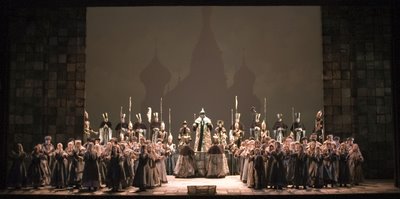
But that uncertain future before us was preceded by a triumphant goodbye to the Colón, a series of performances of Mussorgsky’s “Boris Godunov” that meant a powerful contribution to our operatic life . Marcelo Lombardero, the current Artistic Director, has given us, in South-American premiere, the original full version of Mussorgsky ; not the first, 1869 version which our city saw back in 1998 when we had the unforgettable visit of the full Maryinsky Theatre from Saint Petersburg, but the 1874 revision that added two fundamental things to the original seven scenes: the so-called Polish Act and the closing Revolutionary Scene. I’m not recommending that the Rimsky-Korsakov revision that made the work famous all over the world should be scrapped: I think it’s admirable and that the best solution will be from now on to alternate in successive revivals between the 1874 Mussorgsky and the Rimsky.
What are the main differences between pure Mussorgsky (M) and Mussorgsky/Rimsky? (M/R) Well, M is certainly starker and barer, with disquieting harmonies (which informed opinion no longer considers “errors”), a deeper sense of essential Russianness, pronounced verbal Expressionism, an undernourished and gray orchestration. Precisely this last element is the great distinction of M/R, for Rimsky was the undeniable master of color and wrote a treaty on the subject; when you hear his treatment of the Coronation Scene, all the splendor of the Czars is there; with M the feeling is ominous, you hear the downfall rather than the assumption. So the total effect of M is certainly less accessible but profound in the way a Tarkovsky film is.
The Colón undertook the task with the seriousness of a first-class opera house. The musical side was of a high level, without being outstanding. The staging, alas, fell into the trendy and silly trap of changing the historical context: Mario Pontiggia, after doing the Prologue and First Act in its proper 1600s ambience, absurdly decided to transport Boris and everybody else to the middle 1800s, ditto in the Polish Act. And then he reversed and the final act went back to the 1600s! However, in other aspects Pontiggia did well: he moved the big choral scenes with good timing, the psychological relationships weren’t distorted, and the drama was communicated. One thing was horrid and shouldn’t have been allowed: the ceremonial Polonaise was done by just three dancers in modern tights to a choreography by Carlos Trunsky that went completely awry in style.

Boris Godunov - Teatro Colón 2006 - Anatoly Kotcherga 3 - Foto de Arnaldo Colombaroli

The aesthetics of Diego Siliano’s stage designs were agreeable though hardly Russian; a silhouette of a cathedral was as far as he went. But (more to cut costs than for artistic reasons) we saw a unit set of a variegated wall used in different combinations and parts to represent such disparate things as a tavern, a monk’s cell, a Polish palace, etc. Of course costume designer Daniela Taiana had to comply to Pontiggia’s excentric translation of the action to the 1800s; her costumes were mostly adequate though some didn’t look rich enough. Good lighting by Rubén Conde.

The conducting by Stefan Lano was clear, with rather slow and morose tempi, certainly logical but lacking expansion and emotional communication; the Orchestra played quite well. Excellent work from the Colón Chorus (Salvatore Caputo) and the Children’s Chorus (Valdo Sciammarella).

There was a solid double cast: Anatoly Kotcherga (debut) did Boris with a fine bass voice used with authority and a massive presence; and Mijail Kit gave us a leaner, older Boris , done with fine professionalism. Except from some tense high notes, both Kit and Feódor Kuznetsov sang admirably as the monk Pimen. I was agreeably surprised by the aplomb and intensity of Enrique Folger as the false Dimitri who will usurp the throne; Fernando Chalabe was correct, no more. We had fine Marinas (the Polish Princess): Cecilia Díaz and Virginia Correa Dupuy. Luis Gaeta was splendidly truculent as the mendicant monk Varlaam; Hernán Iturralde sang well but was less of a character. Ariel Cazes was more convincing as the devious Jesuit Rangoni than the exaggerated Lucas Debevec Mayer. Carlos Bengolea and Gabriel Renaud dealt well with the slimy ambiguity of their Boyar Shuisky. Good jobs from (among others) Ana Laura Menéndez and María José Dulín, Elisabeth Canis and Alicia Cecotti, Omar Carrión and Leonardo Estévez, Renaud and Eduardo Ayas (as Misail), Graciela Alperyn and Marcela Pichot. Osvaldo Peroni and Gabriel Centeno sang well as the Innocent but didn’t catch his peculiar anguish.

As the Innocent sang his final lament, I thought of the pain of the Russian people though the centuries and I wished them well for the future.

23/11/06 para el Buenos Aires Herald

Boris Godunov - Teatro Colón 2006 - Prólogo 2 b - Foto Miguel Micciche